












Part 2 of 2 parts
By Dennis Whitehead
Special to NKyTribune
The killer, or killers, left scant evidence at the murder scenes but hairs found pointed to a Black assailant. A dragnet of Black men was launched across the city. Starting with sex offenders, the investigations widened to sweep up men—short, tall, fat and skinny, based solely on the color of their skin. Men who’d worked as janitors, or just applied for a job, were brought in for questioning. Calls came into Station X with reports of Black men working on trash trucks or standing on a street corner, the callers certain their man was the killer. Police were placed on 12-hour shifts while civilians were recruited to assist.
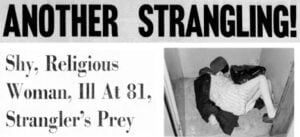
Months passed between the previous murders, but such patterns were cast aside when 81-year-old Rose Winstel was found strangled with an electric massager cord in her Vine Street Hill house on October 20, 1966, barely a week after Alice Hochhausler’s death.
On a rainy Friday, December 9th morning, the tiny elevator in The Brittany apartments on West Ninth Street at Race arrived at the third floor, where the summoning resident was shocked at the sight of an elderly woman lying dead on the floor, a nylon stocking wrapped around her neck. The Strangler had struck again, and 81-year-old Lula Kerrick was his latest victim. But this time, whispers among police and reporters hinted that the killer might be within reach.
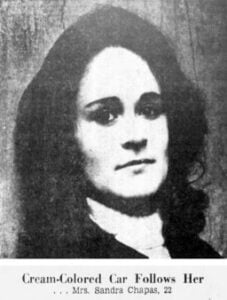
Hours earlier, 31-year-old Sandra Chapas was forced to walk across downtown from her job at Kenner Toys on Sycamore Street at midnight when her husband didn’t pick her up. Nearing her West Court Street apartment, Sandra sensed she was being followed. Hearing footsteps behind her as she ascended the stairs, Sandra ran into her apartment, slamming the door. The man turned and quickly left the building, but a neighbor arriving home from work made note of the license number of the car the man was driving.
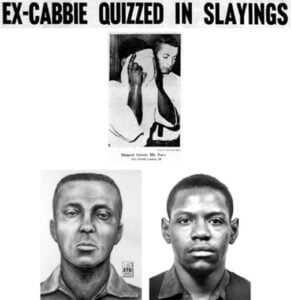
As police were investigating The Brittany scene, detectives were on their way to the Wuest mattress factory on Gest Street where they found the owner of the car – 29-year-old Posteal Laskey, Jr.
Laskey was held without bond on a probation violation from the attempted assault, the judge finding Laskey guilty of assault, as the police investigated the young man’s connection to the strangulation murders.
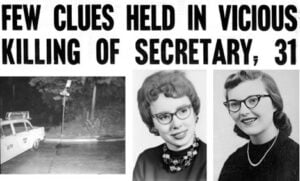
Given Laskey’s familiarity with taxi operations, having driven for Yellow Cab in 1962, the case was built against Laskey in the August 1966 stabbing death of 31-year-old Barbara Bowman who took a Yellow Cab from a Corryville bar to her Price Hill home. Her journey ended only blocks from her home when she was left lying in the pouring rain, bleeding next to the taxi in the intersection of Grand Avenue and Ring Place.
As his trial for first-degree murder commenced in late March 1967, sensational news coverage focused on Laskey as The Strangler. Represented by a pair of attorneys recently fired from positions as assistant Hamilton County prosecutors, the prosecution pressed a circumstantial case girded by inconsistent eyewitnesses from the Corryville bar. Seventy-year-old Judge Simon Leis, Sr. presided over the trial, permitting the prosecution to bring the victim of an uncharged assault to the stand to testify pointedly against Laskey. That was the nail in his coffin. On April 13, 1967, Laskey was found guilty and sentenced to die in the electric chair.
To Cincinnati’s Black community, the heavy-handed police investigation and the perceived injustice of the Laskey trial, made worse by the probation handed to a White strangler, contributed to that summer’s riotous unrest in Cincinnati.
In 1968 the U.S. Supreme Court found the death penalty unconstitutional but it took until 1970 for Laskey’s sentence to be commuted to life. Despite a clean disciplinary record, accomplishments while incarcerated and increasing ill-health, Laskey was denied parole at every opportunity.
Posteal Laskey, Jr. died in June 2007 and was buried on the grounds of the Pickaway Correctional Institute. The six strangulation murders remain cold cases on the books of Cincinnati Police.
See Part I – The Cincinnati Strangler here.
Dennis Whitehead is a writer and photographer in the Washington, DC area. A Cincinnati native, Whitehead is the author of several books from the wars of the 20th Century but was drawn back to his childhood to recount the stories of the Cincinnati Strangler in the nonfiction true crime book, of the same name, drawn from the original police investigation files, court transcripts and prison records.
The Cincinnati Strangler: Murder and Mayhem in the Queen City (ISBN 979-8-9992298-0-9 / Amazon ASIN: B0FPMJJMQ7). The print edition ($29.95) is available in Cincinnati, at Joseph-Beth Booksellers and Cincy Book Rack, but just ask your favorite bookstore and they’ll know where to find it. The book is also available as an ebook ($19.95). If anyone has trouble finding a copy, they can contact the author directly at denniswhitehead@gmail.com.
Paul A. Tenkotte, PhD is Editor of the “Our Rich History” weekly series and Professor of History at Northern Kentucky University (NKU). Click here to browse more than ten years of past columns. Tenkotte also serves as Director of the ORVILLE Project (Ohio River Valley Innovation Library and Learning Engagement). He can be contacted at tenkottep@nku.edu.
See Part 1 of The Cincinnati Strangler here.