











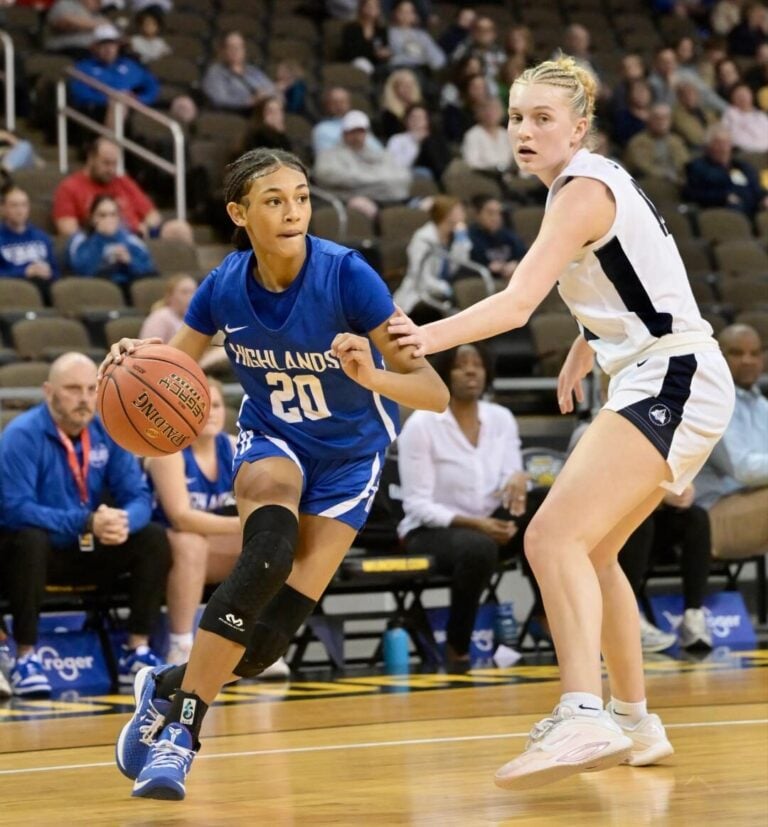

From the “What world is this?” category. Not only have the Cooper High Jaguars (11-3) maintained their No. 1 place in Kentucky high school girls’ basketball for the second straight week, according to the SI.com/high school rankings, they have plenty of local company.
Northern Kentucky has not only the top team, how about two of the top six, three of the top eight, four of the top nine, five of the top 11, six of the top 16, seven of the top 18, eight of the top 19 and finally, nine of the Top 25.
Thank you, No 6, Simon Kenton (17-1). Thank you, No. 8 Campbell County (9-2). Thank you, No. 9 Ryle (9-6). Thank you, No. 11 Notre Dame (10-3). Thank you, No. 16 Bishop Brossart (15-1). Thank you, No. 18 Holy Cross (12-2). Thank you, No. 19 St. Henry (9-4). Thank you, No. 25 Newport Central Catholic (8-5). Ten percent of the state’s population has 36 percent of the state’s Top 25 girls’ basketball teams.

Not sure any Northern Kentucky sport in the history has ever had a rankings week like this. Maybe the most impressive piece of this is that in an unclassified sport like basketball, four of our ranked teams are small Class A schools. But big or small schools, these rankings say a great deal about what a good job youth sports and coaches and parents are doing up here getting so many young girls doing so well.
Nice job, everybody. Going to make for some interesting tournament matchups.
SI.com’s Top 25: 1) Cooper 2) Louisville Sacred Heart 3) Louisville Assumption 4) George Rogers Clark 5) Calloway County 6) Simon Kenton 7) Frederick Douglass 8) Campbell County 9) Ryle 10) Lexington Dunbar 11) Notre Dame 12) South Laurel 13) North Laurel 14) Henderson County 15) Ashland Blazer 16) Bishop Brossart 17) Knox Central 18) Holy Cross 19) St. Henry 20) Southwestern 21) Barren County 22) West Jessamine 23) Owensboro Catholic 24) Louisville Mercy 25) Newport Central Catholic.
How did we get here? No really, how did we?
May have made a mistake listening to the Tuesday Supreme Court hearings on the lawsuits trying to prevent Idaho and West Virginia from limiting girls’ sports to girls? Yeah, you got that right.

As crazy as it sounds, 27 states in all — including Kentucky — have, in their own fashion, had to legislate that only girls should play girls’ sports. That they’ve had to do so is the crazy part.
Girls’ sports for girls? And they had to pass laws to say that a half-century after Title IX was passed and has done such an amazing job allowing girls — and women — an equal shot with boys and men, this is where we are?
And they made nine Supreme Court justices sit through three hours of this, listening to people who say they can’t define “girl” or “woman” suing to change the law to let boys play against or take the place of girls in middle school, high school or college sports.
If it had been up to me, after an hour or so when Justice Samuel Alito asked these two questions, I’d have at least started a running clock on this session.
Justice Alito opened with this setup to the attorney for the Idaho woman plaintiff about what it meant to be a “boy or a girl or a man or a woman” when it came to equal protection purposes.
Plaintiff attorney’s response: “We don’t have a definition for that.”
Alito’s follow-up question: “How can a court determine whether there’s discrimination on the basis of sex without knowing what sex means for equal protection purposes?”
Bingo. Game over. Turn off the scoreboard. Start the buses. Everybody go home. Nothing to see here.
Girls’ sports are for girls. No need to spend all that time on an Ivy League law school education. This is as basic as it gets.
Although I found it somewhat fascinating, and enlightening, that the justices who had personal experience with youth sports, as a coach, parent, participant, sponsor, fan, whatever, had an entirely different approach to their questioning — one that didn’t focus on “circulating testosterone” or some such minutia. But mostly on common-sense basic fairness.
Almost as if they were saying that girls’ sports should be for girls. And how girls felt about the sports they play. And not about the feelings of boys who want to be girls and want to play against them, as difficult as this might be for them.
It’s not about them. It’s about girls — and sports.
Contact Dan Weber at dweber3440@aol.com. Follow him on X @dweber3440.