














The riverboat captain is a storyteller. Captain Don Sanders shares the stories of his long association with the river — from discovery to a way of love and life. This a part of a long and continuing story.
By Capt. Don Sanders
Special to NKyTribune
Who hasn’t stared at photographs of long-dead faces, wondering who they were? If you’re a fan of old-time steamboats, you’ll find yourself doing that quite often. It just goes with the territory.
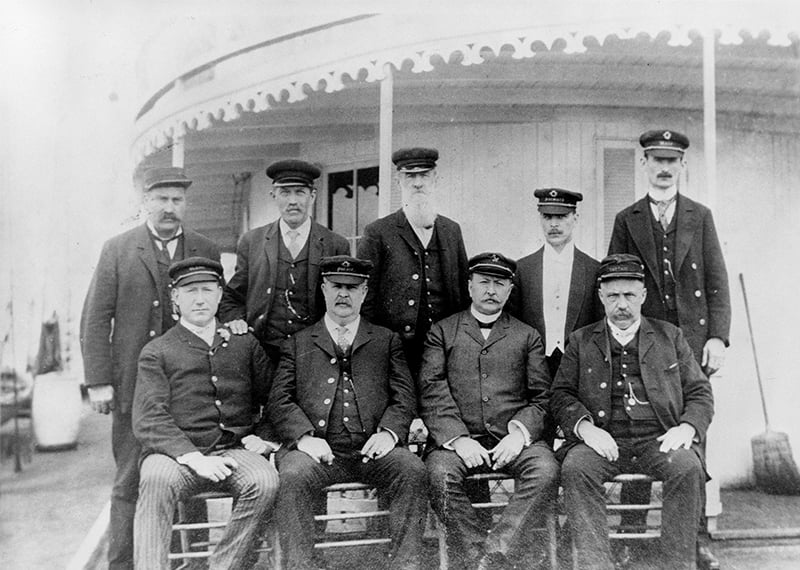
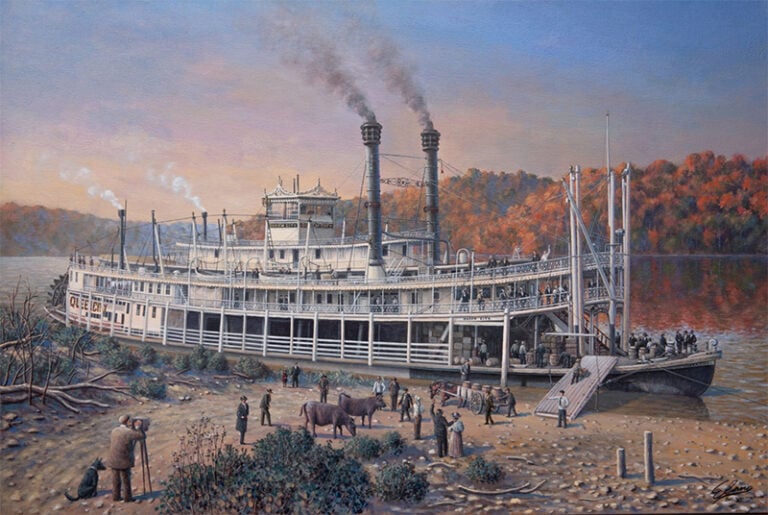
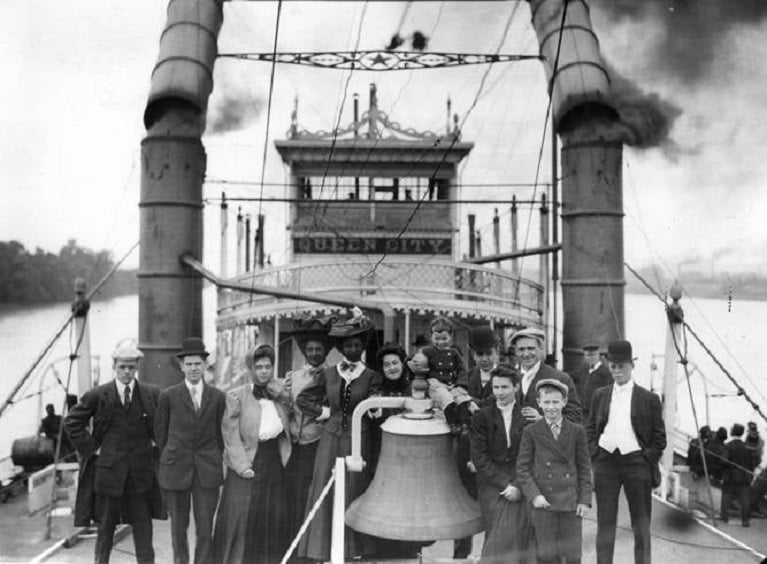
Though I’ve inspected likenesses of many steamboat folks who lived their whole lives decades before I appeared on the planet, a recent group photo of the officers of the Ohio River steamer QUEEN CITY captivated me. Nine well-dressed, unidentified steamboatmen posed for the camera, arranged in a group aboard the QC, quite likely soon after her construction in 1897 at the Marine Railway Company boatyard in Cincinnati. The picture was among a set of four posted by Derby Gisclair in his social media blog, New Orleans Steamboat Stories.
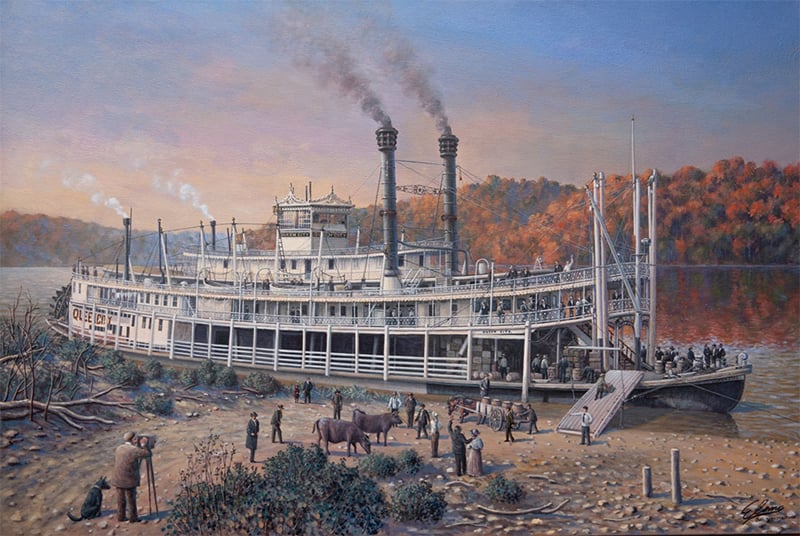
According to Captain Frederick Way, Jr., the QUEEN CITY (Way 4615) was a sternwheel packet with a wooden hull. She measured 236 x 44 x 7-feet, with Rees engines recycled from the FLORIDA, a sidewheel steamer from Jacksonville, FL. Captain J. Frank Ellison, a respected riverman, supervised the construction for the Pittsburgh & Cincinnati Packet Line. Cap’n Way added that the QC came down the marine ways, fully built except for the paddlewheel’s bucketboards.
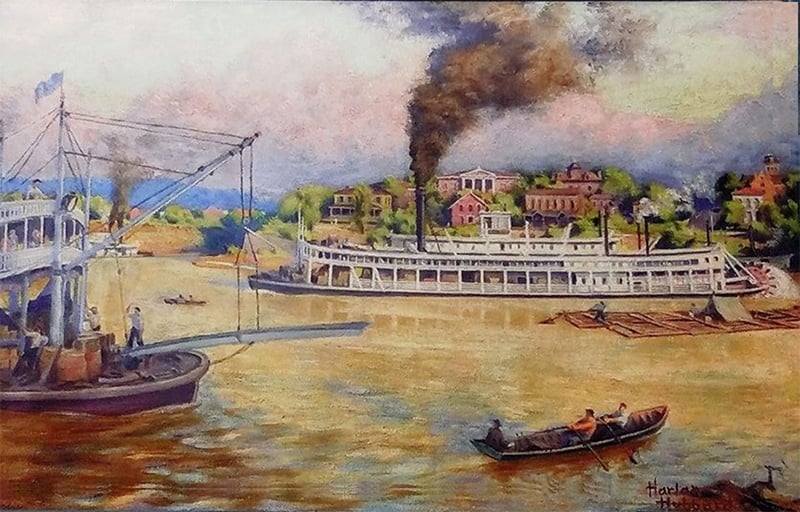
According to Mr. Gisclair, borrowing from Captain Way, the QUEEN CITY “was built in 1897 at Cincinnati, Ohio, for high-class patronage at a time of great affluence. Her mahogany cabin, finished with gilt trim, had a pressed-metal ceiling adorned with an ornate design. She had wire mesh railings studded with rosettes. She had a carved figurehead rising from her stem. A metal ‘Queen City’ emblem in gold appeared on each stateroom door. The Cincinnati Chamber of Commerce presented her with a grand piano. She had oil paintings on the rounded cabin bulkheads. She had shining brass oil lamps in swinging brackets and overhead lights coming from twined oak leaves of metal.”
Or, in the words of Ross Tuckwiller, the former Manager of the PA DENNY, Sternwheeler,
“Ain’t she a peach.”
Starting in 1903, the QUEEN CITY made six successful New Orleans Mardi Gras cruises, but sank on the downbound leg of the 1914 trip in the Falls of the Ohio River at Louisville. Raised to run again for 19 more years, the QC finally lay up in Pittsburgh in September 1933. However, she became a wharfboat at the foot of Wood Street, Pittsburgh, until workers moved her to make room for wharf improvements. Her remains became kindling when she finally burned in February 1940– much to the sadness of all who remembered the QUEEN.
Returning to the photo of the officers of the QUEEN CITY, I immediately recognized the face of Captain Anthony “Tony” Meldahl, one of two pilots standing watch on the QC. The other was likely Captain Phillip Anshutz. Judging by the photo, the officers had their group picture taken in the late 1890s or very early 1900s.
Again, I enlisted Cap’n Fred’s assistance, who provided a roster of the QC’s first complement of officers aboard the boat after she completed her trial runs and departed for Pittsburgh with:
“Captain Robert R. Agnew, Master; James S. Gardner, Purser; Will Chapman, 2nd Clerk; Captains Anthony Meldahl and Phillip Anshutz, Pilots; John Leonard, Mate; William Alexander and Marsh Ellis, Engineers; Charles J. Hall, Steward; and Henry Gear, Carpenter.”
Going by the photo, I’ll try to match the nine crew members to the ten names provided by Captain Way. Ready?
Front Row, seated, right to left: Capt. Robert R. Agnew, Master; Chief Engineer Alexander or Ellis; James S. Gardner, Purser; and Will Chapman, 2nd Clerk.
Back Row, standing, right to left: John Leanord, Mate; Charles J. Hall, Steward; Capt. Phillip Anshutz, Pilot, Capt. Anthony Meldahl, Pilot, and Henry Gear, Carpenter.
More than likely, I have correctly identified six of the nine previously unknown men. Note that the big fellow in the back row, extreme left, has a bandaged hand. I initially surmised that he was Henry Gear, the Carpenter, but from my own steamboat engineering experience, contact with live steam lines can cause severe burn injuries– often to the top of the hand. He may have been one of the Chief Engineers, instead of the nattily-dressed gentleman seated next to Captain Agnew.
So that concludes my brief incursion back into the past — typical of steamboat cognoscenti still hanging onto events of two centuries ago. But no matter how anachronistic my behavior appears in the second quarter of the 21st Century, I remain a remnant of those times when the Mississippi was America’s greatest highway, and steamboats ruled.
 Captain Don Sanders is a river man. He has been a riverboat captain with the Delta Queen Steamboat Company and with Rising Star Casino. He learned to fly an airplane before he learned to drive a “machine” and became a captain in the USAF. He is an adventurer, a historian and a storyteller. Now, he is a columnist for the NKyTribune, sharing his stories of growing up in Covington and his stories of the river. Hang on for the ride — the river never looked so good.
Purchase Captain Don Sanders’ The River book
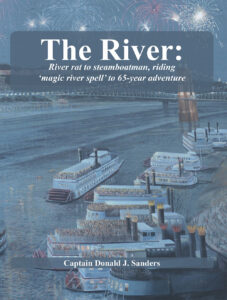
Capt. Don Sanders The River: River Rat to steamboatman, riding ‘magic river spell’ to 65-year adventure is now available for $29.95 plus handling and applicable taxes. This beautiful, hardback, published by the Northern Kentucky Tribune, is 264-pages of riveting storytelling, replete with hundreds of pictures from Capt. Don’s collection — and reflects his meticulous journaling, unmatched storytelling, and his appreciation for detail. This historically significant book is perfect for the collections of every devotee of the river.
You may purchase your book by mail from the Northern Kentucky Tribune — or you may find the book for sale at all Roebling Books locations and at the Behringer Crawford Museum and the St. Elizabeth Healthcare gift shops.
Click here to order your Captain Don Sanders’ ‘The River’ now.