














State Representative Matt Lehman introduced legislation today to modernize Kentucky’s Riverport Authority laws, aimed at expanding economic development tools while strengthening transparency and governance of Kentucky’s Riverport Authorities.
Lehman said the bill was prompted by mounting concerns over the Northern Kentucky Port Authority’s role in relocating Northern Kentucky University programs from Campbell to Kenton Counties.
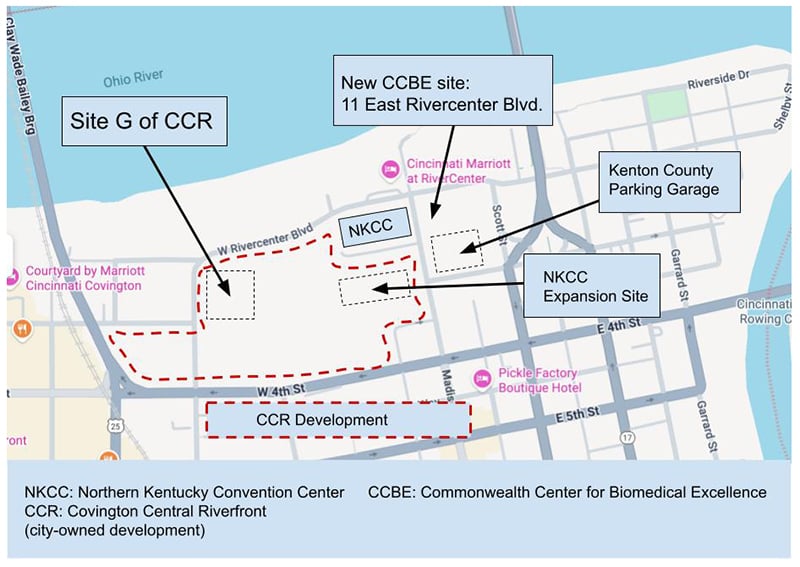
“The proposal to move Chase College of Law and the University of Kentucky medical program from NKU’s main campus to a so-called Commonwealth Center for Biomedical Excellence in Covington is a tremendous waste of taxpayer dollars,” Lehman said. “At a time when Kentucky faces a tight budget and potential cuts to higher education, we cannot justify spending $125 million to move a couple programs six miles down the road, and without adding new jobs to Northern Kentucky or without any public accountability.”
The original proposal and appropriation from Kentucky’s General Fund appeared in a very late version of the state’s budget in 2024 without any apparent feedback from NKU, UK, Campbell County, Highland Heights, or Covington.
Originally intended to be located on a lot at the old IRS site owned by Covington, the NKY Port recently rejected Covington’s below-market offer of $2.3 million and instead has chosen to pay $3.8 million for a lot owned by the Butler Foundation. This price is reported to be more than twice the asking price on a per-acre basis than the other considered sites and more than twice the sale price of other sites sold or under contract in Covington’s Central Riverfront area.
The proposed project creates unresolved financial exposure issues for NKU, including questions about potential lease structures. Kentucky public universities traditionally build and own projects directly, or through their foundations, and finance them through bonds issued through state mechanisms.
Using the NKY Port is an unprecedented development model.
Highland Heights and Campbell County stand to lose out on current occupational tax revenue from the relocation of faculty. And NKU’s tax-exempt status means Covington Independent Schools will lose out on much needed property tax revenue that would have otherwise been collected from one of the city’s most valuable properties.
Oversight concerns driving reform
Currently, Kentucky statute authorizes Riverports to “establish, maintain, operate, and expand necessary and proper riverport and river navigation facilities” and other activities to attract river-oriented industry (KRS 65.530).
The NKY Port does not appear to be acting within the guidelines set by the General Assembly.
Kentucky law does not give special purpose governmental entities such as the NKY Port a general power to transfer or delegate policy-making authority to another organization, especially not a private entity.
The BE NKY Growth Partnership, an independent nonprofit corporation, claims that it currently manages the NKY Port. This is the opposite of how local governments are supposed to work in Kentucky.
Sustainable economic development requires public trust
Lehman’s bill supports development that is strategic, measurable, and aligned with the long-term interests of Kentucky taxpayers. Specifically, it would expand the allowed activities of Riverport Authorities to engage in general economic development projects, ensure that the Riverport Authorities retain their policy-making power, require compliance with local comprehensive plans, clarifies the prohibition on conflicts of interest, and, for multi-county Riverport Authorities such as the NKY Port, add municipal representation to the board and require a written code of ethics.
“When projects of this magnitude involve significant taxpayer investment and the long-term trajectory of public universities, the process must meet the highest standards of transparency, fiscal discipline, and public accountability,” Lehman said. “Kentucky’s competitiveness depends on disciplined decision-making and public trust. Strong governance is not a barrier to growth — it is the foundation of sustainable economic success.”
Legislative Research Commission
See the NKyTribune’s story by Lorelei Smillie on January 12 here.