














By McKenna Horsley
Kentucky Lantern
In the middle of his second and final term as Kentucky governor, Democrat Andy Beshear says he’s focused on helping Kentuckians keep the American Dream within reach.
Beshear, 48, who will lead the red state through 2027, has spent much of the year pushing back against Republicans at the federal level, particularly when it comes to health care and food assistance jeopardized by the Trump administration.
As for what’s ahead, Beshear, who’s talked about as a presidential contender, recently became the head of the Democratic Governors Association, which will support candidates in 2026 elections and put the governor in a key position to influence national Democratic politics.
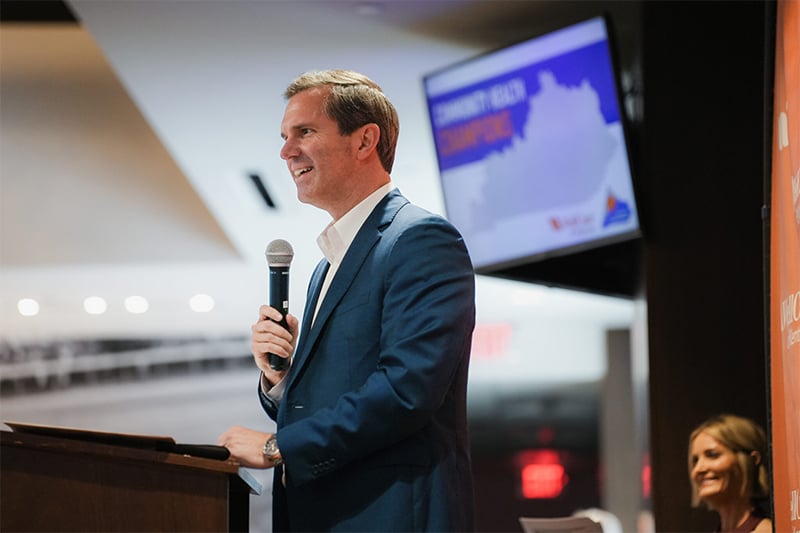
Beshear has joined multiple lawsuits by Democratic state officials against the administration since Republican Donald Trump returned to the White House. In a Wednesday afternoon interview with the Lantern, he vowed to keep challenging the president.
Beshear pointed to AmeriCorps funding being restored in Kentucky as an example of what Democrats can accomplish. AmeriCorps is a public service and volunteerism program that works with communities on housing, hunger, disaster relief and more.
“I sued on that. We won, but only the states that went to court got that funding,” Beshear said. “So, blue states or states with Democratic governors have AmeriCorps and Republican states do not, so we’re going to continue to stand up for our people.”
However, Beshear hopes “standing up for Kentuckians is bipartisan.” He referred to calls from Republican state lawmakers earlier this year for him to fill a funding gap in meals for seniors. His administration ended up re-allocating $9.1 million to support the program in October.
“You know, I heard a lot of Republican senators push really hard on senior meals, saying, ‘Listen, people should have enough to eat. No one in my community should starve,’ but I didn’t hear one of them speak out when Donald Trump said he wasn’t going to pay SNAP benefits during the shutdown,” Beshear said. “Either you believe that people shouldn’t go hungry or you don’t. It shouldn’t be political.”
Beshear echoed comments he’s publicly made before, such as criticizing Trump for being the first president to not pay SNAP benefits during a government shutdown. The governor was also critical of threats by the Trump administration to block food assistance for states led by Democrats that have not complied with requests to provide personal information of SNAP recipients.
“I promise to protect that data,” Beshear said. “I’ve gone to court once to protect it. I’ll do it again.”
What’s next?
Beshear is seen by some as a 2028 presidential candidate given his repeated electability in red state Kentucky. However, he is “trying to live in the here and now,” adding that he will be governor until Dec. 14, 2027, and he doesn’t want to “waste a single minute or a single moment.”
The governor also believes the next two years will be “complicated by federal policy … hurting our American families,” such as tariffs, rising costs and the GOP One Big Beautiful Bill Act (which Beshear called the “Big Ugly Bill”) that could put rural hospitals nationwide at risk.
As leader of the Democratic Governors Association, Beshear said he’s “got 36 races to think about in 2026 before thinking about anything past it.” The association helps candidates across the country.
But some Kentucky Democrats have suggested that Beshear enter the 2026 race for Kentucky’s open U.S. Senate seat. Longtime Republican U.S. Sen. Mitch McConnell announced earlier this year that he would not seek reelection. Candidates — both Republican and Democratic — have lined up to launch campaigns to replace McConnell in office.
Beshear doesn’t want to join them.
“My parents always taught me never to interview for a job that you don’t want. At the end of the day, it’s just not something that I’m interested in,” Beshear said. “I’ve loved my time being governor. I wouldn’t give up one year of being governor for a six-year term in the U.S. Senate, and I like getting things done. Voting on the rule to the amendment to the continuing resolution — it just isn’t how I want to spend my days, and so if that means eventually going back into the private sector, I’m at peace with that. Getting to serve as governor for eight years is pretty special.”
He does believe that Democrats will be in good shape when it comes time for him to leave office, Beshear said. He sees a “big shift across the country,” and that “the Republican Party has turned its back on our American families” when it comes to affordability issues.
Democrats have “a chance to be the party that reignites and refuels the American dream that focuses on families’ everyday concerns,” such as working hard to afford needs like groceries but also still being able to take family vacations and enjoying time together, the governor added.
“Part of the American Dream is that affordability,” he said.
Final budget session
Next month, Kentucky lawmakers will return to Frankfort for the 2026 legislative session. It will also be the last time Beshear can make proposals for the next two-year state budget.
Throughout Beshear’s time as governor, Republicans have held supermajorities in the state House and Senate, making it difficult for Beshear’s agenda to get through the General Assembly and all GOP legislation is veto-proof.
Nevertheless, Beshear said his final budget proposal would include “investments in our Kentucky families” in areas such as job creation, health care and public education. He will unveil his recommendations at the annual State of the Commonwealth address the first week of January.
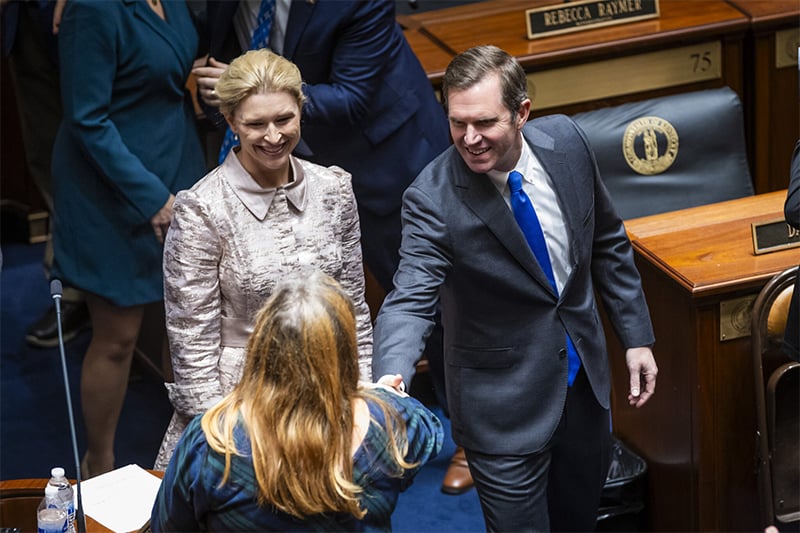
“I don’t want to give away too much of what we’re going to be talking about, but to me it’s going to be centered on the fact that while we are doing better in Kentucky right now, life has gotten harder for many, if not most American families, and for government to work, we’ve got to be supporting that American Dream, where if you work hard and you play by the rules, that you can get ahead,” Beshear said.
Beshear has taken steps to highlight one particular proposal he’ll put before the legislature — his Pre-K for All initiative. In June, he established an advisory committee of education officials, former Democratic and Republican state lawmakers and workforce development leaders to explore support among Kentuckians for universal pre-K programs.
The group later announced its recommendations, including that Kentucky should phase expanded access to pre-K over several years.
Asked if he had concerns about Pre-K for All becoming partisan in the Republican-controlled legislature, Beshear quipped he did not know “how four-year-olds can be partisan” as they can’t vote, “so if it becomes partisan, it is because someone made it partisan.”
Beshear said he’s approached the idea differently by going to rank-and-file Democrats and Republicans, particularly those in education policy.
He also said the proposal has changed since he first introduced the idea earlier this year after getting feedback from Kentuckians, including lawmakers.
“This is going to be the people’s proposal,” Beshear continued. “And so if leadership from the other side wants to create an us versus them, it’s going to be them versus the people of Kentucky and their plan. But I hope that doesn’t happen.”
Also looking ahead, Beshear said his upcoming State of the Commonwealth address may have answers for a coalition of advocacy groups that urged him earlier this week to halt utility disconnections in Kentucky until March amid an uncertain future for federal housing, heating and food assistance. The group’s request was to issue a moratorium through executive order like Beshear had in the beginning months of the COVID-19 pandemic. However, the governor said that he was able to do so in 2020 because of the state of emergency and powers it gave him.
“But what I’d tell that group is, tune in to the State of the Commonwealth and the budget address, and they’ll see how much I believe in helping people and keeping that heat on,” Beshear said.
Power of a Kentucky governor
Beshear has frequently defended his authority as governor against pushes by Republicans in the General Assembly to limit his power.
Earlier this year, Beshear’s office appeared before the Kentucky Supreme Court to argue against two Republican-backed state laws that shift appointment power of the governor to other constitutional officers, all of whom are currently Republicans.
Asked if he has concerns about similar efforts to limit his power in the next legislative session, Beshear said Kentucky Republicans should be asked about their support for checks and balances, as Trump has repeatedly tried to expand his own executive powers at the federal level.
“I think to be fair, if they’re going to attempt to increase legislative power and decrease executive power, they should be asked about the federal government where a president they support is trying to vastly increase executive power,” Beshear said. “So, either you believe in checks and balances, or you don’t.”
Amid legislation on the table for 2026, Northern Kentucky Republican TJ Roberts is working on a bill that would require all Kentucky police agencies, including the Kentucky State Police, to enter federal agreements with U.S. Immigration and Customs Enforcement (ICE) for immigration enforcement under the 287(g) Program.
Beshear, who has authority over KSP as governor, expressed concern about the proposal, saying that day-to-day officers do not have the training ICE officers have, which includes an “intense education in federal immigration enforcement and federal law.” Beshear also pointed to reports that ICE has attempted to recruit employees from law enforcement agencies with which they have such agreements.
“I think what that bill would be doing is creating an open season on trying to take our law enforcement officers away from the city they’re working for, away from the county they’re working for, away from the state that they’re working for, and leave us with fewer day-to-day law enforcement officers that are keeping us safe,” Beshear said.
Beshear said the executive branch he heads is “critically important” as it is charged with administering
law.
“A signing of a bill or a piece of legislation doesn’t get to the end result on its own. It takes an executive branch that operates, and operates in many instances quickly, to try to get especially positive results for our people,” the governor said. “So, limiting an executive branch could also limit the effectiveness of legislation they want to pass.”
Kentucky Lantern is part of States Newsroom, a nonprofit news network supported by grants and a coalition of donors as a 501c(3) public charity. Kentucky Lantern maintains editorial independence. Contact Editor Jamie Lucke for questions: info@kentuckylantern.com.