














By Paul Tenkotte
Special to NKyTribune
Daylight Saving Time (DST) took effect early Sunday morning at 2 a.m. Did you wake up refreshed or tired? Did that missing hour of sleep mess up your body’s natural circadian rhythm? Did the circadian rhythms of your family and pets automatically reset to allow you to sleep longer? Did you wonder why we have to suffer through these time changes twice a year? Whom does it benefit? And lastly but most philosophically — Why do we place so much emphasis on wringing every little second out of each and every day instead of valuing each moment?
Before 1883, people of the United States observed “local time.” Also called “solar time” or “sun time,” that meant that time differed dependent upon where you were located. If you were further East, the sun rose earlier and set earlier than it did in Cincinnati/Northern Kentucky. If you were further West, the sun rose and set later than in Cincinnati. And the very definition of local time depended upon when the sun was “highest” in the sky above that particular place — what was literally known as “solar noon.”
For example, if it’s solar noon in Cincinnati/Northern Kentucky (84 degrees W longitude), then the local time in New York City (74 degrees W longitude) would be about 12:40-12:45 p.m., dependent upon the time of year. Conversely, if it’s solar noon in Cincinnati, then local time in St. Louis, MO (90 degrees W longitude) would be about 11:38 a.m., or about 22 minutes’ difference.
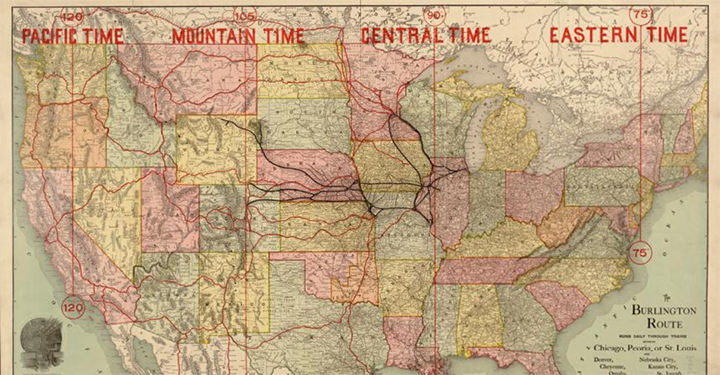
That 22 minutes was of great importance when, on November 18, 1883, the major railroads of the United States and Canada adopted a new national time standard, based upon four time zones (Eastern, Central, Mountain, and Pacific). That implementation—which was really only for the sake of the railroads—was designed to catch up with the increasing speed of trains and to avoid the confusion of hundreds of different local times and hence, of departure and arrival times.
The railroads’ decision made a great deal of sense for their overall operations but contained within it a major flaw. They decided that the Eastern Time Zone would be comprised of the area east of 75 degrees W longitude (to include all the important Eastern cities). The Central Time Zone would consist of the area west of 75 degrees W longitude and east of 90 degrees longitude. So, Cincinnati and Northern Kentucky (at 84 degrees W longitude) fell in-between the defining longitudes, meaning that their local time would be 22 minutes ahead of St. Louis and up to 40+ minutes behind that of Eastern coast cities. The basic flaw was that each time zone represented an hour’s difference, instead of perhaps some additional longitudinal lines at half-hour increments.
People throughout the United States, who had already witnessed the outsized power of the railroads, seemed dubious. Many cities and towns simply refused to change from their local times. Farmers and city workers alike disliked any changes to their routines. What had worked for decades seemed best to keep.
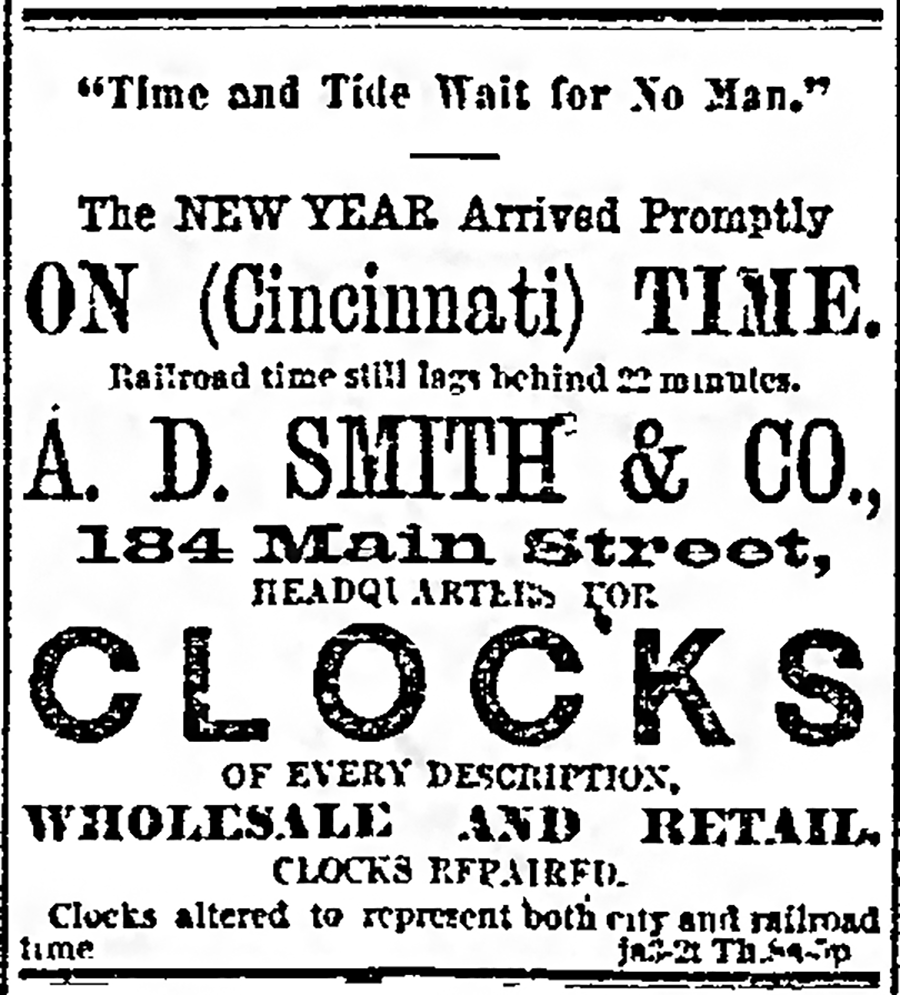
Some newspapers, including the “Cincinnati Commercial Tribune,” even refused to list the railroad timetables for the benefit of their readers in the new standard, sticking instead to local Cincinnati time. Sarcasm ruled the day as the “Commercial Tribune” of November 16, 1883, expressed wryly: “Nobody proposes to go to bed or get up by railroad time. Even the birds have more sense than to do anything of the kind. Perhaps the railroad people will undertake to show that the earth does not revolve, or that the sun is not the center of our system.”
A letter to the “Cincinnati Commercial Gazette” (reprinted in the “Cincinnati Commercial Tribune” of November 22, 1883), signed as “An Old Man,” suggested that the newspaper “inform your many readers where they can get a breed of chickens that will crow according to railroad time.” And celebrating New Year’s Day, a Cincinnati clock dealer advertised on January 5, 1884, in the “Cincinnati Commercial Tribune” that “The New Year arrived promptly on (Cincinnati) Time. Railroad time still lags behind 22 minutes.”
However, as railroads continued to impact more of American life, even the “Cincinnati Commercial Tribune” surrendered, beginning to list time departures and arrivals of passenger trains according to railroad time in March 1890. Hotels and other businesses had long already made the switch to accommodate their guests and customers. However, before World War I local time still reigned in many places outside of railroad stations.
On March 19, 1918, the federal government implemented the Standard Time Act, giving the Interstate Commerce Commission (ICC) the power to establish five official time zones (the four zones of the railroads and a new fifth one called Alaska Standard Time). In addition, the act mandated a new creation, year-round Daylight Savings Time (DST) called “War Time.” Created to allow industries more daylight time to work later hours, DST proved as confusing and controversial as the railroads’ 1883 time zones.
In truth, however, so-called “more-daylight” proposals predated the mandated DST of World War I. For example, in May 1914, the city of Cleveland, Ohio decided to adopt Eastern Standard Time in defiance of Ohio state law — that had established all of Ohio as Central Time. On the other hand, the “Cincinnati Post” of May 22, 1914, reported that Cincinnati’s City Solicitor had offered an opinion that a proposed “more-daylight” ordinance would contravene Ohio law, and therefore should not be considered.
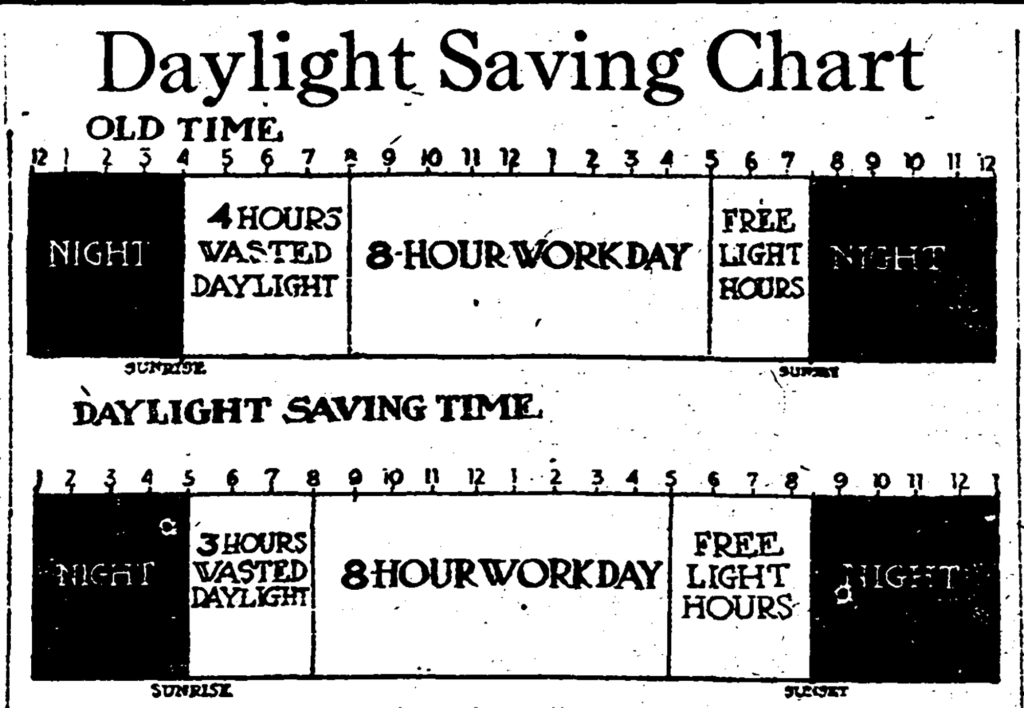
Often called “more-daylight” ordinances — as a marketing scheme to pass them — the attempt of places in the Central Time Zone to basically change to the Eastern Time Zone was understandable but only from the point of view of “social daylight or “clock time,” not actual physical daylight. For example, if it were 9 p.m. year-round in Central Time Cincinnati (where the sun rose earlier), it would also be 10 p.m. in Eastern Time New York City. So, if Cincinnati moved to Eastern Standard Time, sunrise would happen later on the clock, as well as sunset. That would translate to coordinating business transactions with Eastern cities more effectively, as well as allowing Cincinnatians to stay out longer in the evening. In Cincinnati, at least, no such ordinance passed.
Repealed in August 1919 over the veto of President Wilson, the Standard Time Act pulled back DST but kept the five time zones as well as ICC control over them. Cincinnati and Northern Kentucky, therefore, remained within the Central Time Zone. In terms of DST, localities could adopt whatever they liked.
On January 20, 1927, the ICC issued a decision approving the permanent change of Cincinnati and Northern Kentucky from CST to EST. According to the “Cincinnati Enquirer” of January 21, 1927, the new boundaries of the EST would run along “the line of the Baltimore and Ohio Railroad from Cincinnati to Toledo, and that portion of Kentucky along the Chesapeake and Ohio Railroad from Covington to Catlettsburg,” including Maysville and Ashland KY, as well as a small portion of West Virginia.
World War II brought the advent of DST once again to the nation. By congressional action, DST began on February 9, 1942, at 2 a.m.. That meant that Cincinnatians and Northern Kentuckians moved their clocks ahead one hour. Northern Kentucky adhered to DST without any noted opposition (“War Time” Adopted Here,” “Kentucky Post,” February 9, 1942, p. 1).
On the other hand, many Cincinnatians requested that their city switch back to Central time, thereby not necessitating any change whatsoever. A downtown business woman, for instance, was among thousands of letter writers to the Cincinnati City Council. In order to commute to work by 8 a.m., she said, “ ‘we have to get up in midnight darkness,’ equivalent to 5 a.m. central standard time.’ ” A mother wrote that the “new time was having a bad effect on the health of children ‘who don’t get to bed early enough and then have to get up in darkness to get to school’ ” (“Request Return to Central Time,” “Cincinnati Post,” August 28, 1942, p. 25).
In February 1943, Ohio Governor John W. Bricker signed a bill to move Ohio back to Central time. However, either way, DST (or “war time”) would remain. By April 1943, thousands of letters supporting the continuation of DST or “war time” (also called “fast time,” because you moved the clocks ahead as if they were running fast) flowed into Cincinnati City Council. War workers and industries were decidedly in favor of the continuation of DST.
Cincinnati, however, was not about to play along with the Ohio statehouse on Central time. In 1943 Cincinnati City Council determined to stay on Eastern War Time. Keeping in step with Cincinnati, Northern Kentucky also remained on Eastern time, “a compromise” with Kentucky’s own state law (“Time, Oh, Time in Thy Flight—Is Slow or Fast in Sight?” “Cincinnati Post,” March 5, 1957, p. 1; “No change in Time Is Seen Here,” “Kentucky Post,” February 19, 1943, p. 1).
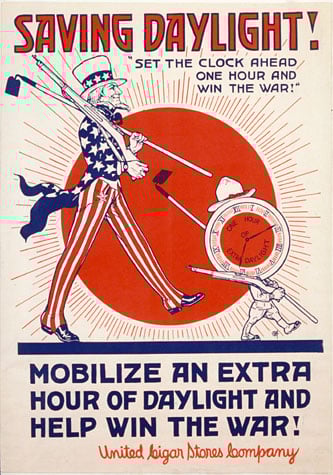
Until the war’s end, DST remained. Then, the matter erupted in the press and centers of political power once again. By 1945, Cincinnati rejected DST, as did “many sections” of the nation, leading railroads to scamper to change departure and arrival times. Generally, by 1955, DST remained popular in Northeast Ohio but had declined in places further south (“Railroads Warn of Time Changes,” “Cincinnati Post,” September 21, 1949, p. 1; “Daylight Time to End at Later Date,” “Cincinnati Post,” July 5, 1955, p. 16).
Meanwhile, at Kentucky’s statehouse in Frankfort, DST became a heated political issue in the 1950s. In 1952 Kentucky Governor Lawrence Wetherby signed the “anti-Daylight Savings Time” bill. Fortunately, however, the act did not provide any penalties for localities defying the state law. As a result, some Kentucky communities simply passed their own “voluntary ordinances,” encouraging but not mandating citizens to change their clocks and business hours to DST (“Governor Signs Time Bill, Others,” “Kentucky Post,” February 15, 1952, p. 1).
Nationwide the subject of time just would not go away. In 1957 the front-page headline of the “Cincinnati Post” proclaimed “Time, Oh, Time in Thy Flight—Is Slow or Fast in Sight?” Terminology had changed too, distinguishing Eastern Standard Time (also called “slow time”) from Eastern Daylight Time (“fast time).” This time, however, it wasn’t about being patriotic and winning a war. Instead, the “Cincinnati Post” noted amusingly that “Television people and golfers want fast time—the former so they won’t have to educate viewers to new schedules, the latter so they can get in 18 holes of golf after work instead of nine” (“Time, Oh, Time in Thy Flight—Is Slow or Fast in Sight?” “Cincinnati Post,” March 5, 1957, p. 1).
By 1959, about half the nation had switched to DST but not Cincinnati. In Kentucky, it depended upon the municipality. Some cities, such as Lexington, stayed on DST year-long.
Continued next week
Paul A. Tenkotte, PhD is Editor of the “Our Rich History” weekly series and Professor click here. Tenkotte also serves as Director of the ORVILLE Project (Ohio River Valley Innovation Library and Learning Engagement). For more information see https://orvillelearning.org/. He can be contacted at tenkottep@nku.edu.