






In an age when political discourse often is harsh and divisive — from city halls to Capitol Hill — a Greater Cincinnati organization stands out for its culture of consensus, a feat that feels especially meaningful in this season of reflection and renewal as the New Year nears.
At the Ohio-Kentucky-Indiana Regional Council of Governments (OKI), “unsurpassed cooperation” is not the exception. It is the rule.
“Our member communities represent every shade of political persuasion, yet they act in unison, and for the greater good of the region,” said OKI CEO Mark Policinski. “I don’t think we’ve had one dissenting vote in the past fifteen years, or so.”
Federally mandated and funded, OKI serves as the metropolitan planning organization (MPO) for southwest Ohio — including Butler, Hamilton, Warren and Clermont counties — southeast Indiana’s Dearborn County, and Northern Kentucky’s Boone, Kenton and Campbell counties.
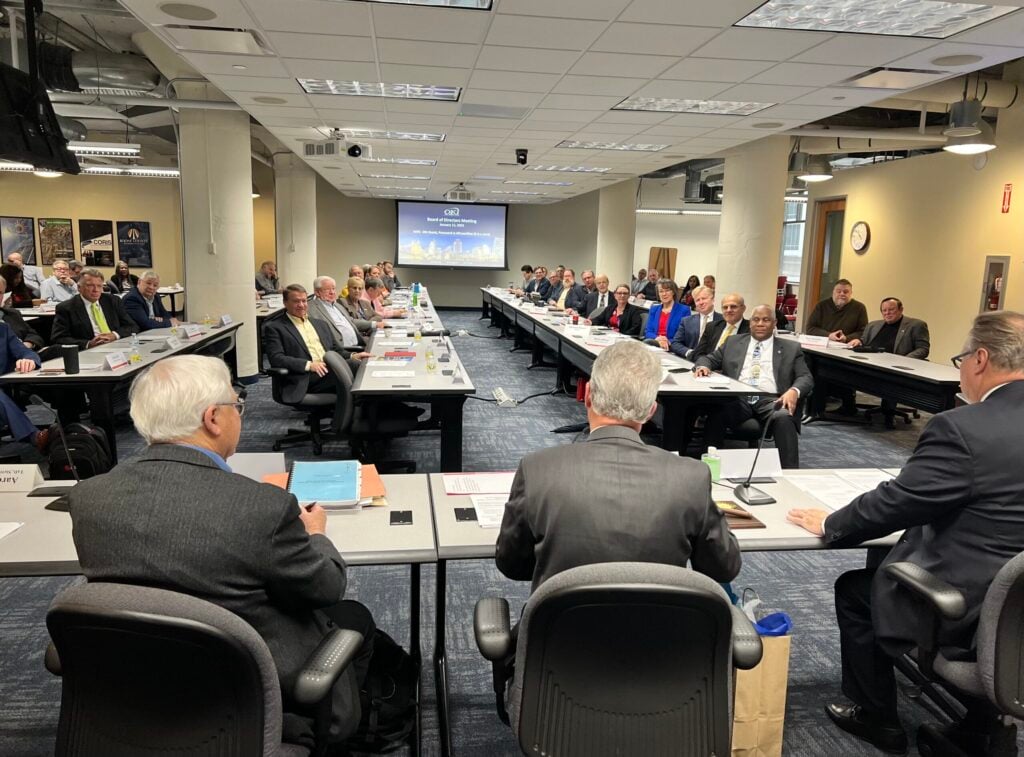
With a 118‑member board representing eight counties across three states, OKI annually approves roughly $400 million in transportation projects and directly invests between $50 million and $80 million into regional infrastructure.
Remarkably, given today’s fractious political climate, every vote since 2003 has been unanimous.
OKI’s funding is a powerhouse for local communities. Since 2002, the agency has invested more than $1.27 billion in transportation infrastructure, including the most recent round of project awards approved in October and programmed through FY 2030.
“Is there another organization in the country, with the size and breadth of OKI, that has operated with such social, political and legislative harmony for over two decades?” Policinski asked. “Perhaps, but it is safe to say this is a rare occurrence, especially when more than a billion dollars has been allocated during this time among nearly 200 communities across a three-state region. I would call that unsurpassed cooperation.”
OKI’s impact is everywhere: on the trails people walk, the buses they ride, the bridges they cross, the roundabouts they navigate, and the major interchanges they rely on. Its long‑range decisions shape mobility and connectivity for more than two million residents across the Tri-State.
Clermont County Commissioner Bonnie Batchler shares Policinski’s perspective.
“In a time when division often dominates the headlines, OKI proves that bipartisan cooperation is not only possible, it is productive,” said Batchler, who serves as OKI Board First Vice President. “When we sit at the same table, listen to one another, and focus on what’s best for the entire region, we deliver infrastructure and investment that improve lives on both sides of the river and across all eight counties.”
MPOs were created to ensure that federal transportation funds move directly to regions — not through governors’ offices — giving local leaders authority to shape investments that reflect community priorities. Because of that structure, OKI holds final say over every federal surface transportation dollar spent in the region.
And while OKI has that authority, its member communities drive every decision. Every seed of a project that OKI supports begins with a local village, city, township, county or transit agency. The entire investment strategy is built from the community level up and never imposed from the federal level down.
In discussing his tenure as OKI Board President (2021-22), Clermont County Commissioner David Painter highlighted the power of bringing diverse voices to the same table.
“It showed me firsthand that consensus isn’t accidental. It’s the product of leaders who choose collaboration over competition. When 118 voices from three states come together with a single purpose, we don’t just build roads and bridges. We build trust. And that trust is what allows OKI to deliver investments that strengthen every community in our region, from the smallest township to the largest county.”
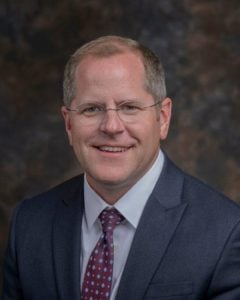
Kenton County Judge/Executive Kris Knochelmann underscored the strength of OKI’s decision‑making model.
“The process leading to consensus decisions at OKI is rigorous,” said Knochelmann, who served as OKI Board president in 2019-20. “The product of it elevates the level of service we provide to more than 2 million residents across this region. It’s unique and allows our region to deliver infrastructure investment with a speed and certainty that sets our community apart.”
Since its founding in 1964, OKI has become one of the most decorated MPOs in the nation. The Federal Highway Administration has awarded the agency 30 commendations for innovation and leadership since 2003, and its funding prioritization process is regarded as a national best practice — a distinction not lost on Butler County Commissioner T.C. Rogers.
“During my time as OKI Board President (2017–18), what impressed me most was how leaders from very disparate communities could look past politics and focus on results,” Rogers said. “OKI’s consensus model isn’t just unusual in today’s climate; it’s a major reason our tri-state continues to grow stronger and more connected year after year.”
Rogers concluded, “It’s no accident that the Federal Highway Administration stated that OKI sets the standard for the other 420 MPOs in the country.
OKI Regional Council of Goverenments