













By David Rotenstein
NKyTribune reporter
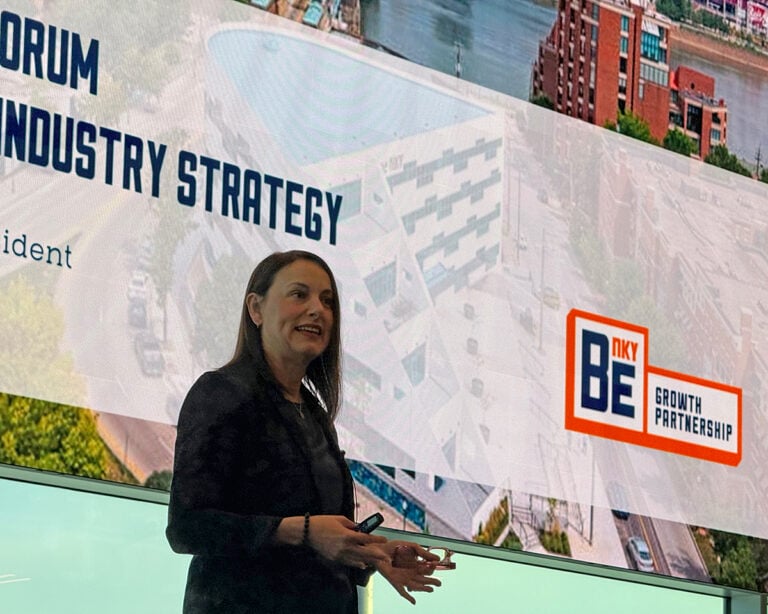
BE NKY Growth Partnership, a regional economic development company, held its annual forum Jan. 30 at Turfway Park Racing & Gaming. Nearly 200 business and community leaders mingled over coffee and breakfast. BE NKY CEO Lee Crume introduced keynote speaker Amy Holloway, president of consulting firm Aha! Advisors.

Crume laid the groundwork for Holloway by explaining what BE NKY does.
“We work with clients typically through what we call the site selection process,” Crum said. “It’s a corporate process of making decisions on where to invest and grow their businesses.”
Crume described the process as risky and challenging. Yet, since 1987, BE NKY and its predecessor, Northern Kentucky Tri-ED, worked with 814 unique business projects that created approximately 79,000 jobs in Northern Kentucky.
BE NKY, Crume explained, has three service lines: growth, strategy and working with the Northern Kentucky Port Authority in the site selection process. Key achievements Crume highlighted include the recent former Duro Bag and C&O Roundhouse complex acquisition, Sparkhaus, and the OneNKY Center.

Crume ticked off other accomplishments while describing Northern Kentucky as a prosperous region. He urged attendees to see the region’s challenges as positive indicators.
“There’s no doubt that in our lives that we have friction. Some of you will drive home tonight,” Crume said. “To me, that is a really positive friction. That’s good friction. That’s the friction that you get from a growing community.”
Holloway was a consultant, along with Ernst & Young to BE NKY for the production of the 2026 Target Industry Study.
“That’s what we’re here to talk about today, is what that targeting looks like for you, and specifically which industries we recommend that you focus your economic development efforts,” Holloway said.

Holloway framed her discussion in terms of what she described as “target clusters”: an approach that takes a holistic approach to economic development instead of a singular business attraction one. “Cluster-driven approach means that we’re tackling this from all sorts of different angles,” she said.
The region, according to Holloway, should be focused on targeting four industry clusters: advanced manufacturing, information technology, life sciences and supply chain management and services.
Holloway also spoke about workforce development and adapting to external pressures, including the uncertainty surrounding the Trump administration’s tariff policies, demographic changes in the local workforce, and the role automation is playing in the local economy.
Focused positive messaging about the region’s innumerable assets, Holloway said, is key to economic success.
“If you can continue to get that message out loudly and clearly to companies in this field, the opportunities are going to be extraordinary, and you’re going to be able to drive growth here in the way that you want it to happen and achieve that future that you all have in mind for the community,” Holloway stressed.

In the Q&A that followed Holloway’s illustrated talk, one attendee emphasized local tendencies to not enthusiastically tout the region’s assets to companies looking to locate here. “We also have an ‘aw shucks’ kind of southern mentality that it’s like, yeah, we’re great, but we don’t really talk about it too much, that kind of thing,” he said. “If we are going to make that next level and elevate and build the next generation of Northern Kentucky, there has to be an ‘oh, hell yeah,’ about Northern Kentucky.”
Holloway asked if others recognized an enthusiasm gap: “Like, you know that there’s all these assets, but there just hasn’t been that, ‘hell yeah, let’s do this?’”
A subdued response only underscored the point.
“The enthusiasm gap in the answer to your question,” Crume observed.