











I write today about an issue that has been festering in Northern Kentucky (NKY) for decades.
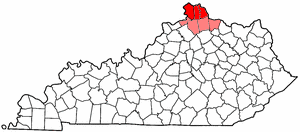
As my good friend Brent Cooper, head of the NKY Chamber of Commerce, frequently points out, the collective population of the three Northern Kentucky counties is over 400,000 residents – significantly more than Fayette County’s 330,000 residents. We are the second largest community in the state.
The major difference is that 330,000 Fayette Countians live under one urban county government, while 400,000 Northern Kentuckians live under three county governments and 36 small city governments.
What is the significance of our being so large in number, but our living in so many small governmental units?

In my analysis, three issues are raised by this configuration that are worthy of our consideration – issues that should concern citizens across Northern Kentucky. These are waste of resources; quality of services; and clout in state and national matters.
Beginning with waste. It is self-evident, when looking across the landscape of multiple counties and small cities, that there is immense duplication in the number of service entities within their small bureaucracies.
For example, Kenton County has at least fifteen law enforcement agencies, including the County Police Department, the County Sheriff’s Office, municipal departments in Covington, Ft. Mitchell, Erlanger, Ludlow, Elsmere, Villa Hills, Crestview Hills, Lakeside Park, Taylor Mill, Edgewood, and Park Hills, a regional drug strike firce, the Kentucky State Police, and various federal agencies.
Similarly with fire protection. Municipal fire departments are in Bromley, Covington, Crescent Springs/Villa Hills, Edgewood, Erlanger, Elsmere, Ft. Mitchell, Ft. Wright, Independence, Kenton, Ludlow, Park Hills, Ryland Heights, and Taylor Mill. Some involve volunteers.
Finally, the County operates two administrative centers, in Covington and Independence, while each of the incorporated cities in the County operate their own city hall buildings and administrative services.
To any reasonable observer, this is obviously an inefficient system. And a very expensive one.
Nobody sat down and invented this system in one fell swoop. It evolved over a long period of time.
And the fact is, many people like it. They like the localness, the sense – and the fact – that the people and agencies serving them are their friends and neighbors.
But there are additional prices to pay. Which leads to the second major issue raised by this Balkanization of local government: quality of service.
Not all fire departments need the largest pumper. If several departments share one, as occurs in NKY, it is available when needed without each department having to buy and maintain one.
Yet while there are examples of sharing and cooperation, there are multiple examples of resources not subject to sharing agreements whose costs exceed their usage.
This sharing of resources and expenses is obviously one way to address the inefficiency of each department without compromising its quality.
But other inefficiencies do compromise quality. Small departments are not funded to provide state-of-the-art training. Nor can they do complicated operations. Or hire those with specialized skills who are not needed enough in a small setting to justify the expense.
The third area where the NKY Balkanization of local government lies in its impact on our region’s ability to get what it needs from the state and federal governments.
Back to the 400,000 v. 330,000 people differential between NKY and Lexington-Fayette Urban County (Lexington). We have more people, more resource, and greater economic activity in NKY than in Lexington. Our economic growth is significantly greater, several times that of Lexington, as are our exports.
Yet we receive less state and federal government funds and benefits.
If the three NKY counties and their 36 cities were to consolidate into one urban county, it would immediately move into second place in size because of population and other assets. And because the region would speak with one voice. A far more powerful voice than any we have now.
I remember efforts made in this direction some 40 years ago. They failed, largely because of the parochialism of our citizenry.
There is much more at stake today. There are some things to be lost, but importantly, much more to be gained.
Finally, as in other consolidated urban centers, local communities would retain their identity and uniqueness. The benefits of localness are not lost.
I believe it is time to exhume this discussion. For the benefit of our region and all of its people.
Col Owens lives in Fort Mitchell. He is a retired legal aid attorney and law professor, author of Bending the Arc Toward Justice, longtime Democratic Party activist, and member of the Boards of Directors of Gateway Community and Technical College and the Kentucky Board of Elections. He is an occasional columnist for the NKyTribune.