
















By Liam Niemeyer
Kentucky Lantern
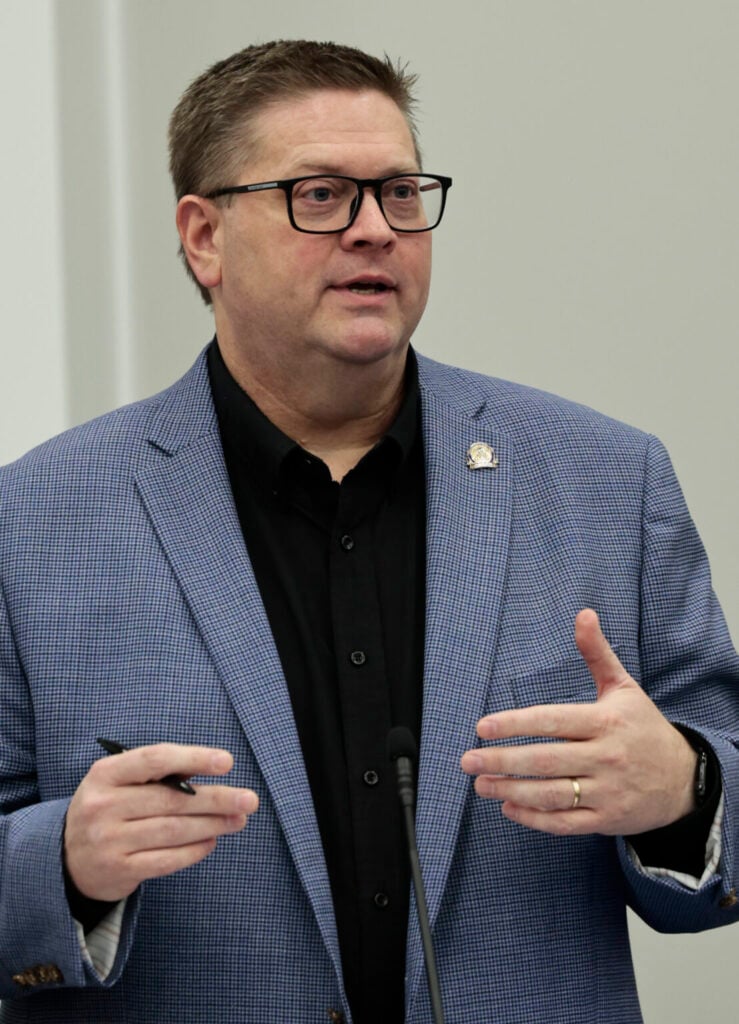
The Kentucky House on Thursday approved a two-year state spending plan described by budget chair Jason Petrie as “restrained” and fulfilling “needs, not wants.”
House Bill 500, approved on a mostly party-line vote, allocates more than $30 billion in General Fund revenues and adds $617 million to the $3.7 billion already filling the Budget Reserve Trust Fund or ‘rainy day’ fund.

The minority of House Democrats and other critics said the budget underfunds education and Medicaid and should do more for Kentuckians struggling with the cost of living.
“This austerity is not a necessity. It’s a choice,” said Jason Bailey, the executive director of the progressive think tank Kentucky Center for Economic Policy.
Petrie, the House Appropriations and Revenue Committee chair, told his legislative colleagues that his House Bill 500, the executive branch budget, was a “good first draft.” The bill will now go to the Senate before a final version is hammered out in House-Senate negotiations. Petrie said the process of having stakeholders come before budget review subcommittees in past weeks “has resulted in greater transparency.”
“We did not feed the appetite of $10 billion of additional funding from the executive branch’s requests,” Petrie said, saying the House budget holds spending growth to a little under 2%.
The House approved the budget by a vote of 81-18, with all Democrats opposing the bill except Rep. Ashley Tackett-Laferty, D-Martin.
The state budget funds a broad scope of government services and programs including schools, prisons, Medicaid health care benefits, and state cabinets regulating the environment and promoting economic development.
The House budget targets specific categories of spending by the Beshear administration, including travel, referencing findings from Republican State Auditor Allison Ball. A spokesperson for Democratic Gov. Andy Beshear dismissed those spending reductions as “unfounded and politically motivated.”
The supermajority of Republicans in the House praised the budget bill, saying it would ensure public safety and strengthen workforce training opportunities.
Rep. Kim Banta, R-Fort Mitchell, said the budget provides “historic investments” in education that “must be matched with measurable academic progress.”
However, the House plan increases per-pupil funding through the Support Education Excellence in Kentucky (SEEK) formula, by less than 1% the first year of the biennium and 3.6% the second year, while giving schools no increase in transportation funding.
Total funding for postsecondary education is cut by 16% over the biennium compared to the last budget’s enacted appropriations, according to an analysis by the Kentucky Center for Economic Policy.
The budget provides $190 million in bond funding for universities’ building maintenance and provides funding for the Kentucky Community and Technical College System, though KCTCS’ funding would decrease by about 5% in the next fiscal year.
A coalition of advocates argued the legislature has chronically underfunded education, among other state services. Bailey, the executive director of the progressive think tank, which is a part of that coalition, in a statement said the Republicans’ budget continues to underfund public education, Medicaid benefits and senior services, arguing lawmakers are holding down spending to meet fiscal triggers to be able to again lower the state’s income tax rate in the future.
“As the budget continues to move through the legislative process, lawmakers should continue listening to the people who advocated for, and won, improvements to HB 500,” Bailey said.
House Democrats unsuccessfully tried to add provisions to the budget bill, including a direct raise for school employees, expanding preschool access, adding $123 million for housing and a cost-of-living adjustment for government retirees.
HB 500 was brought to the House floor less than 24 hours after clearing the committee on Wednesday. House rules require floor amendments be filed 24 hours before a bill is considered on the House floor, meaning it was impossible for Democrats to meet the 24-hour requirement for floor amendments.
Democrats needed a majority of the chamber to vote to suspend the House rules to consider the floor amendments, which Republicans declined to do. Republicans turned away Democratic floor amendments in a similar fashion during the last budget cycle in 2024.
Democrats, while praising the legislature’s nonpartisan staff and Petrie’s work on the budget, criticized the process that excluded consideration of their floor amendments.
Rep. Lindsey Burke, D-Lexington, asked lawmakers what it would mean to allow Democrats to “have a meaningful seat at the table.”
“We represent constituents that you don’t, and our constituents are no less important than yours,” Burke said. “We’re doing a really hard job up here, because you might get a seat at the table when we don’t, and that’s just wrong. And as a result, this budget is just wrong. It fails to consider many of the things that Kentuckians across the state need and deserve.”
Rep. Josh Bray, R-Mount Vernon, the vice chair of the House Appropriations and Revenue Committee, pushed back, saying that he hasn’t denied any meeting with a legislator among the “over 3000 meetings” he’s had on the budget.
“We all want to see more taxpayer dollars spent in appropriate manners. We want to see more education funding. We want to see more money for our universities. …We want to see more Medicaid funds,” Bray said. “But the fact of the matter is we have to live within our means.”
Bray in heated remarks referenced concerns shared by Ball, the state auditor, in a legislative committee over the executive branch’s international travel among other expenditures.
He also referenced a key priority of Beshear to provide universal preschool throughout the state, saying it “sounds like a great idea.” But he said he’s still waiting for answers from the Beshear administration on the staffing and building requirements for the expansion, pointing to subpoenas that Republicans issued this week for information they say they need to pass the budget. A Beshear spokesperson had called the subpoenas “a stunt with no merit.”

“How about a little cooperation, or a little collaboration? Because that’s what we need,” Bray said. “When we write a budget, there’s a lot of stuff we’d love to have in there, but there we can only fund so much.”
A Beshear spokesperson did not immediately provide a response on Bray’s criticism of the administration.
House Minority Floor Leader Pamela Stevenson, D-Louisville, following Bray’s remarks said Democrats had “submitted 92 budget requests” and had been in “conversations with a lot of people” including the “chairman of the budget request.”
“The fact remains that health care and eating are not wants, they are needs. And for this body to suggest that only some people need it and others don’t, is a problem,” Stevenson said. “We have chosen over and over and over and over and over and over again to deny the poor people, the working people of this state, what they need just to live as human beings.”
“They’re not asking for a trip to Paris. They just want to feed their children,” Stevenson said.
This story first appeared at The Kentucky Lantern, a part of States Newsroom, the nation’s largest state-focused nonprofit news organization. It is reprinted here under Creative Commons license.