

















By David Rotenstein
NKyTribune reporter
First of two parts
Remember when your neighbors had names like John and Mary Smith or Frank and Louise Harris? Now, thanks to the proliferation of short-term rentals in cities throughout Northern Kentucky, they’re just as likely to have names like Fun Guy Lodging or SS Tiki Lands LLC. And, the new businesses really aren’t your neighbors; the new neighbors are a revolving cast of visitors there for the night or a weekend.

In the wake of the COVID-19 pandemic that exploded the popularity of short-term rentals, Covington sought to tamp down on the number of the businesses rapidly cropping up throughout the city by passing an ordinance in 2023 regulating them. The new law followed on the heels of a six-month moratorium the city enacted to give it time to study the ways short-term rentals were impacting Covington neighborhoods.
Proposed legislation in Frankfort threatens to upend how Covington regulates short-term rentals. This is the first of a two-part series on the popular lodgings in Covington.
Back before the moratorium and subsequent regulations, Covington was like the Wild West of short-term rentals. “As we were drafting the ordinance a couple years ago, it was real concern because it was essentially unregulated and you could have as many as you wanted to and turn an entire block into short-term rentals,” said Director of Neighborhood Services Brandon Holmes.
Then-Mayor Joe Meyer recalled city officials being bombarded by complaints about trash, noise and parking. Connecting with owners and managers was difficult because limited liability corporations (LLCs) owned and managed many of the short-term rentals.
“Those were all very, very significant problems,” Meyer told the NKyTribune.
Meyer and other city leaders held meetings to take the pulse of residents and neighborhood leaders. They studied the ways other cities were tackling short-term rentals. The goal was to better protect neighborhoods and permanent residents from non-resident owners exploiting demand for lodging near Cincinnati and Covington’s eateries, bars and other attractions.
“In the process of developing the scheme for Covington, I know we looked at four or five different cities that were recommended for the quality of their regulatory schemes,” Meyer said. “Then we picked out the elements that were most consistent with the situation on the ground here in Covington.”
What emerged is a law and regulatory regime that limits the number of short-term rentals by neighborhood type, i.e., residential, commercial, historic district overlay, etc. And, it distinguishes hosts who live onsite from those, like LLCs, who do not. It also imposes limits on the number of units individual owners and LLCs may have.
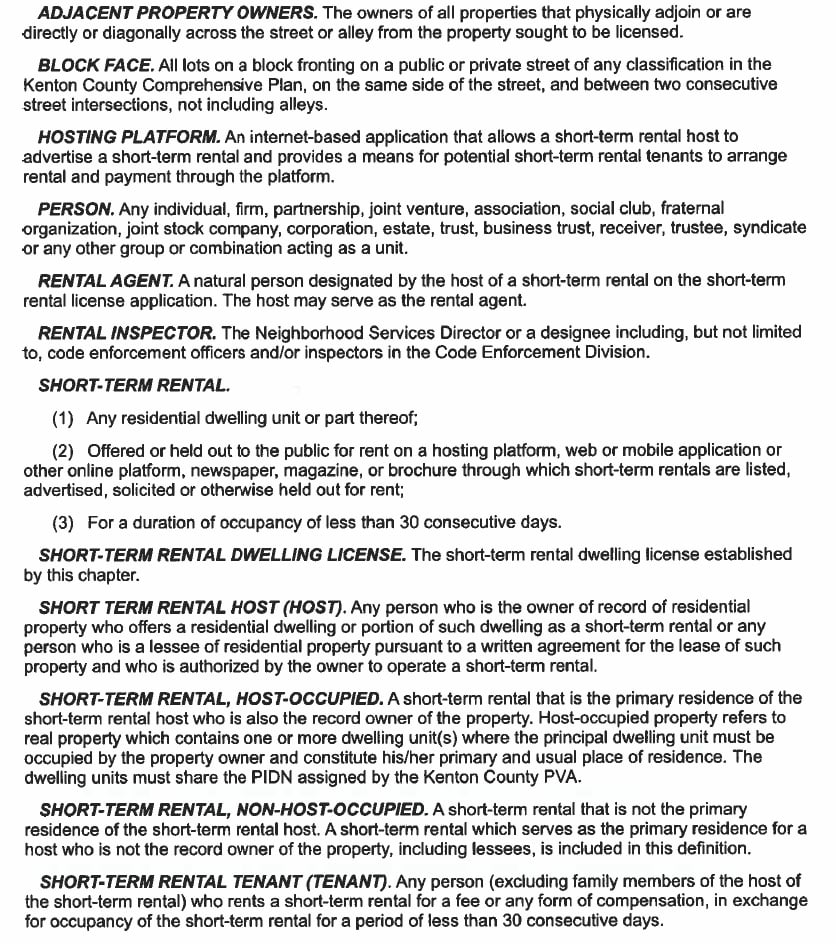
A bill in the Kentucky State Senate threatens to upend all of the time and money that Covington invested in its short-term rental law. In January, Kentucky State Sen. Craig Richardson (R-Hopkinsville) introduced SB 112 (An Act to Relating to Short Term Rentals). If enacted, the law would strip local jurisdictions from regulating short-term rentals by eliminating residency and licensing requirements.
“If the local government is going to deprive a private property owner from doing what they want with their property, then I think that’s where we have to come in,” Richardson told the NKyTribune.
Richardson said Kentucky needs the new law to protect property owners, which he says are adversely affected by local regulations governing short-term rentals.
“It’s creating a negative impact on homeowners and their opportunity to earn income,” Richardson said.

The senator rattled off economic statistics about the economic benefits of the short-term rental industry in Kentucky.
“AirBnB alone has a almost $600 million economic impact,” he said. “I think the greater advantage here, instead of looking at a cultural shift in our historic neighborhoods, is the opportunity to liven these neighborhoods back up and breathe life back into them.”
Covington City Manager Sharmili Reddy disagrees with Richardson.
“There are a lot of sections in this bill that directly contradict with what we already have in place,” Reddy explained. “This bill basically removes any restrictions we can place on the number of short-term rentals in our community.”
Though Reddy didn’t start her job with the city until last year, she is well versed in the history of the short-term rentals law.
“We took four years to basically understand what our community is willing to accept,” Reddy said. “We had several iterations of the local ordinances before we arrived at where we did.”
Richardson’s bill would override Covington’s law and leave the city with few options.
“This bill seeks to undo a lot of that work that was done,” Reddy said.
Undoing all of that work will be costly. Covington and other cities would lose all of the investments made in revising local laws.
“We would have to modify all of our regulatory framework around this, zoning will have to be changed,” Reddy said.
The city manager couldn’t put a price tag on what the process would cost taxpayers.
“Anything we touch is expensive,” she conceded.
Without the tools to regulate short-term rentals, Covington and other Kentucky cities will find themselves at the mercy of corporate interests, many of them not local, looking to cash in. Those corporate interests sought to put the kibosh on Covington’s short-term rental law as the city was drafting it.
“Airbnb had their lobbyist contact us to oppose the type of regulation we were considering, and then some of the people who were investors in the local short-term rentals,” Meyer said.
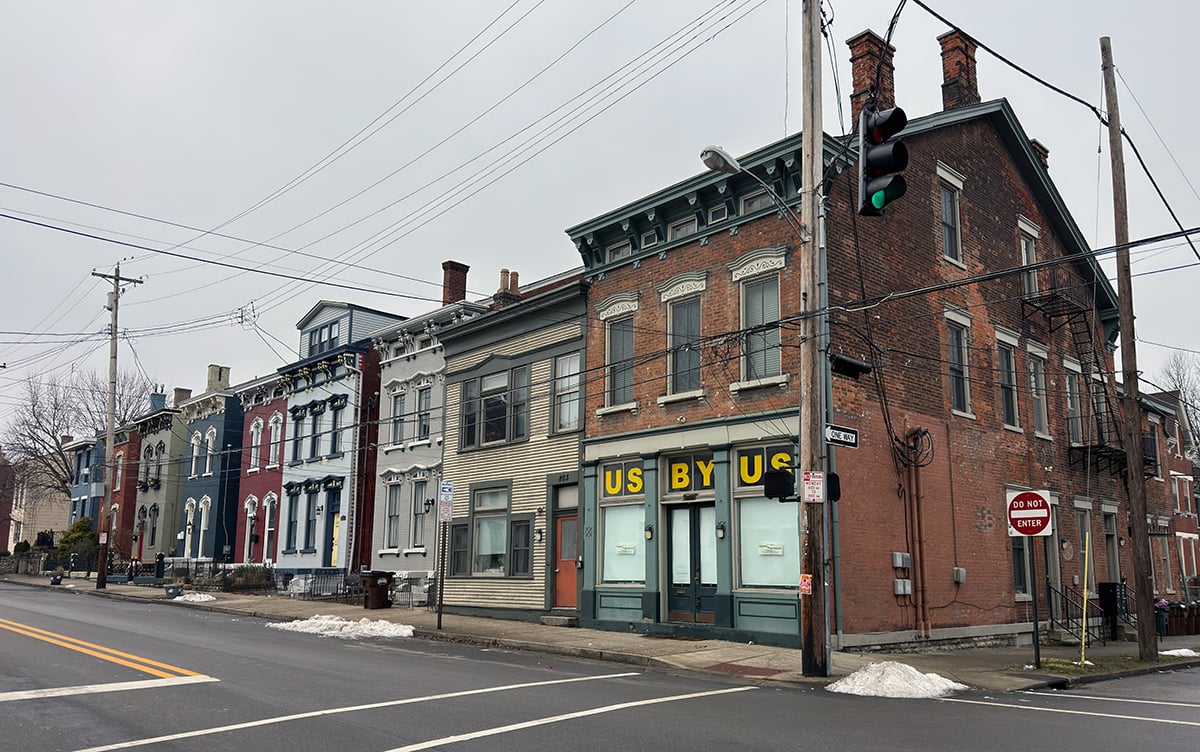
Though Covington has come a long way in its efforts to manage the spread of short-term rentals in the city, some residents think that more can be done. Casual conversations in local coffeeshops about short-term rentals lead to speculation by long-term residents that the number of short-term rentals in the city is much higher than the 136 license holders (data current through January). They cite the number of people toting “rolling bags,” especially weekends, seen throughout their neighborhoods.
The city instituted several mechanisms to track short-term rentals, including deploying a software package that scoured online listings for the units.
“We would be able to tell based on who we had licensed and who was operating illegally,” Holmes explained. “We would send notices of violations and at some points fines for people to get everybody who was essentially doing that to stop doing that. So that’s how we managed it.”
Holmes thinks that the city’s system is effective.
“It’s working. It’s not broken right now,” he said. “The only time short-term rentals are on my radar is when a reporter asks a question about them or if there’s something that may have happened, which we don’t have.”
Coming in Part Two, we’ll look at some of the impacts short-term rentals have on Covington neighborhoods and some of the ways that operators have found to bend the rules.