














By Sarah Ladd
Kentucky Lantern
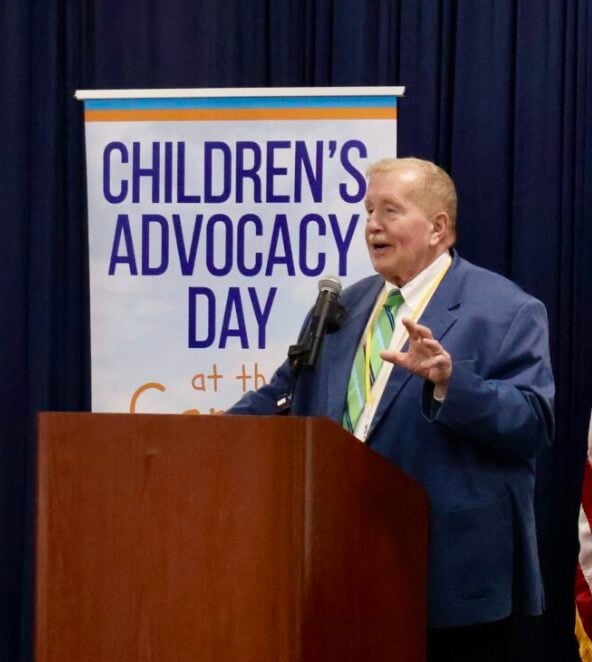
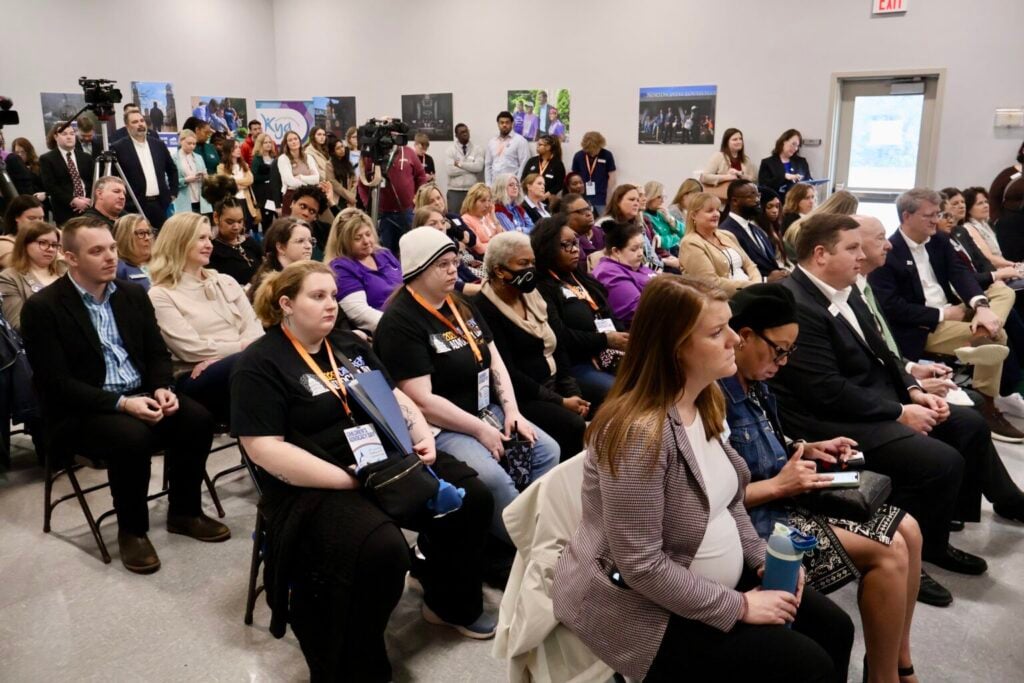
At the Children’s Advocacy Day in Frankfort Wednesday, Kentucky Youth Advocates Executive Director Terry Brooks said this legislative session has, simultaneously, “excellent legislation when it comes to kids” as well as “anti kid measures” he pleaded with lawmakers to reject.
“Some of the worst legislation that I’ve seen in 22 years is on the table,” Brooks told a crowd gathered in the Capitol Education Center as part of the annual rally for kids’ wellbeing.
Legislation that Brooks sees as positive for kids includes measures to reallocate JUUL settlement dollars toward youth smoking prevention, require child care providers to get training on caring for kids with special needs and providing diapers to needy families through a trust fund.
But he slammed Senate Bill 101, which would, among other things, require school boards to expel students between sixth- and 12-grades for at least 12 months if they intentionally physically harm a school employee on campus or during a school function.
The bill has passed the Senate but has yet to receive a hearing on the House side.
“Do we really want to see kids expelled for 12 months, falling behind academically, having no supports, becoming more isolated?” Brooks asked. “Every high school principal I have talked to about that issue wants two things. They want a bad acting kid out of their school, and we believe the kids have to be held accountable, but they immediately wonder what that kid is going to be like when he comes back. A kid who has been isolated for 12 months is going to be more likely to come back as a troubled kid.”
Legislator panel
Senate President Pro Tem David Givens of Greensburg, House Speaker David Osborne and Sen. Cassie Chambers Armstrong, D-Louisville, sat for a panel about child wellbeing and legislation related to kids during Children’s Advocacy Day.
Despite “uncertainty” surrounding changes made to Medicaid and other issues from the One Big Beautiful Bill Act, passed by Congress last summer, and the end of COVID-19-era federal funds, Osborne said the Republican supermajority’s approach to crafting the two-year state budget has stayed the same this year.
“The way we approach the budget — the way we’ve approached it every year since 2018 when we wrote our first budget — is how to make Kentucky as efficient as possible,” Osborne said. “That doesn’t mean: Spend less than we are. That doesn’t mean: Spend more than we are. That means: Utilize Kentucky taxpayer dollars in the most effective and efficient manner possible.”
It also involves trying to correct any inefficiencies, he said.
“I think everybody would admit that the government fails in some areas,” Osborne said. “So, when we look at those failing areas, are there ways to either improve those failures or replace those failures with something that does work? That’s a constant, evolving process.”
Givens promoted House Bill 1 as “a true anti-poverty bill” that will help families. HB1 is awaiting a signature or veto from Gov. Andy Beshear.
It would opt Kentucky into a federal education tax credit program established by the One Big Beautiful Bill Act, which supporters say is a way to let Kentucky kids and families benefit from the tax credit at no cost to the state. Critics have argued the legislation is a way to support “school choice” options — at the expense of public schools — despite rejections by Kentucky voters and the state Supreme Court.
This legislation would let individuals who donate to scholarship granting organizations get a federal tax credit up to $1,700. Money would then go to scholarships for eligible students.
“I think all of us in the room will agree that one of the answers to poverty is education. I hope that’s a sincerely held belief by all of us,” Givens said. “Would you rather send that money to Washington, D.C. or keep it in Kentucky with the scholarship granting organization to help kids in K through 12? It’s a no brainer.”
Chambers-Armstrong, who is pushing again this year to exempt diapers from the sales tax and provide a child tax credit to parents of kids younger than 6, said the General Assembly “can’t stop trying” to end child poverty, which she said “is an entrenched problem.”
The latest Kids Count Data Dashboard, released by Kentucky Youth Advocates in December, shows about 21% of children are living in food-insecure households, 20% live below the poverty level and 44% live in low-income households.
“Children don’t live in communities on their own. When we do things to help families, to help communities, to help our economy, that also helps children, but we pass all kinds of dedicated bills for all kinds of interest in all kinds of groups. What would it look like if we had a child poverty bill?” she said. “I have young children. I look at my credit card account every day and I’m just amazed … it keeps going up and up and up because kids cost money. Investing in kids costs money. What would it look like if we made sure that every family had the tools they need to access early childhood education, broadly defined?”
This story is reprinted from the Kentucky Lantern, a part of States Newsroom, the nation’s largest state-focused nonprofit news organization. It is share here by Creative Commons license.