











By Paul A. Tenkotte, PhD
Special to NKyTribune
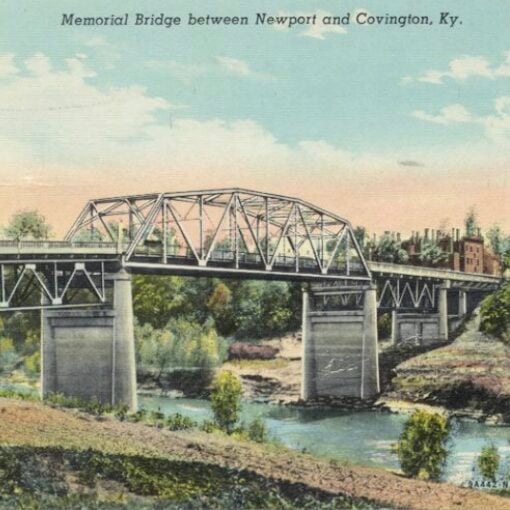
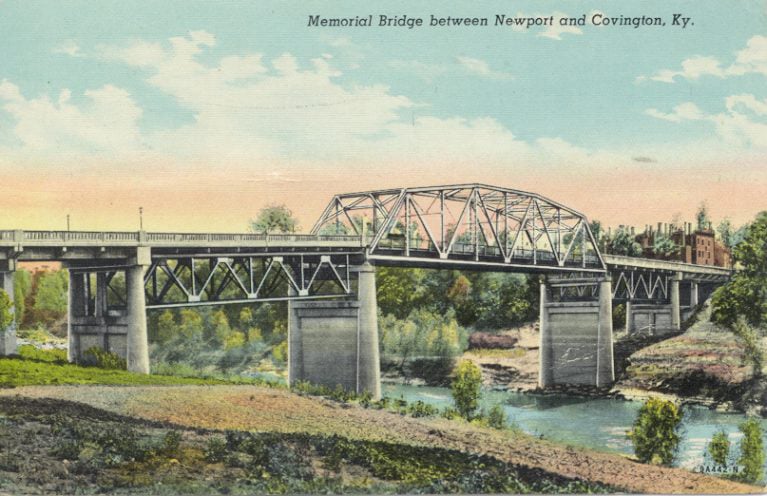
On Monday morning, March 2, 2026, a controlled blast will demolish the World War Veterans’ Memorial Bridge over the Licking River, linking Covington and Newport, Kentucky. For nearly 80 years, the Veterans Bridge has served the region.
Even more impressive, however, is the fact that three Licking River bridges have stood at Covington’s East 4th Street, providing access between the two cities since 1853.
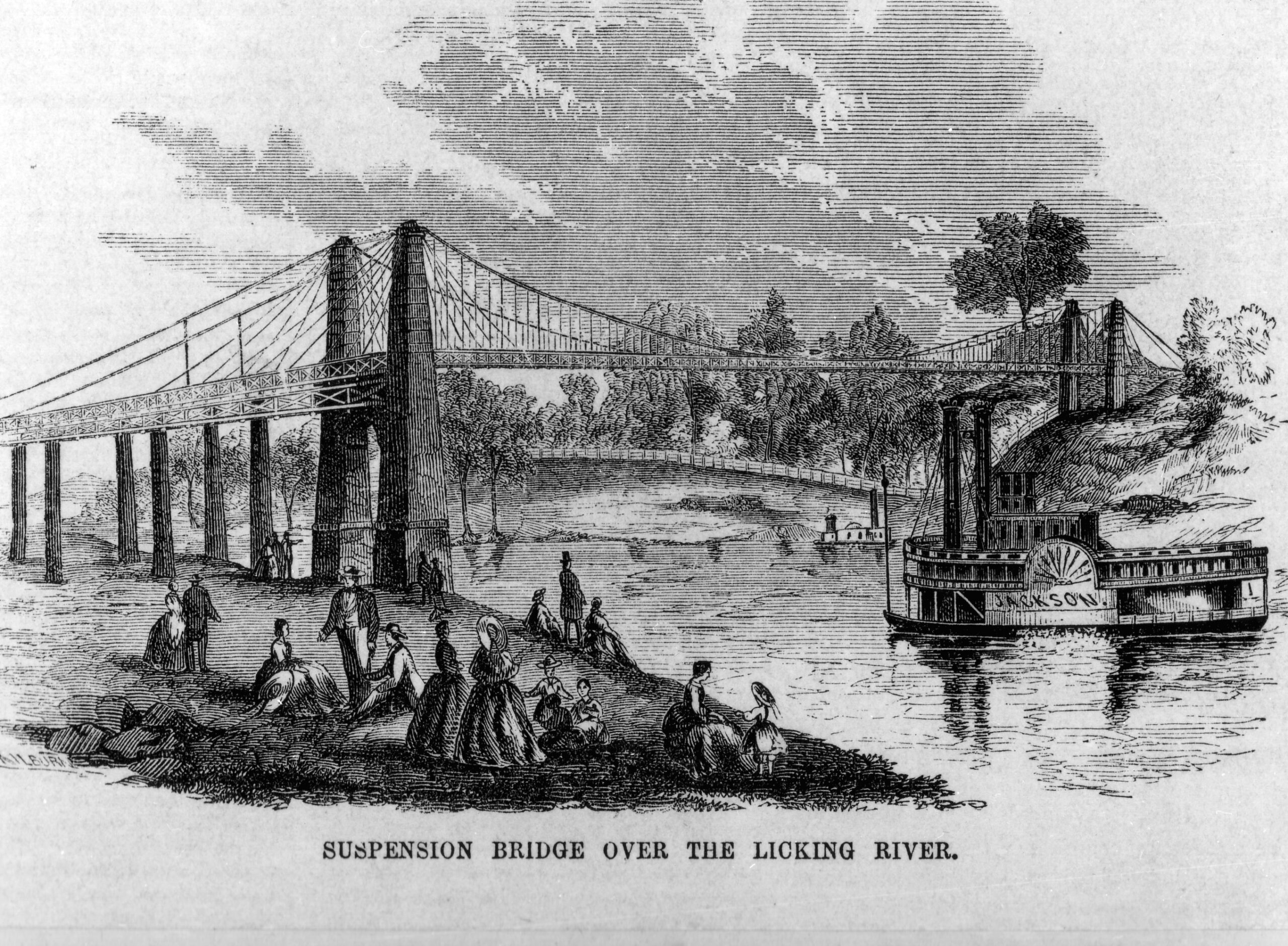
More than a decade before John A. Roebling’s graceful suspension bridge spanned the Ohio River between Cincinnati and Covington, a suspension bridge connected Covington and Newport. Located at East 4th Street in Covington, the Newport and Covington Suspension Bridge had a storied past.
On January 27, 1830, the Kentucky General Assembly passed an act incorporating the Licking Bridge Company. The incorporators included the most prominent Newport and Covington residents of the time: James Taylor, Richard and William Wright Southgate, Edward Colston, Thomas D. Carneal, Samuel Kennedy, and others. Capitalized at $15,000, to be divided into a total of 3,000 shares, the company was to advertise the opening of stock subscriptions within six months of the passage of the act. Further, the charter stipulated that, upon the sale of 2,000 shares, the corporation could officially organize. Apparently, lack of funding dissolved the corporation (Kentucky, “An Act to incorporate a company to erect a Bridge across Licking River, between the towns of Newport and Covington,” 1829-30, p. 115).
In February 1844, the Covington-based “Licking Valley Register” published an article describing an iron suspension bridge just completed over the Miami Canal at Race Street in Cincinnati. Noting that it was the first such bridge built “west of the mountains,” it further referenced the success of a similar suspension bridge, designed by Charles Ellet, and erected over the Schuylkill River at Fairmount near Philadelphia. Moreover, the article stated that Northern Kentuckians were “discussing the propriety of erecting a wire suspension bridge” over the Licking River (“From the Cincinnati Atlas. Wire Bridge,” “Licking Valley Register,” February 24, 1844, p. 2).
On June 27, 1844, a public meeting was held in Newport to discuss the proposed Licking River Bridge. Marcus T. C. Gould reviewed the success of the Schuylkill span and reported that a suspension bridge over the Licking could be built for as little as $20,000, $5,000 of which he claimed the city of Covington was willing to subscribe. The bridge, he attested, would “add to the comfort and convenience of our own citizens,” and would increase the commerce and real estate of Newport (“Bridge across the Licking,” “Licking Valley Register,” July 20, 1844, p. 2).
By mid-August 1844, the “Licking Valley Register” reported that the town of Newport, as well as nearly eighty individuals, had subscribed to the stock of the bridge company. With already 2,000 shares sold, the company was officially organized, and held its first meeting in Newport on Saturday, August 31, 1844, when the shareholders elected six directors and chose Marcus T. C. Gould as President.
By the first week of April 1845, the east (Newport shore) bridge pier was begun, with promises that the Covington abutment was to be “commenced” the following week.
Unfortunately, the work slowed, so much so that by September 1846, it had apparently been halted for lack of funds (“Covington & Newport,” “Licking Valley Register,” September 2, 1846, p. 2).
The Licking River bridge proposal was resurrected in 1849, at which time only a single pier, on the Newport shore, stood in testimony of the earlier efforts of the 1844 company. Charles Ellet, a noted suspension bridge designer, traveled to Northern Kentucky in late February or early March of 1849, and made arrangements to build a suspension bridge between Covington and Newport. He was to begin construction on April 1, and he projected completion by December 1. Although the exact circumstances are unknown, Ellet’s proposal never reached fruition.
In January 1852, the Kentucky General Assembly chartered the Newport and Covington Bridge Company, a corporation of prominent Covington and Newport residents, with the privilege of “constructing one or more permanent bridges” between Covington and Newport. The act provided that the cities of Covington and Newport could subscribe for stock in the span, and within ten years, both cities or either had the option of purchasing the bridge for the cost of construction, plus six percent interest (Kentucky, “An Act incorporating the Newport and Covington Bridge Company, Kentucky Acts,” 1851-52, p. 521).
By June 1853, the “Covington Journal” reported that construction of the company’s suspension bridge, at the end of 4th Street in Covington, was proceeding quickly under the superintendence of George C. Tarvin of Covington. The contractor was John Tarvin Gray, and the cost of construction was originally pegged at $62,500.
On Wednesday, November 30, 1853, the wire cables for the Newport and Covington Suspension Bridge were strung across the channel. The process involved attaching a rope to each of the eight cables, and using a series of pulleys, rollers, and drums on the riverbanks, as well as “on the hulls of steamboats in the river.” Two 93-foot-tall brick towers carried eight cables measuring 902 feet in length, and weighing a total of 88 tons. Six of the cables were composed of “250 strands of wire each,” and the “remaining two of 308 strands each.” On Wednesday, December 28, 1853, George Tarvin, joined by Mayor Foley of Covington, made the first vehicular passage across the bridge (“Bridge Cables,” “Louisville Daily Courier,” December 5, 1853, p. 3; “Covington Journal,” June 25, 1853, p. 3; “Covington Journal,” December 31, 1853, p. 3).
On Monday evening, January 16, 1854, while two men and eighteen head of cattle were crossing it, the bridge suddenly collapsed into the river. There were no human casualties. The disaster was blamed on poorly manufactured cast iron rings holding the cables. The bridge’s piers were completely intact, permitting rebuilding to begin immediately. Damage amounted to about $14,000, and with other additional expenses, it was estimated that the final cost of the bridge would be about $81,000. Reopened in May 1854, the bridge was further strengthened and improved in 1867 by Washington Roebling, son of John Roebling, designer of the Covington and Cincinnati Suspension Bridge (“The Suspension Bridge,” “Covington Journal,” February 18, 1854, p. 3).
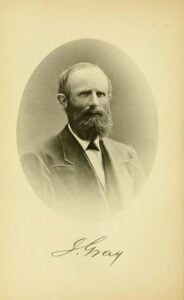
Sadly, the Newport and Covington Suspension Bridge experienced more deterioration as time passed. In 1863 John Gray — then of Covington — began “quite extensive” repairs costing a rather substantial sum for the time period, $4,000. Ten years later, when Bruce R. Morton, Newport’s city engineer was overseeing additional “repairs and improvements” to the bridge, Gray questioned whether Morton’s work was sufficient, claiming — as paraphrased by the “Cincinnati Daily Gazette” — that “the structure is liable to fall down any day” (“Newport and Covington Bridge,” “Cincinnati Commercial Tribune,” May 21, 1863, p. 2; “Newport,” “Cincinnati Daily Gazette,” January 27, 1873, p. 4).
Gray’s analysis was apparently correct, as only two years later — in 1875 — the bridge needed restrengthening. Two proposals were submitted. John Gray proposed adding two new steel cables. Unfortunately, Gray’s plan was rejected for the other proposal, namely to build a mid-channel pier underneath the bridge and also to add truss work, essentially changing it from principally a suspension to a truss bridge. The bridge company split the work between Imerson and Limerick of Newport to build a new stone mid-channel pier at a bid of $21,478 and John Gray of Covington to add truss work at a cost of $3,559.50 (“The Licking Bridge,” “Cincinnati Daily Gazette,” September 22, 1875, p. 3; “Cincinnati Daily Gazette,” October 12, 1875, p. 3).
Once again, the bridge company would have benefited from John Gray’s analysis. By 1882 it was clear that the mid-channel pier had done little to strengthen the bridge. The bridge company called in engineers from across the nation, including W. H. Paine, assistant superintendent of the Brooklyn Bridge, who determined that the Newport and Covington bridge needed to be totally replaced. Paraphrasing his report, the “Cincinnati Enquirer” stated in an article entitled “A Death-Trap,” that the “Newport and Covington Bridge has eight cables purporting to contain 2,508 wires, and of this number it can be safely said that not more than one-half are in good order. They have lost their original strength, and in many places the wires are disconnected, and have been eaten clear through. . . It would be no trouble to take a pen-knife and pick one of the cables of this bridge apart.”

In addition, the middle pier was a “flat failure. It added strength to no point except that portion of the bridge which is directly over the pier, and for perhaps ten feet on each side” (“A Death-Rap That Swings between Covington and Newport: A Bridge that Suspends from Corroded Wires,” “Cincinnati Enquirer,” November 15, 1883, p. 8).
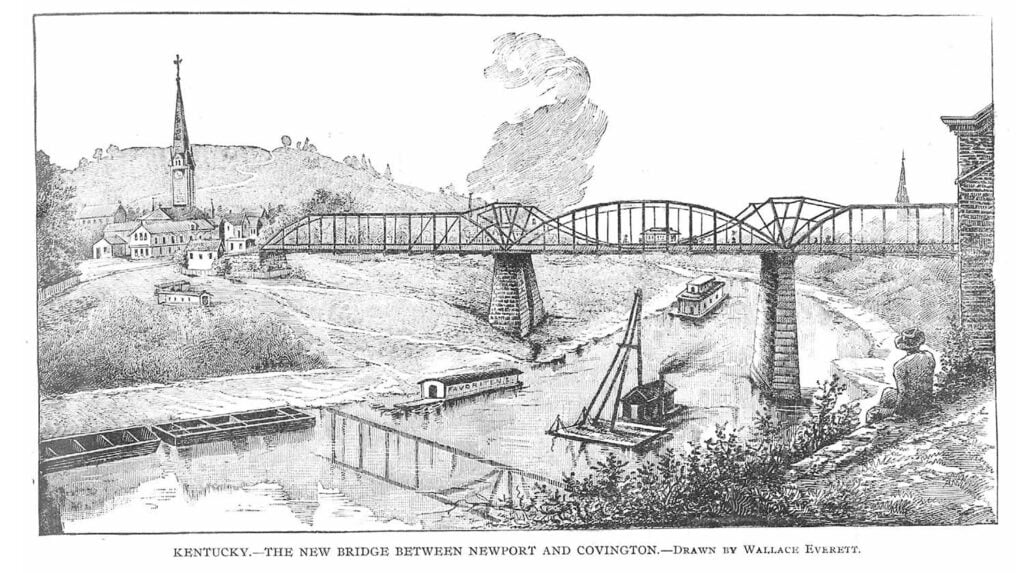
By this time, the bridge was owned by the cities of Covington and Newport, and the city councils of each did not agree on a clear path forward. By 1885, however, the bridge company had decided to demolish the old bridge and to accept proposals for the construction of a new one. The noted firm of Keystone Bridge Company of Pittsburgh was awarded the contract. On Christmas Day in 1886, the new truss bridge opened (“Cincinnati Post,” September 2, 1885, p. 4; “Covington,” “Cincinnati Post,” December 24, 1886, p. 4).
The 1886 truss bridge served the community well until the 1930s, when a more modern and wider bridge was required. Commissioner J. Lyter Donaldson of the Kentucky Highway Commission announced that the cost of a new truss bridge would be covered by President Roosevelt’s New Deal PWA (Public Works Administration) and was to be supervised by the Kentucky Highway Department. Preparatory plans included the removal of the old bridge piers, as well as the laying of a submarine telephone cable (formerly carried by the 1886 bridge) along the bed of the Licking River (“New Bridge,” “Cincinnati Enquirer,” January 26, 1934, p. 11; “Ultimatum,” “Cincinnati Enquirer,” March 27, 1934, p. 11).
By August 1934, the contract for construction of the “substructure and concrete approaches” of the new bridge was awarded to the Temple Foundation of Cincinnati, and the steel superstructure to the R.C. Mahon Company of Detroit. The new bridge — to be named the World War Veterans’ Memorial Bridge — was to be owned by the state and totally free of tolls (“Cincinnatians Wins Contract for Bridge Across Licking,” “Cincinnati Enquirer,” August 29, 1934, p. 1; “Bridge Name,” “Cincinnati Enquirer,” April 27, 1936, p. 1).
On Thursday evening, July 23, 1936, the new bridge opened with great pageantry, including parades, speakers, and fireworks. Thousands of spectators witnessed the event as the principal speaker, attorney Charlton B. Thompson, delivered the main address, proclaiming a new era of unity in Northern Kentucky. Thompson also emphasized that “ ‘In honor of those who risked their lives for our nation in a great conflict this exquisite monument to our progress shall be known as the World War Veterans’ Memorial Bridge. Under that name, may it inspire harmony and forever bind together in spirit the two cities now joined by this mighty link of steel and concrete.’ ” (“Throng Sees New Bridge Thrown Open,” “Kentucky Post,” July 24, 1936, p. 1).
Paul A. Tenkotte, PhD is Editor of the “Our Rich History” weekly series and Professor of History at Northern Kentucky University (NKU). To browse more than ten years of past columns, click here. Tenkotte also serves as Director of the ORVILLE Project (Ohio River Valley Innovation Library and Learning Engagement). He can be contacted at tenkottep@nku.edu.