The River: Sharing a recently-rediscovered account of early days on the river from a former comrade
The riverboat captain is a storyteller. Captain Don Sanders shares the stories of his long association with the river — from discovery to a way of love and life. This a part of a long and continuing story.
By Capt. Don Sanders Special to NKyTribune
While rootin’ through an old trunk, recently, a fading manuscript slipped out of a moldering leather satchel and slid to the floor. Reaching down and retrieving the yellowing document, I recognized that it was an account written half a century ago by a long-deceased former comrade of mine from my early steamboat days. After some deliberation, I decided to share it in this week’s river column.
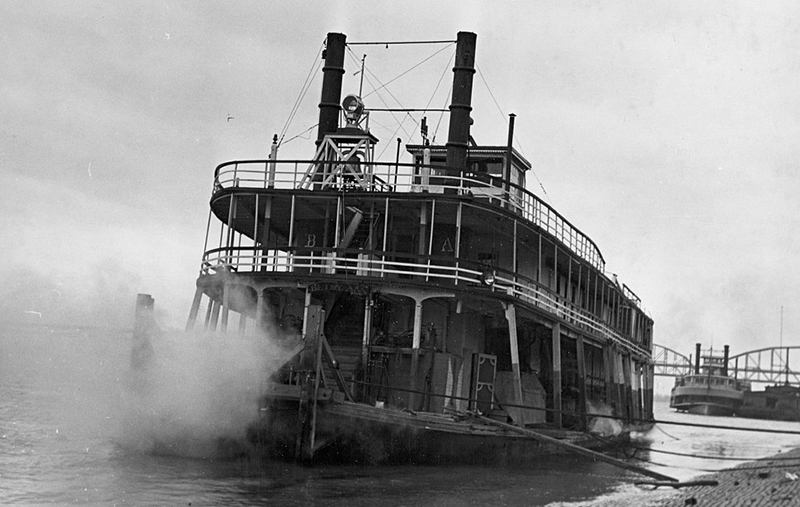
A steamboat similar to the GLENDORA on the St. Louis landing. (Photo provided)
A Recollection. (Written in 1974 or 1975.)
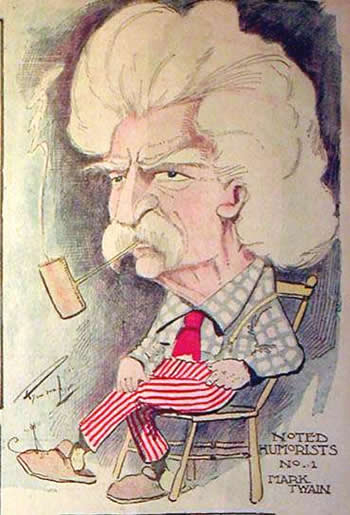
Captain Westley “Wess” Smithers, a grizzled, scrappy, hard as boiler-iron, old cuss, commanded the GLENDORA, a steam sternwheeler running out of Cincinnati. Cap’n Wess wore his white, shoulder-length hair much like a pilot he knew when he was growing up on the river. He called that elder steamboat statesman, “Old Quaker Oats,” just like the old timer on the cereal boxes. Later, I discovered there actually was a steamboatman called “Old Quaker Oats.” His name was Calvin “Cal” Blasier. I never met Captain Blasier, but Cap’n Wess sure talked a lot about him.
Cap’n Wess wore his white, shoulder-length hair and smoked an old-fashioned pipe much like this caricature of Mark Twain (Image provided)
Captain Wess smoked an old-fashioned pipe that looked like a yellowed chunk of a corncob. That pipe never left his mouth except when he’d grab it by the cob and jab the stem at ya’ to poke the words he spoke deeper into your subconscious — making pigeon holes where the learnin’ he conveyed could take root, grow, and eventually flower into the truths he found after 70-some years in the pilothouses of a hundred different steamboats on the Mississippi System.
Captain Smithers embarked on his steam boating career when the country was only about a century and a decade old —around 1886, I recall him saying. Cap’n Wess actually worked on the river in ’86, not born then. He was 17. We stood watches together many nights on the old GLENDORA. The Captain was 94, and I was 17.
Captain Wess always prefaced his words to me by addressing me as “boy,” as most of the older steamboat men seemed to do to younger fellows, especially ones still in their teens. When we first began working together, his conversation ran much like this:
“Boy,” go down and fetch me a hot cup of coffee and a slice of apple pie from the passengers’ buffet, and not any of the crew’s leftovers.” Or, “boy do this… boy do that.”
As time passed, however, as he commenced “teaching me the river,” Captain Smither’s tone changed more to:
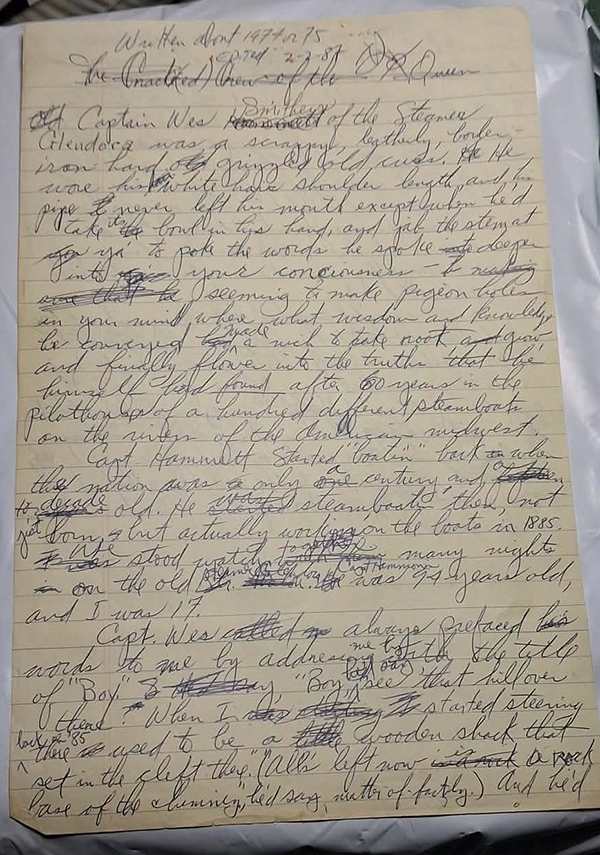
The unknown memoir from a since-deceased associate (Image provided)
“Boy, see that hill over there?” Back when I started steering in ’86, there used to be a small wooden shack set in the cleft, there.” All’s left now is the rock base of the chimney,” he’d add matter-of-factly.
As his mind wandered to when the tiny wooden home still clung precariously to the rocky hillside, he recollected a pretty, dark-haired girl of about his age, or maybe a couple of years younger, living there with her father, or perhaps her grandfather, and their few mangy hounds milling about.
The GLENDORA slid past the siloutted trees beneath the unseen cleft in the hillside under a moonless sky so dark that the elder pilot instinctively steered the great white steamer with an instinct born of many decades piloting along these same stretches of seemenly formless shores on countless moonless nights like tonight when river, land, and sky become as one punctuated only by a distant light in a cabin along this remote fringe of riverbank completely removed and unknown to the outside world.
Only fragments of the pilot’s spoken words reached my inner self that night in the blackness within the pilothouse of the GLENDORA. The obscurity of the gloominess prevented my observation of the stabbing punctuation of the old gentleman’s cob pipe, jabbing, but lost in the darkness. His words rolled off me like the wave cut into the silent, formless waters of the river beneath the bow of the GLENDORA, four decks below.
So there you have it. A previously unknown memoir, until now, scribbled in pencil on a sheet of yellow legal paper from a since-deceased associate, who, after receiving his appropriate Coast Guard pilotage certificates, left the river for a job close to home, married his high school sweetheart, and raised a family. After losing track of my friend nearly two decades ago, I entered his name into Google, hoping to reacquaint us; instead, I found his obituary — something that’s happened several times since.
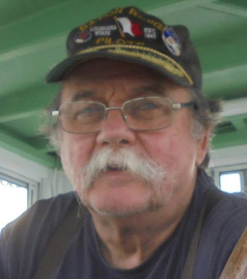
Captain Don Sanders is a river man. He has been a riverboat captain with the Delta Queen Steamboat Company and with Rising Star Casino. He learned to fly an airplane before he learned to drive a “machine” and became a captain in the USAF. He is an adventurer, a historian and a storyteller. Now, he is a columnist for the NKyTribune, sharing his stories of growing up in Covington and his stories of the river. Hang on for the ride — the river never looked so good.
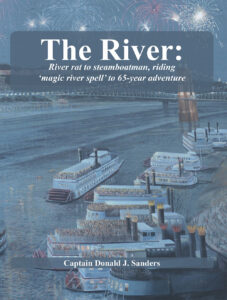
Capt. Don Sanders The River: River Rat to steamboatman, riding ‘magic river spell’ to 65-year adventure is now available for $29.95 plus handling and applicable taxes. This beautiful, hardback, published by the Northern Kentucky Tribune, is 264-pages of riveting storytelling, replete with hundreds of pictures from Capt. Don’s collection — and reflects his meticulous journaling, unmatched storytelling, and his appreciation for detail. This historically significant book is perfect for the collections of every devotee of the river.
You may purchase your book by mail from the Northern Kentucky Tribune — or you may find the book for sale at all Roebling Books locations and at the Behringer Crawford Museum and the St. Elizabeth Healthcare gift shops.







 Captain Don Sanders is a river man. He has been a riverboat captain with the Delta Queen Steamboat Company and with Rising Star Casino. He learned to fly an airplane before he learned to drive a “machine” and became a captain in the USAF. He is an adventurer, a historian and a storyteller. Now, he is a columnist for the NKyTribune, sharing his stories of growing up in Covington and his stories of the river. Hang on for the ride — the river never looked so good.