










By Judy Clabes
NKyTribune editor
Pen America, founded in 1922, is a nonprofit that celebrates free expression and champions the freedom to write while recognizing the power of the word to transform the world. It works to ensure that people everywhere have the freedom to create literature, to convey information and ideas, to express their views and to access the views, ideas, and literatures of others.
The organization is a community of more than 4,500 novelists, journalists, nonfiction writers, editors, poets, essayists, playwrights, publishers, translators, agents and other writing professionals as well as readers and supporters of their mission.
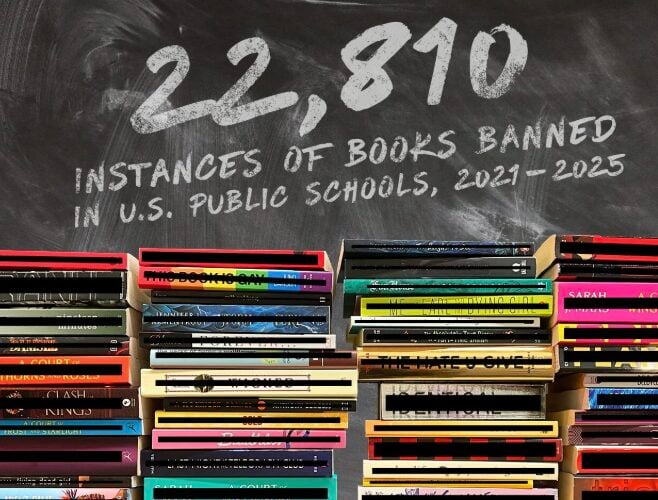
Since 2021, PEN America has documented 22,810 cases of book bans in U.S. public schools and has produced a yearly “Banned Books” list.
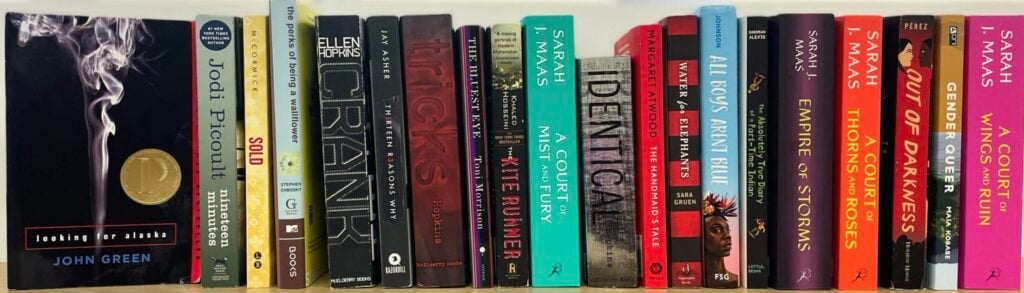
Thousands of books have been targeted repeatedly – as many as 147 times for John Green’s popular young adult novel Looking for Alaska and 142 for bestselling author Jodi Picoult’s book centered around a school shooting, Nineteen Minutes. Seven of bestselling author Sarah J. Maas’ books appear in the top 52, along with seven by young adult author Ellen Hopkins.
These lists provide a sobering look at efforts to wipe out everything from classic literature to children’s picture books. Bans have occurred in 45 states and 451 public school districts.
The 52 most banned books of the last four school years include National Book Award and Pulitzer Prize winners, bestsellers, and beloved books by authors including Toni Morrison, Margaret Atwood, and Judy Blume.
Censorship proponents frequently frame their movement as a drive to remove “porn” from schools, but many of the most banned books don’t contain so much as a kiss. Instead, many explore themes of race and racism or reflect LGBTQ+ identities, particularly those of the transgender community. Others reflect the realities of sexual abuse and violence, something far too many children experience outside the pages of a book.
Pen America asks: If groups pushing censorship consider widely read classics indecent, if they can come for the likes of John Green and Toni Morrison, is anything off limits?
PenAmerica’s list of “Most Banned Books of the 2024=2025 School Year include:
• A Clockwork Orange by Anthony Burgess
• Breathless by Jennifer Niven
• Sold by Patricia McCormick
• Last Night at the Telegraph Club by Malinda Lo
• A Court of Mist and Fury by Sarah J. Maas
• Crank by Ellen Hopkins
• Forever by Judy Blume
• The Perks of Being a Wallflower by Stephen Chbosky
• Wicked: The Life and Times of the Wicked Witch of the West by Gregory Maguire
• All Boys Aren’t Blue by Gregory M. Johnson and
• A Court of Thorns and Roses by Sarah J. Maas
• Damsel by Elana K. Arnold
• The DUFF: Designated Ugly Fat Friend by Kody Keplinger
• Nineteen Minutes by Jodi Picoult
• Storm and Fury by Jennifer L. Armentrout
To see the full list of banned books click here.
PenAmerica reports that in today’s America, censorship is rampant and common — and includes pressure from politicians, legislators, parents, and ideological groups that bully schools and local libraries to remove books from their shelves. Today’s social issues around gender, sexual preference, DEI, sexual identity, suicide, and race add impetus to the trend. Some states have gone so far as to mandate “no read lists.”
A federal judge has just recently overturned part of a Florida book ban law, drawing on nearly 100 years of precedent protecting First Amendment access to ideas. The ban included Jack Kerouac’s On the Road, a quintessential chronicle of the Beat Generation in the 1950s.
Sadly, the PenAmerica data is just a snapshot of the problem, as it represents only the cases of bans reported directly to the organization. Books banned within public libraries and prisons do not appear on the list.
The bottom line, however, is clear — be aware, be responsible parents and citizens, encourage your students to be well read, to open their hearts and minds to the opinions and views of others, and to question. Reading is supposed to expand the mind and expose all of us to situations beyond our own experiences so that we can empathize as we view fit and find our way to a moral world and kinder world.