












By Jim Tecco
Special to NKyTribune
On a Monday evening in mid-October 2025 — 175 years after the passage of the Fugitive Slave Act of 1850 — I attended an ICE de-escalation training. The room had over 25 attendees. As I walked in, I felt a sense of connectedness, yet the tension was unmistakable. The attendees were diverse in age, race, ethnicity, and gender — all united by a shared goal of safety for our neighborhood, its people, and the broader community.
I’m troubled by Immigration and Customs Enforcement’s (ICE) increasingly aggressive tactics toward community members. But I was also there with a quieter, personal fear, one shaped by my own experience as an immigrant whose safety has never felt entirely guaranteed. As an adoptee from Korea who was naturalized as a child, I carry the same passport and constitutional protection as anyone born here. However, a lingering anxiety remains. What if one day the constitutional law says otherwise? What if there is a federal system error? What if someone with a government shield decides that paperwork is not enough? Some can view my fear as irrational, nevertheless, at any moment, it is a reality for many that live in my community.
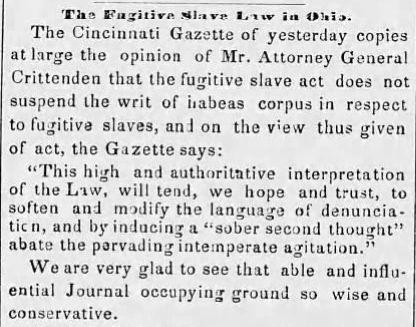
The fear of not belonging has echoed across American history. Communities along the Ohio River once faced similar questions about law, morality, and belonging.
On September 18, 1850, Congress passed the Fugitive Slave Act, extending the reach of slavery to the free states. Its passage by the Senate with a 27–12 vote crystallized a moral crisis that had been building for decades. Although roll-call data is incomplete, strong evidence suggests that states like Ohio opposed the act, while border states like Kentucky — with entrenched slaveholding interests — supported it. As the Ohio River region struggled with the clash between morality and law, mirroring the national dilemma, the Fugitive Slave Act deepened divisions and fueled resistance in the north, becoming a focal point in a crisis that eventually led to the Civil War (U.S. Senate, Roll Call Vote 31st Congress, 1st Session—S. 246,” GovTrack).
The act’s enforcement in the Ohio River watershed forced everyday people to choose between obeying federal law or following their moral convictions. It nationalized slavecatching, turning ordinary citizens into potential informants, compelling local officials in free states to participate, and denying enslaved people the right to testify on their own behalf. At the local level, the Fugitive Slave Act challenged many border communities to weigh the legality of the Constitution against the demands of personal conscience. An article in the “Tri-Weekly Maysville Eagle” emphasized that the changes in the revised law were simply extensions of the constitutional requirements of the 1789 Fugitive Slave Act (United States, “Fugitive Slave Act of 1850,” Washington, D.C., 1850, Library of Congress; “The North and the Laws of the Union — The Fugitive Slave Act.” “The Tri-Weekly Maysville Eagle,” October 5, 1850, p. 2).
The Ohio River watershed became the critical stage where this national conflict played out. Even though the northern side of the river was free soil, not all community members supported freedom for African Americans. Historian Darrel E. Bigham, drawing on Kenneth L. Kusmer, explains that “the lives of blacks on the free side of the Ohio River were severely restricted, since most whites in the lower Midwest shared the cultural values of Negrophobes across the river.” The Ohio River functioned not only as a geographic boundary but as an ideological one. Keith P. Griffler points out in “Front Line of Freedom,” Ohio itself “embodied the stark contradictions of the existence of slavery in a free Republic.”
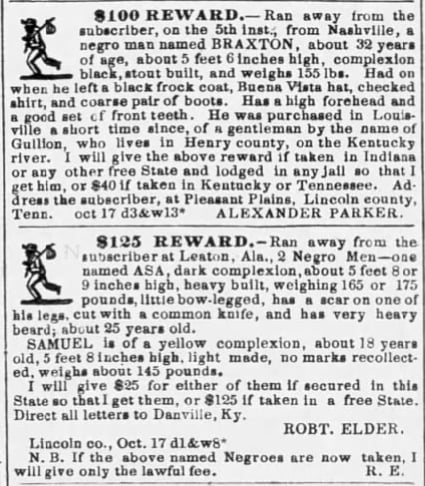
As a result, border communities were forced to choose between the legality of the Constitution and their own moral or religious convictions. For many, following federal law required violating personal conscience, while for others, defending slavery became synonymous with defending the Constitution itself (Kenneth L. Kusmer, “A Ghetto Takes Shape: Black Cleveland, 1870-1930,” Urbana: University of Illinois Press, 1976, p. 55, quoted in Darrel E Bigham, “On Jordan’s Banks: Emancipation and Its Aftermath in the Ohio River Valley,” Kentucky: University Press of Kentucky, 2006, p. 33).
Kentucky newspapers such as the “Tri-Weekly Maysville Eagle” framed compliance as a patriotic duty, justifying the forced return of human beings as the protection of “property rights.” In doing so, the paper downplayed the expanding national crisis over human rights and the impossibility of reconciling justice with bondage.
Across the river, Ohio communities saw the law differently. Southern Ohio’s residents, diverse, politically fractured, and deeply religious, recognized the severe moral implications of participating in federally mandated human capture. Abolitionist preachers such as Reverend Thomas Smith Williamson and Reverend John Rankin became known for their refusal to let law muzzle conscience. Their pulpits, homes, and church basements became sites of resistance, where faith drove action even as the federal government criminalized their compassion.
Religious leaders in the Ohio River watershed lived in communities divided by fear—a fear of law, violence, politics, and slave catchers. In Ohio’s free river towns, many ministers shaped their identity around their responses to the Fugitive Slave Act. Historian Wilbur Siebert recounts how Reverend Thomas Smith Williamson, living in Adams County, Ohio near the Ohio River, was known for aiding enslaved Kentuckians who crossed the Ohio River. These leaders chose to interpret Christianity through the lens of human dignity, not property rights, even as their Kentucky counterparts struggled to find moral footing in a slaveholding society (Wilbur H. Siebert, “Mysteries of Ohio’s Underground Railroad,” draft manuscript, n.d., p. 44, Wilbur H. Siebert Underground Railroad Collection, Ohio History Connection, Ohio Memory).
Their actions reflected a broader national struggle unfolding across denominations. Yet no one could escape the reach of the law. Compliance was no longer passive; inaction became an active endorsement of someone else’s bondage. The Fugitive Slave Act forced churches, communities, and neighbors to declare their loyalty. Would they comply and report on fugitive activity, cooperate with slave catchers and federal marshals? Or act against a legal system that placed property above people?
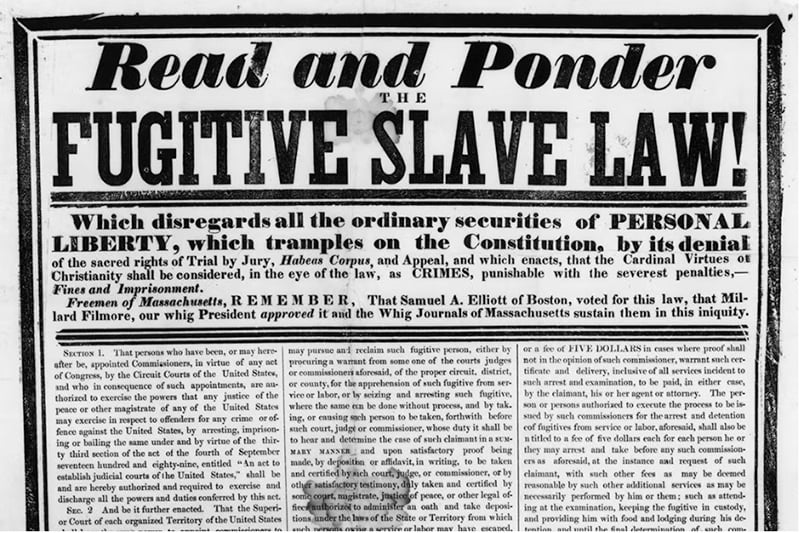
The history of the Ohio River watershed reminds us that legality and morality do not always move in the same direction. It also shows how a system of laws can be designed to protect some while still being fundamentally immoral. In response, religious leaders, Black residents, free-soil activists, and ordinary citizens stepped forward to confront that wrongdoing. They understood that federal enforcement could strip people of their rights, and that fear was often used to force compliance. Still, people resisted, not because it was safe, but because it was right.
As I sat in my ICE training, I thought about those river communities and the choices people faced when confronted by a law that demanded obedience at the expense of humanity. I realized that the questions confronting us today are the same ones they faced: When the law knocks, who are we expected to be? And who do we choose to become?
The enforcement agents of 1850 and those of today are not the same, yet the moral stakes feel hauntingly familiar. Both systems rely on public compliance, fear, and the presumption that federal authority is beyond question. Both shape the identities of those who are targeted and those who are expected to participate. And both force communities to decide whether to protect the vulnerable or uphold policies that harm them.
Jim Tecco is a graduate student at Northern Kentucky University and the public historian behind the APIA History Cincinnati initiative. His work focuses on uncovering the silenced histories of Asian & Pacific Islander American (APIA) communities in the Cincinnati region, stories often omitted from textbooks, archives, and public memory. Combining archival research, oral history, digital mapping, and community collaboration, his approach is rooted in care and inquiry, with a commitment to honoring lives that have been historically erased and silenced.
Paul A. Tenkotte, PhD is Editor of the “Our Rich History” weekly series and Professor of History at Northern Kentucky University (NKU). To browse more than ten years of past columns, click here. Tenkotte also serves as director of the ORVILLE Project (Ohio River Valley Innovation Library and Learning Engagement). For more information see orvillelearning.org/. He can be contacted at tenkottep@nku.edu.