












By Brenna Keller
NKyTribune associate editor
On Tuesday morning, the Northern Kentucky Chamber of Commerce hosted Eggs ‘N Issues, its monthly breakfast forum. February’s theme was Shaping the Future of Healthcare in Northern Kentucky. The forum took place at Receptions Event Centers in Erlanger.

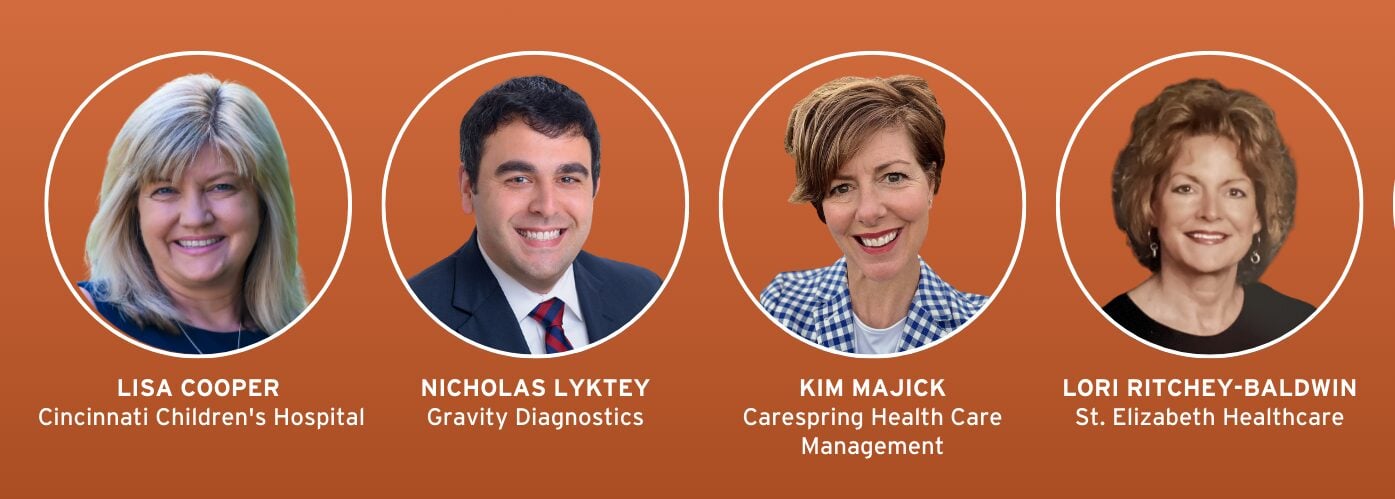
The main presentation at the event was a panel moderated by Charlie Vance, CEO of Current HR. The panelists were Lisa Cooper, Senior Government Relations Analyst at Cincinnati Children’s Hospital, Nicholas Lyktey, Chief of Laboratory Operations at Gravity Diagnostics, Kim Majick, Chief Development Officer at Carespring Health Care Management), and Lori Ritchey-Baldwin, Executive Vice President, Chief Financial Officer at St. Elizabeth Healthcare.

The panel began with a discussion of how healthcare has changed since COVID. There were some positive changes. For example, Cooper noted that Children’s Hospital has expanded virtual monitoring so patients do not always have to come into the hospital. This technological advancement improves both patient access and quality of life. However, both Majick and Ritchey-Baldwin mentioned the healthcare worker shortage post-COVID. Ritchey-Baldwin also discussed the increase in patients at St. Elizabeth who are covered by Medicare Advantage, Medicare, and Medicaid.
Ritchey-Baldwin was then asked how upcoming policy changes in the One Big Beautiful Bill and the expiration of the Affordable Care Act enhanced subsidies will affect Kentucky providers. She reported that studies show that 20-30 rural healthcare systems in Kentucky will close, which will have a large impact on those communities. Hospitals are often one of, if not the, largest employers in rural communities. Regarding the Affordable Care Act, patients who lose coverage will still be treated by hospital emergency rooms. The result is longer wait times for everyone and hospitals not being paid for those patients. The hospitals will have to raise prices for commercially insured patients to make up for other loses.
Cooper was asked to discuss the talent pipeline. She noted that our region has a lot of good educational opportunities for students going into healthcare. However, there is a shortage of workers. According to Cooper, “Healthcare is a difficult field to be in. Healthcare used to be seen as heroes. That since COVID has changed a little bit, and people question whether they want to go into a field where they’re going to be constantly questioned, and they’re going to be looked at as sometimes the villain.” She also mentioned that the shortage of physicians may be impacted further by upcoming caps on graduate-level student loans.
Majick was asked to discuss the biggest issues in long-term nursing care given the demographic shift toward an aging population. She identified the move away from traditional Medicare as the biggest threat. There is a large administrative burden on the healthcare provider to get paid for services provided. Access is not about having enough beds; the access issue is if providers participate in a health plan.
Lyktey was asked to identify technological advancements that may have implications for patients and healthcare providers. He believes that AI still has a long way to go before it can be used in healthcare. According the Lyktey, companies tout a 95% success rate, which is “not an acceptable error tolerance” in healthcare. He believes that genetic testing is something that should be widely adapted within healthcare. While the Human Genome Project, which lasted from 1990-2003, cost around $3 billion, genetic testing is fast and accessible today. It can help clinicians make informed decisions on things like medication dosing, which can be very useful for identifying the best medication for mental health conditions, for example.
The panel concluded with more policy discussions. An audience member asked what businesses can do to support the community in partnership with our healthcare system. The response: advocacy. Advocacy in both Frankfort and Washington, D.C.
The next Eggs ‘N Issues will be held on Tuesday, March 17.