











By Hayden Gooding
University of Kentucky
The University of Kentucky Center for Interprofessional and Community Health Education (CICHE) held its annual Interprofessional Collaboration and Team Skills training (iCATS).
iCATS is a required core curriculum that brings together UK students from the colleges of Medicine, Dentistry, Health Sciences, Nursing, Public Health, Pharmacy and Social Work. During the daylong training, students gain knowledge and skills needed to participate in interprofessional care teams.
This year, more than 900 students from UK campuses in Lexington, Bowling Green, and Northern Kentucky participated in iCATS.
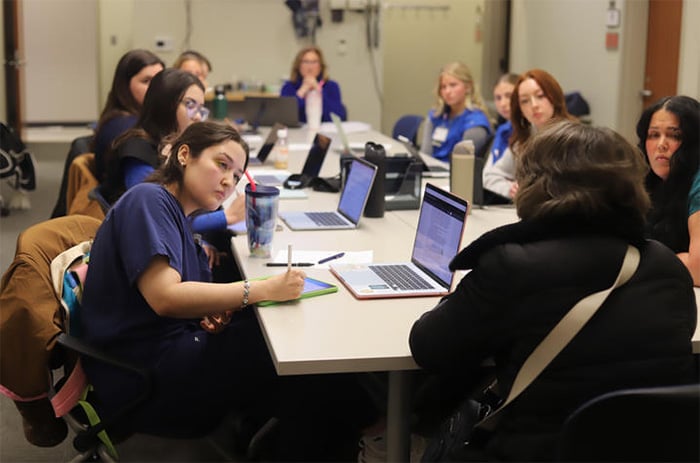
At each campus, students were split into interprofessional teams. There were 82 teams in Lexington, 10 in Northern Kentucky and 18 in Bowling Green.
The training day included activities focused on learning about each other’s professions and building team communication skills, culminating in a team simulation with a standardized patient educator.
“A key takeaway from the training was recognizing how different academic programs prepare students to contribute their unique expertise to a collaborative team,” said Courtney Tipton, a master’s student in the College of Health Sciences’ communication sciences and disorders program. “In interprofessional situations, one profession’s knowledge can address aspects of care that another may not specialize in. Together, each profession’s contribution enhances the overall plan of care and supports more holistic, patient-centered outcomes.”
The iCATS training is designed to prepare health profession students to work as a collaborative interprofessional care team. It’s not possible for a single profession to be able to fully address complex or chronic patient needs alone. This training shows how effective patient care depends on communication and trust across all health care disciplines.
“Collaborating with students from other professions helps me better understand both when and who to reach out to, while also gaining insight into the different ways disciplines think, communicate and problem solve,” said Caroline Thigpen, a master’s student in the College of Health Sciences’ communication sciences and disorders program. “This experience reinforced how essential interprofessional awareness is to provide thoughtful, coordinated care that truly meets individuals’ needs.”
Health care providers want to give their patients the best possible care. This training day allows for the students to collaborate and practice together on a real-life patient scenario. Research shows that patients receive better care when they are treated by interprofessional health care teams, which is why it’s important for UK to have the iCATS training day.
“I have been part of iCATS since its inception,” said Todd Cheever, M.D., division chief of academic medical education for the College of Medicine. “I love this course and the enthusiasm the students bring about their own professions. They often end the day realizing how much more similar they are than different from other disciplines. There is value in that knowledge.”
Each group had a different patient simulation to work through as a team. Some examples of the scenarios they were given include:
• Intake conversation with a patient suffering from substance use disorder
• Discussing a child with cerebral palsy with their caregiver
• Infectious disease outbreak tied to an athletic team
• Team disclosure of a medical error
“Interprofessional health education involves learning with, about and from other disciplines,” said Kara Lee, D.P.T., director of physical therapy clinical education in the College of Health Sciences. “If students start this type of interaction early on in their careers, it will become an ingrained behavior to work with other professions. If you are learning alongside each other, honest and open dialogue lays the groundwork for open communication downstream in their clinical education, when they may meet again over the care of an actual patient.”
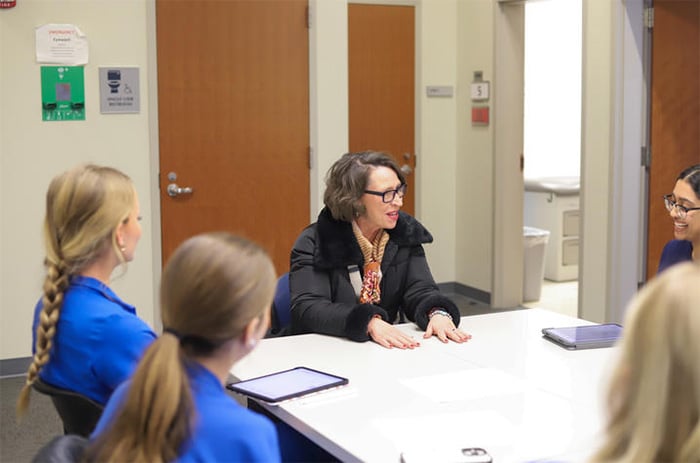
Lee has been part of the iCATS training for 12 years. She says her favorite part is watching the looks on the students’ faces as they work together solving the patient case.
“They realize that they can accomplish something they likely have not done before in their young health care career — contribute to the wellbeing of a patient in a holistic manner by being a part of a team, taking care of a portion of the ‘patient iceberg’ that lies within their scope of practice, with a hefty dose of communication skill engagement,” Lee said.
The impact of the training extends beyond the students in the room. For faculty facilitators, the experience is a chance to reconnect with the purpose behind their career.
“I’m always excited when I get to lead one of the teams,” said Jim Ballard, director of CICHE. “Working with students really grounds me and helps me understand why I chose to do this career. Our facilitators come together because they recognize how important it is. They always tell me how much they learn from the students by doing this. When you look at our faculty colleagues across the campus, it’s amazing that they’re willing to come together and work with us on this.”
What begins as a training exercise has long-term implications for patient care across the state. By emphasizing collaboration and communication, the program helps build a stronger health care workforce in Kentucky.
“We want students to understand not just their own profession, but the roles of everyone on the care team, so they can work together to make better decisions for complex patients and ultimately provide better care across Kentucky,” Ballard said.
For students, that focus on teamwork translates into a clearer understanding of how collaboration shapes patient care.
“The training was a great reminder of the importance of mutual respect, open communication and shared goals across professions,” Thigpen said. “It left me feeling encouraged and excited about future opportunities for collaborative practice.”