










By Patricia A. Scheyer
NKyTribune reporter
On a cold night in March with snow blowing sideways outside, about four dozen people chose to gather at Honey Locust Farm in Morning View to listen to seven candidates for Kenton County Commissioner in districts 2 and 3 answer questions about issues that matter to the residents of those districts.
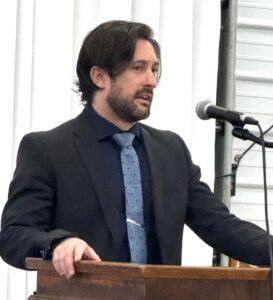
The South Kenton County Citizens Group hosted the forum, and topics of discussion included Kenton County’s Site Readiness Initiative, land use planning, zoning decision making, fiscal court politics and county taxes, among other subjects.
First up were John Busse and Jordan Baldridge, the two Democratic candidates for Kenton County Commissioner from district 3. They will face off in the May 19 primary and the winner will face the winner of the Republican primary. The Republican candidates are Matthew Hayden, Rebecca Reckers, and Scott Kimmich.
The Republican candidates for Commissioner in District 2 are Jeff Niceley and Sherry Goodridge.
The moderator for the evening was Matthew Code, Kenton Election Chair, and he gathered his questions from other public meetings held in recent months.
“In late 2024, Kenton County unveiled their Site Readiness Initiative, which calls for the industrial development of 5400 acres of southern Kenton County,” he said. “The SRI has proven to be unpopular with residents and land owners in the area. A petition had over 3200 verified signatures as of this morning. If elected, would you support the Site Readiness initiative?”
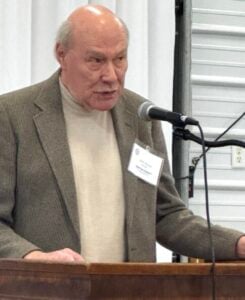
Jordan Baldridge said he would not support the SRI, but would be in favor of repealing the issue, and creating a new study that would listen to the people. He did say he thought there should be some development, but his main message was that leaders must listen to the people.
John Busse said the SRI does not benefit everybody, and thinks it is a sales tool by a larger group that wants to sell the land in Southern Kenton County. He said they need to talk to the people and ask them if they want to sell their land, and if they do there is an opportunity, but if not the government needs to listen to the people who live there.
Rebecca Reckers questioned if the SRI could be repealed, since it was a technical study that was performed, and though there are questions such as how many people were surveyed, she stated that the majority of the land is already zoned Industrial, and there is no way that she would support a blanket rezoning, because it would be unconstitutional. It is also something that a commissioner cannot do.
Scott Kimmich allowed that the fiscal court can and does engage in a lot of studies. But he said he will not stand up there and say he will not vote for a zone change because if he takes the oath of office it will mandate that he upholds and defends the constitution, but he stated that he will not, under any circumstances, vote for eminent domain for industrial development in Kenton County.
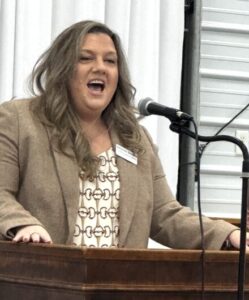
Matthew Hayden mentioned that the rural nature of Southern Kenton County is incredibly important, and it is paramount that the court needs to listen to the people, and if they don’t, the people do not trust the government in any decisions they make.
Sherry Goodridge said that in her perfect world farms would stay farms forever, but in reality there is a lot of that land that is already zoned industrial and she agreed that having a plan in place for what is built where is good for the county and the residents. She said the SRI plan can’t be repealed, but she said she could see the benefits of being able to control what is being built in the county.
Jeff Niceley said unequivocally that he is against SRI as it stands today. He said he came to southern Kenton County to look for farm storage, and ended up buying a farm because it is so incredibly beautiful there. He said this is my home, and these are my people. He said that not because he drove around looking at warehouses, but because he saw the beauty of the farmland. As he found out about SRI he started to learn about it, and he continues to be a strong no on the issue.
The next question involved the future land use plan of Kenton County and how each candidate viewed the land use plan.
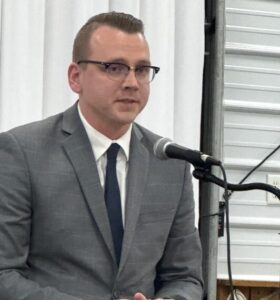
Busse said land use planning is highly important, not only in this county, but also in the entire country, and he deplored when companies would try to change the land use plan for their own use.
Baldridge brought up that many warehouses have been built, but then abandoned. He said that if the companies can’t use those warehouses, fine, they can tear those down, but it is definitely not correct to just put a factory in at the expense of moving people out of the area just to make money. He explained that the county has a huge affordable housing crisis, and possibly the county should take a look at trying to focus on more affordable homes.
Question two for the Republican candidates focused on zoning changes that the fiscal court is tasked with making, and what criteria would the candidate use to rule out zoning applications? Also, how much weight would the testimony from residents and landowners count?
Kimmich said that KRS 100 had specific directions on what leaders can consider on zone changes, but he countered that by saying that any leader who does not consider the human factor is not telling the truth. He said if the infrastructure is not in place already it should not go in. He said he doesn’t believe in using taxpayer money to incentivize and enhance projects if the people have objections. He said listening to the people is paramount.
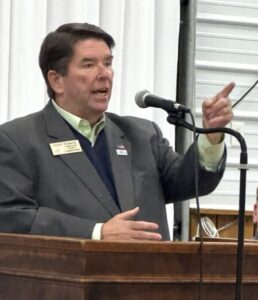
Hayden said if a plan comes before the court, all factors need to be taken into consideration. The plan needs to be opened up to the public, and if that feedback includes major objections, they need to go back to the drawing board. He said if it is done appropriately, it shouldn’t be a problem.
Reckers brought up a problem that members of her family had 32 years ago, where the land was rezoned right out from under them, without due process. She said the zoning is not perfect. It does depend on the Planning and Zoning Commission which is an independent entity. She brought up that there was a gas station that wanted to locate at the intersection of Stevenson and Turkeyfoot, and though the gas station, a WaWa, was desirable, it was contraindicated for that location.
The same question went to the candidates for commissioner for the second district.
Niceley said he thinks the government is the people, and when it comes time for a zoning change, the people have to be listened to. He said he is all for land use, and all for planning, but when it comes down to it, the community has to have input.
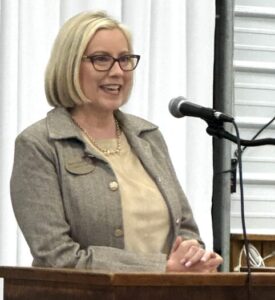
Goodridge agreed that the community input is essential. She said her family was impacted with eminent domain many years ago, and although she knows there are regulations in place that have to be followed, she said she will always, always listen to the people.
Question three was that the fiscal court rarely sees a no vote and would the candidate be willing to be the lone no vote on the court or would they go along in order to get something passed?
Baldridge said he would be very happy to be the lone no vote. He said he frequently has to say no to his stakeholders. He said if something is wrong, he has to say no, and point out the way that is intelligent, and the correct way, instead of going along with things. He also pointed out that public/private partnerships need to be evaluated, and leaders need to be aware that people can be manipulated and their rights need to be protected.
Busse acknowledged that some decisions are going to be good and some decisions are going to be bad. As far as land use, they need to listen to professionals as well as the people. He said he thinks agricultural businesses can grow in this area.
Question three for the Republican candidates was that Kenton County currently dedicated funding to groups like BE NKY Partnership and OneNKY Alliance. Does the candidate support that funding, and would the candidate change the funding?
Hayden said he believes there is a place for organizations like these, to help compile data, and assist lawmakers in making high quality decisions. He said obviously at the end of the day they have to make sure that the decisions that are being made are for the will of the people. It needs to be remembered that they are advisory organizations and they are not the fiscal court, and leaders need to take all data points into consideration.
Reckers said the groups serve a great purpose in the area, and they leverage the information for marketing and strategy on the type of industry for the area, and whether they should come to the area. She said they do serve a good purpose for what they do. She admitted that she didn’t know much about BE NKY, but since the court assigns members to oversee what they do, the courts should definitely have reports from them.
Kimmich said Ronald Reagan once said the closest thing to eternal life is a government program. He said BE NKY started out as Tri-Ed 30 years ago, where each of three counties put up $30,000 and assigned two members to it. They were to improve industry in the area. But Kimmich said these agencies need to be held accountable. For instance, if they received $50,000 one year and want $55,000 the next year, the court needs to see what they did with the $50,000. Those organizations are not the only ones to be held accountable — he said all those who are being funded need to be held accountable. Then the court should make decisions based on the outcomes of those reports.
The same question was asked of the candidates for district two.
Goodridge said she didn’t know the amount of funding although she knew where the funding came from. She said there are advantages to having groups like that advocating for the region helping it grow and thrive, and though they aren’t the end all and be all, they can be a fresh perspective for the community. She said she would look into the matter.
Niceley said that he is in favor of the groups. He said all three counties have to work together on matters, and these groups look out for all three counties, guiding the fiscal courts. He said he is 100 percent pro business, since he is part of a business. He said the new areas in Covington where the Chase Law school, and the UK college of medicine, and the Spark Haus are all coming in, get help from organizations like that.
Question four for the Democratic candidates was the same as question 3 for the other candidates about the BE NKY and OneNKY Alliance.
Busse said he thinks these groups do good work in the areas, but there has to be limitations on the groups and what they do. He said the government has to react to people, and if they don’t, there needs to be changes in government. He said development is necessary, but it has to be good development.
Baldridge said he believes in the work these organizations do and he thinks they are an important part of connecting to the local area and helping government plan. However, he thinks they have an outsized amount of power over what happens. He thinks the county tends to rubber stamp the recommendations the groups make, instead of listening to the people. He said the groups need to be held accountable, and be held in check.
Question four for the Republican candidates and the candidates for district two was the same as question five for the Democratic candidates for district three. Code said all across the country the value of real estate is increasing. The same is true in Kenton County. Of course the county property taxes are assessed based on the value of property. As the values rise, so does the amount the people pay in taxes. Is this rise in value improper? How does the county solve this?
Baldridge acknowledged that it is a problem. He thought creating more housing would be a solution. He said he just had his first child, and bought his first house, and the average age for people buying their first house is in their forties. He compared that to his parents who bought their first house in their twenties. He said there needs to be more supply so that people can buy houses. He said the state is accountable for deciding what people pay for taxes, and even though taxes are important, they should be held accountable.
Busse agreed that housing is part of what society needs. Housing will always be needed. Without taxes there won’t be any society. He said they need to keep taxes low. Pay for social services are very good. Taxes can be used to help people, he said.
Kimmich said the county doesn’t set the tax rate, Frankfort does, based on the assessment in the county. He said the analysis by the association of Realtors tells the county in the first three months the home costs are down 4 percent. Gross sales are down 3 percent. The county has lost $3 million in volume this year. So next year the values are going to be $3 million lower, so the county will have to decide if the services can be maintained without raising tax rates significantly. He said someone has to pay the bill. He also said he will be in Frankfort a lot if he is elected to be the lobbyist for the people. He said they should definitely increase the Homestead exemption to $75,000 statewide for the senior citizens.
Hayden said if he were the king of the world, he would do away with property taxes. He said taxing property into perpetuity effectively makes people renters.He said property taxes affect everybody, but he thinks that the taxes have gone down in the last five years. He promised if he is elected he will continue to enforce policies that reduce the tax rate. He also said they should look at the wealth tax, because that is taxing unrealized gain. He said people can’t sell a piece of their house.
Reckers said she has been part of reducing taxes in Erlanger. She said the argument can be made that property taxes should be reviewed, but more than that, she said the opportunity is there to reduce the insurance premium tax, and they should look at that tax first.
Niceley told the audience that he thinks the tax is way too much as it is and even though the tax has gone down for five straight years, he has a problem with the library and school taxes, as well as the insurance premium tax, and if given a choice, he will come down on the side of lowering taxes every time.
Goodridge said she thinks they pay too much in taxes. As a conservative, she will look for every opportunity to lower taxes. She said she understands that they need money for services, she knows how it works, but she would really like to work with the state legislators to reduce the burden, especially for the senior citizens and the veterans.
The last question involved how to keep the farms going, since this area is designated as prime farmland.
Busse told the people that agriculture is as important today as it will be tomorrow. Ninety percent of farmland is small farmers and government needs to support these small farms. Government needs to help the farms, and be cognizant that the small farms are feeding the country.
Baldridge said that Kentucky is the largest producer of beef this side of the Mississippi. The government should take care of preserving the farms, and keeping family farms as family farms. He said he doesn’t have a solution, but there needs to be ways to protect the family farm and make sure that no program takes advantage of family farms. Farms need to remain autonomous.
The same question was posed to the candidates for the second district.
Goodridge stated that it is vital to do all they can to keep family farms active, to support the rural community and small businesses, which is what family farms are. She said she hopes to keep family farms going for many years to come.
Niceley said family farms are the backbone of the country. He said if we don’t have farms, society can’t exist. It is important to protect family farms so that what people eat can be protected.