













As someone who has been a dog owner and knows the delightful camaraderie that comes with sharing life between best friends, I can’t help but reflect on the magic of a warm afternoon at the dog park. There’s something so effortlessly joyful about watching dogs sprint across the grass as if they’ve just hit the jackpot, while neighbors gather to chat and unwind. In those moments, the simple act of letting leashes fall away seems to transform the city’s park system into a haven for spontaneous happiness and connection.
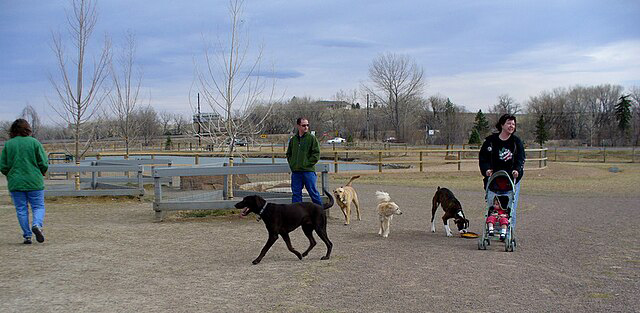
Dog parks are also high distraction environments where unfamiliar dogs interact up close — often at full speed. Picture a toddler birthday party, but with more fur and fewer nap schedules. That combination increases the risk of scuffles, bites, falls, escapes, and illness — and it’s why dog parks are a frequent source of personalinjury claims.
Most serious incidents start at predictable pressure points: crowded gates, tight spaces, toys or food, poor supervision, or a stressed dog that can’t disengage — the canine equivalent of needing a quiet corner at a loud party. When several of these factors overlap, the risk of injury rises fast.
Dog parks concentrate everyday doghandling risks into a faster, noisier, more stimulating space—like turning the volume up and then losing the remote. Common problems include:
• Dog-to-dog conflict. Fights are most likely when dogs mob the entrance, play styles don’t match, or arousal stays high without breaks, where everyone is excited, nobody is listening. A large dog repeatedly bodyslamming a smaller dog—or a dog guarding a ball or water bowl—are common warning signs. When owners miss those early signals or assume the dogs will “work it out” (spoiler: they are not scheduling mediation), minor tension can escalate quickly.
• Dog-to-human injuries. People often get hurt trying to break up a fight—brave, wellintentioned, and usually underequipped. Grabbing collars, reaching into a fight, or stepping between dogs during a higharousal moment can lead to redirected bites. In many cases, the dog had no history of aggression toward people; it simply reacted instinctively in a chaotic situation.
• Disease and parasites. Shared spaces increase exposure to contagious illness and parasites—yes, even when every dog looks perfectly adorable. Bringing a sick dog into the park or failing to pick up waste can put other dogs and their owners at risk.
• Physical hazards and escapes. Broken fencing, worn latches, holes, slick mud, uneven ground, standing water, and poor lighting are more than “maintenance issues.” They’re basically an obstacle course no one signed up for. These hazards commonly contribute to falls, sprains, fractures, and dog escapes—some of which lead to secondary injuries.
In plain language, negligence means failing to use reasonable care under the circumstances. At dog parks, negligence is rarely one single mistake. More often it’s ignored warning signs, known hazards left unaddressed, or repeated rule violations (a.k.a. “the rules are for everyone else”). As a result, responsibility for injuries may fall on different parties, depending on the facts.
When dog owners may be negligent
 Keven Moore works in risk management services. He has a bachelor’s degree from the University of Kentucky, a master’s from Eastern Kentucky University and 25-plus years of experience in the safety and insurance profession. He is also an expert witness. He lives in Lexington with his family and works out of both Lexington and Northern Kentucky. Keven can be reached at kmoore@higusa.com
Dog owners and handlers are generally expected to keep control of their dogs and follow posted rules (the park’s version of “terms and conditions,” but shorter and with more drool). Injuries are more likely to be attributed to an owner when they:
• Bring a dog known to be unsafe in group play (optimism is not a safety plan)
• Fail to supervise or stay engaged (scrolling counts as “handsfree,” not “eyeson”)
• Ignore early signs of escalating behavior
• Allow repeated bullying, mounting, or targeting
• Introducing food or highvalue toys into posted nofood areas
• Cannot recall or leash their dog when conditions change (if “come” only works at home, it’s not a recall)
As an example, an owner brings a dog with a known history of resource guarding into a busy park and throws a ball despite posted rules prohibiting toys (because surely this time will be different). A fight breaks out, and another owner is bitten while intervening. Liability may focus on introducing a known trigger and ignoring park rules.
When the city or park operator may be negligent
Cities and park operators are typically responsible for maintaining reasonably safe premises. Liability concerns often arise when hazards are known—or should have been known—and aren’t addressed within a reasonable time.
Common examples include:
• Broken or inadequate fencing
• Gates that do not latch or selfclose
• Known holes, trip hazards, or drainage problems
• Repeated reports of gate crowding without operational changes
• Poor lighting or sight lines that limit supervision
• Missing or unclear rules and emergency information.
As an example, a park has a documented history of gate latch failures and multiple complaints about dogs escaping. Months pass without repair. A dog escapes and a cyclist crashes while trying to avoid it. In that situation, attention may turn to whether the City had notice of the hazard and failed to act—because “we meant to fix it” is not a maintenance program.
When other visitors may share responsibility
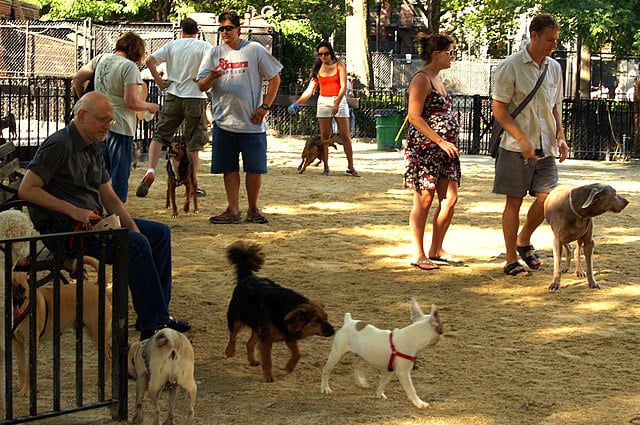
Sometimes liability involves third parties whose actions help create the mess.
Examples include visitors who provoke dogs, bring food into posted nofood areas, allow unsupervised children to run among dogs (small, fast, and squeaky—basically a chase toy), or intervene recklessly during a fight.
Another example whould be a visitor who feeds treats to multiple dogs despite posted rules. Guarding behavior follows, and another owner is bitten while pulling dogs apart. Responsibility may extend beyond the dog’s owner to the person who introduced the trigger.
What typically matters in claims against park operators
While outcomes vary by jurisdiction, dogpark injury claims tend to revolve around the same core questions. So, slip on your imaginary “Attorney Hat” for a moment — adjust the brim, practice your best thoughtful nod and try not to bill anyone for it.
• Duty of care: Who operates the park, and what level of inspection and maintenance is reasonable?
• Notice: Did the City know—or should it have known—about the hazard or recurring issue?
• Response: Was the issue addressed within a reasonable timeframe?
• Foreseeability: Were the risks predictable based on prior incidents or common dogpark dynamics?
• Documentation: Are inspections, repairs, complaints, and incidents logged and dated?
• Risk controls: Were reasonable measures in place, such as double gates, clear rules, and adequate fencing?
Waivers and warning signs may help, but they rarely replace the need for basic hazard control and timely maintenance, for instance a sign cannot, unfortunately, latch a gate.
What typically matters for dog owners
Dog owners are often held responsible when injuries stem from lack of supervision, poor control, or ignoring posted rules; the classics. Practical steps that reduce both injuries and liability include:
• Keep dogs within sight and under voice control
• Interrupt play early and often
• Avoid toys, treats, and crowding
• Leave when a dog is overwhelmed or escalating
• Leash promptly when conditions change
If an injury occurs, exchange information, take photos and document what happened after you’ve made sure everyone is safe. Report bites as required by local law — doing the right thing early can keep a bad day from becoming a long, expensive one.
The fact is across nearly all dogpark injuries, one factor shows up again and again: insufficient supervision. Crowd pressure, constant chasing, and repeated gate greetings push arousal up. Space, shade, movement, and breaks bring it back down. As a dog owner, guest, or visitor, know this: leaving isn’t a failure. It’s one of the most effective safety tools you have, second only to the leash you brought — and actually use.
Dog parks work best when treated like shared public spaces: thoughtfully designed, consistently maintained, and used responsibly. When cities address hazards promptly and visitors supervise actively, the most serious risks — bites, falls, fights, escapes, and preventable illness — drop significantly. Dog parks will never be riskfree. But when predictable dangers are recognized and reasonable care is taken, injuries — and the liability that follows — are far less likely.
Be safe my friends.