








By Michael O’Bryant
Special to NKyTribune
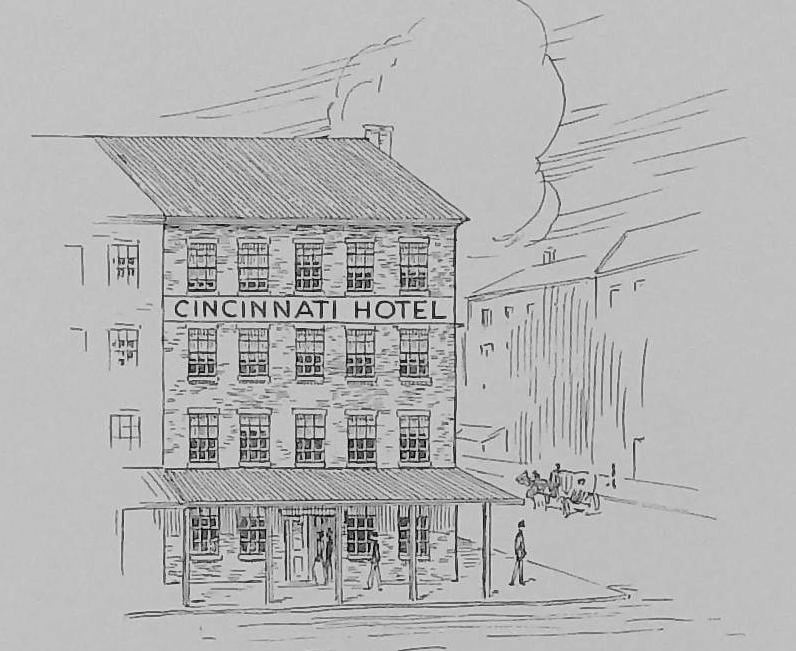
In the 1850s, when Cincinnati had an immense trade with the South, fifty to seventy riverboats often filled the city’s wharf at any time. It was during this heyday of Ohio River traffic that the Spencer House opened in December 1853. The new five-story, four-hundred room hotel cost its builder, John H. Groesbeck, $400,000. The Spencer House was located on the former site of the Cincinnati Hotel on the Public Landing, situated on the northwest corner of Front and Broadway Streets on a lot that was said to have been purchased at one time for a cow, a team of mules, and $1.50.
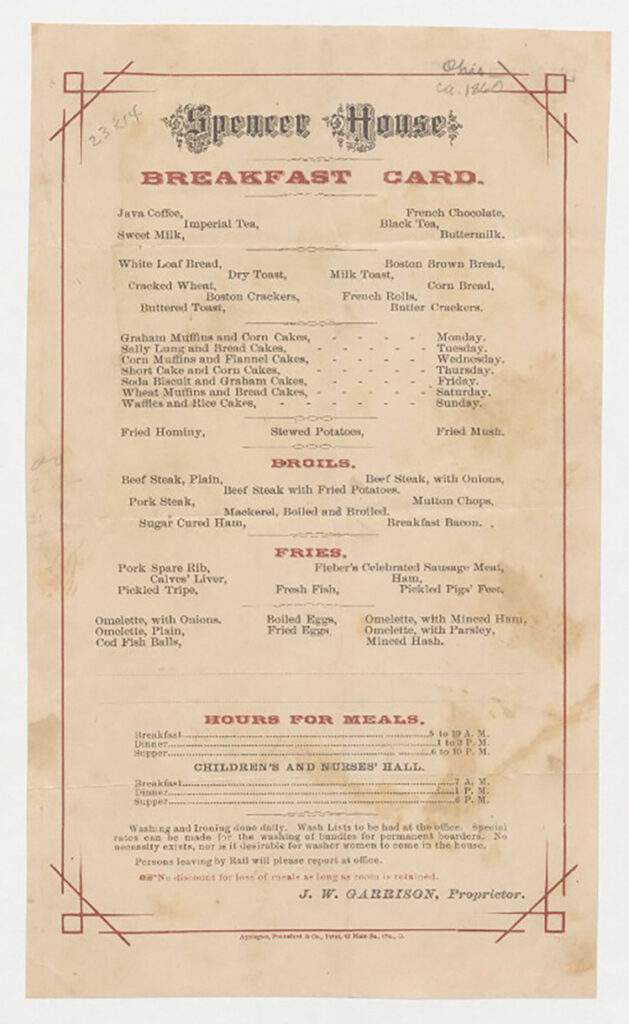
The Spencer House quickly became a favorite place for wealthy southern planters who came with their families and slaves to escape the summer heat. Fashioned in a southern style, it had three large areas where, in the summer evenings, guests promenaded. Its popular spacious balconies overlooked the quietly moving, intricate dance of the river traffic and the lively scenes of the levee.
It wasn’t only wealthy planters who frequented the Spencer House. One of the hotel’s rooms—built to be soundproof — was utilized for gambling. This helped make the hotel a natural stop for the professional gamblers who traveled the riverboats between Pittsburgh and New Orleans.
During the Civil War, the hotel’s reputation as a southern resort brought it under suspicion as being a rendezvous for Confederate sympathizers. Its gambling room was reputed to be a place where the Copperheads (also called anti-war Democrats or Peace Democrats) could plot in secret, earning the hotel a reputation for being the “Copperhead House.” In all likelihood there was at least some truth to the suspicions. C. C. Vallandigham, a famous Copperhead, frequented the hotel and was once arrested there, taken from his room, and placed on a Union gunboat.
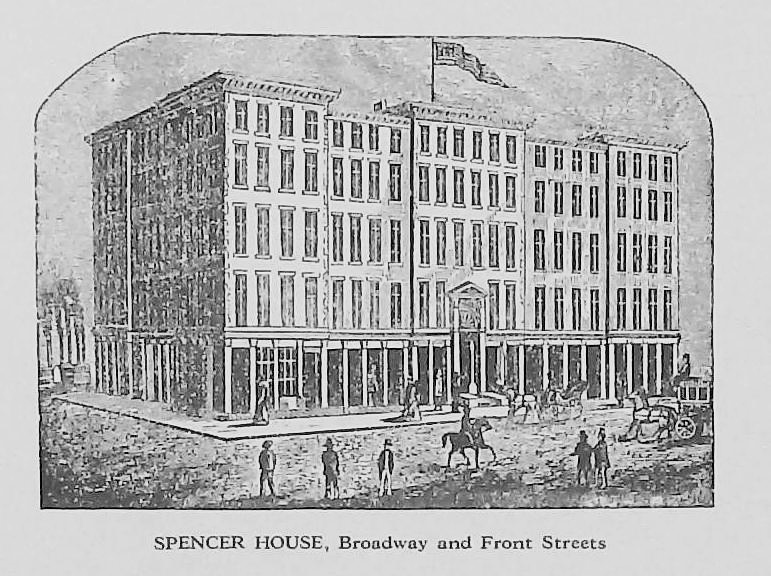
Following the Civil War, the Spencer House briefly retained its reputation as one of the city’s prominent hotels. In 1866 it was the site of a lavish reception for President Andrew Johnson following his impeachment trial. Others entertained at the hotel after the war included Secretary of State William Seward, Admiral Farragut, and Generals Custer and Grant.
One of the more notable events was for General Grant. All of fashionable Cincinnati was waiting on the immense balconies of the Spencer House for his arrival. In front of the hotel, two huge flags were suspended. When the smoke against the sky from the steamer “Robert Burns” (carrying Grant) appeared, the crowd cheered in celebration. That night the Spence House hosted a grand ball in his honor.
Soon after the war, the railroads gained in importance, and river trade slowed. Business had been moving off the levee for years and more modern and convenient hotels were being built uptown as the city was turning its back on the riverfront. The neighborhood around the Spencer House went into decline. The last event of note hosted by the Spencer House was the Ohio Constitutional Convention in 1873–1874.
By the late 1800s, the poor of the city paid $2 to $6 a month to reside in the riverfront district. The Spencer House became a tenement. For a time, it was leased to the Weber Brewery for $1,500 a month. By 1920 an Italian family lived in the rooms where Grant had stayed, and a tobacco factory occupied the ballroom. When the hotel came up for auction, it attracted an opening bid of $15,000. The “Cincinnati Commercial Tribune” reported that the lack of interest moved the auctioneer to tears and for half an hour he tried everything in his power to attract additional bidders. Finally, the original bidder increased his offer to $20,000. Despite a “further gnashing of teeth by the outraged auctioneer,” there was no other bid. For the next decade and a half, the Spencer House limped on as a five-story, brick tenement before it was torn down in 1933.
Michael O’Bryant was born in Dayton, Kentucky, but grew up in Mason, Ohio, when it was still a farming community and the first day of rabbit hunting season was an unofficial local holiday. Earning his undergraduate degree in Education from the University of Cincinnati, he taught at Mason Public Schools, where he was asked to inaugurate their junior high football program. He later moved to the high school level, teaching English and Social Studies. O’Bryant took temporary leave to attend Morehead State University where he served as an assistant track coach and earned his MA. Returning to Mason, he taught and served as an administrative assistant and Social Studies Curriculum Leader. For more than twenty years, he has worked in publishing, including Orange Frazer Press in Wilmington, Ohio, as well as the textbook company Cengage Publishing.
Paul A. Tenkotte, PhD is editor of the “Our Rich History” weekly series and Professor of History at Northern Kentucky University. To browse more than ten years of past columns click here. Tenkotte also serves as Director of the ORVILLE Project (Ohio River Valley Innovation Library and Learning Engagement). For more information see https://orvillelearning.org/. He can be contacted at tenkottep@nku.edu.