











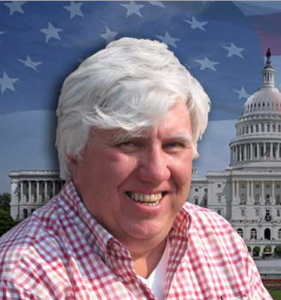
By Paul A. Tenkotte, PhD
Special to NKyTribune
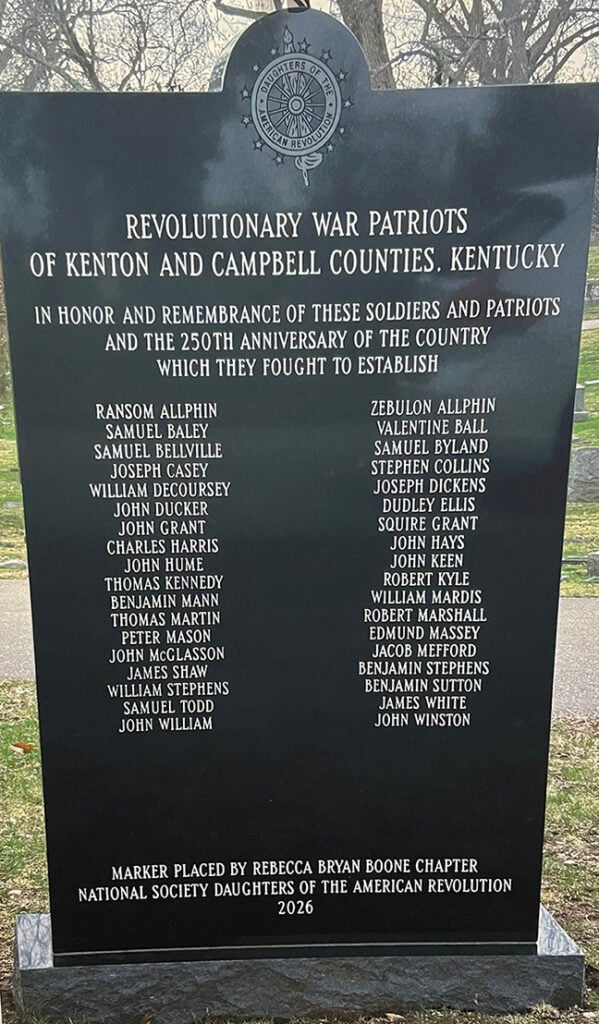
On a sunny Saturday afternoon, March 28, the Rebecca Bryan Boone Chapter of the National Society Daughters of the American Revolution dedicated a 6-foot-tall granite monument in Highland Cemetery, Fort Mitchell. It is engraved with the names of 36 patriots known to have served in the American lines of the Revolutionary War and to have resided within the confines of what is now Kenton or Campbell counties. The list is not meant to be a conclusive one. If more soldiers are discovered within the course of future research, their names will be added later.
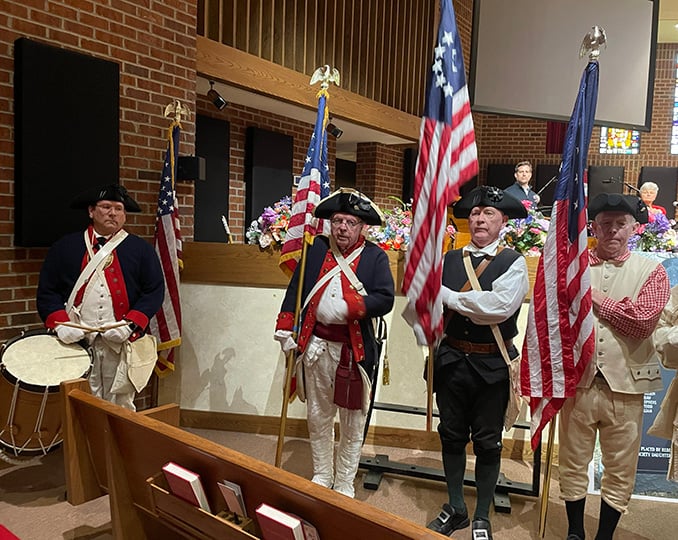
In an impressive ceremony attended by more than 200 and held at Fort Mitchell Baptist Church prior to the monument unveiling, four DAR chapters, the Simon Kenton Chapter of the Sons of the American Revolution (SAR), the State Society of Cincinnati of Pennsylvania, and others participated in an hour-long ceremony. The program featured music, the Presentation of Colors, Floral Wreath Tributes, and a solemn ceremony of the 13 Folds of the Flag. Kathy Dorsey, Regent of the Rebecca Bryan Boone Chapter DAR, was master of ceremonies.
As one of the project’s history experts, I was asked to deliver a short address that summarized the importance of the celebration:
“I am honored to be here today to celebrate with you the dedication of a Revolutionary War monument. I wish to thank the Rebeca Bryan Boone Chapter of the National Society Daughters of the American Revolution for their kind invitation and to recognize them for the important work that they do in our community, documenting our American history, preserving that memory for ages to come, and celebrating the history that unites us as a people and a nation.
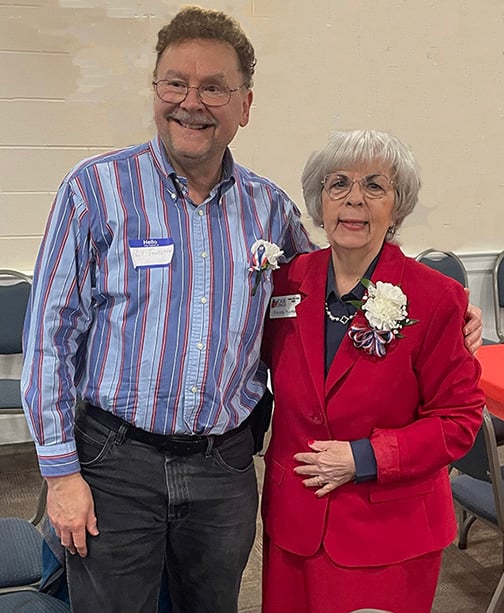
“The 6-foot-tall granite monument that you will dedicate today to 36 Revolutionary War patriots of Kenton and Campbell counties, Kentucky, is testimony to the impressive work that you do. Thank you for commemorating these courageous soldiers. They literally made our celebration of 250 years of freedom possible.”
As I was preparing this talk, I heard a rather classic song on the radio. In 2008 the Zac Brown Band released “Chicken Fried” on its “Foundation” album. The lyrics celebrate the simpler things of life. “Cold beer on a Friday night. A pair of jeans that fit just right.” Then, after mentioning the joys associated with having “the radio up” and “home-cooked food,” the lyrics shift to something more foundational: “We get to enjoy them because others protected the freedom that makes them possible.” At that moment, I have to confess that I succumbed to a very self-righteous attitude. “Really?” I asked myself, “that’s how you describe freedom? Reducing it to a cold beer and jeans that fit just right?”
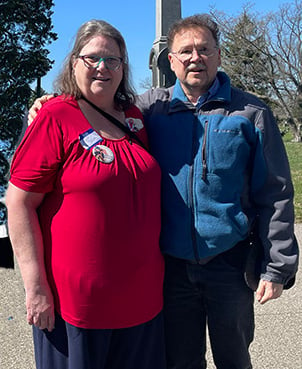
The soldiers who fought in the Continental Army of the American Revolution were placing their lives, their families, their homes, and all that was dear to them in grave danger. Never before — and never since — were the risks higher than they were for those American Revolutionary War soldiers. Under British law, the revolution was treasonous. The king was regarded as the legitimate sovereign of the British Isles and its colonies. Taking up arms against the king was literally high treason.
Had Britain won, or had the imperial army wished to enforce the worst possible legal retributions within its arsenal—captured American soldiers could have been routinely executed, imprisoned, deprived of their properties and businesses, stripped of their basic rights as British citizens, and even exiled abroad. Fortunately, the Americans won. And further, the British government and armed forces —i n hopes of reconciling with the colonists — tried to avoid the full force of the law available to them, not seeking to further embolden and provoke the Americans.
Of course, hindsight is 20/20. The American Revolutionary soldiers did not have a crystal ball in which to see the future. Both the present and the future were highly uncertain. Their freedoms were hanging by a thread. Their lives—and everyone and everything that they valued—were at stake. The odds were against them, facing the most powerful navy in the world and one of the strongest armies.
So, then, what is freedom? Let me try to describe it as best I can:
• Freedom is the strongest influence in the world yet also the most fragile.
• Freedom cherishes truth yet allows those who oppose it to speak freely.
• Freedom seeks to enlarge its embrace yet understands when people choose to celebrate their own cultural uniqueness.
• Freedom prefers diplomacy yet defends its existence when it has exhausted other possibilities.
• Freedom promotes the prosperity of all yet recognizes the limits of human nature.
• Freedom esteems history yet respects those with different perspectives.
• Freedom seeks cooperation yet does not demand blind loyalty.
• Freedom encourages debate yet does not silence its critics.
• Freedom respects all religious beliefs without privileging any.
• Freedom delights in the extension of freedom yet never imposes itself.
• And perhaps most importantly, freedom allows us to live our journeys yet never defines what individual paths we take.
Once again, thank you for the many things you do for our community, especially in this year 2026 — the 250th year of our freedom.
Paul A. Tenkotte, PhD is editor of the “Our Rich History” weekly series and Professor of History at Northern Kentucky University (NKU). To browse more than ten years of past columns, click here. Tenkotte also serves as Director of the ORVILLE Project (Ohio River Valley Innovation Library and Learning Engagement). For more information see orvillelearning.org/. He can be contacted at tenkottep@nku.edu .