








By Michael O’Bryant
Special to NKyTribune
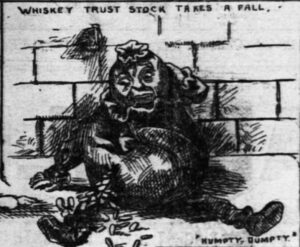
In 1893 the Distilling and Cattle Feeding Company, better known as the Whiskey Trust, became the subject of a U.S. House of Representatives Judiciary Committee hearing into its practices. At the time, the Whiskey Trust controlled distilleries that produced between eighty and ninety percent of the alcohol sold in the United States. Much of it was clear, neutral spirits used for rectifying whiskey, not whiskey aged in a barrel. Cincinnati was a major rectifying center in the United States.
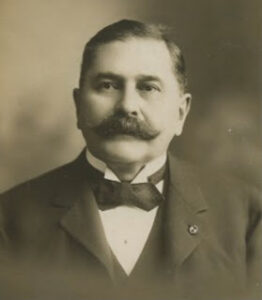
The hearings opened with the testimony of a Cincinnati traveling liquor salesman, James Noble Veazey (1854–1921). Since 1878, Veazey had sold liquor for a variety of companies in Ohio, Kentucky, and Illinois. For several years, he worked for flavoring extract manufacturer and chemist Alexander Fries & Brothers in Cincinnati where, he testified, “I became acquainted with its [whiskey’s] entire manipulation.” It was “the secret of the liquor trade.” For the first two days of the hearing, Veazey told the committee that a dealer could produce any kind of liquor with “five minutes notice.”
“Say an order comes in for any class of goods, say Jamaica rum; Jamaica rum essence is put into [spirits] and it is colored with burnt sugar and the name branded upon it as the law requires it shall be stamped, and away it goes. Say another order comes in for gin, and the spirits is filled out of the same tub, flavored with gin essence, colored with sugar, sirup [sic] then, or glucose, and away that goes. Yes, sir; anything you want, and it is generally in use, and represents to-day one-half of the liquor business of this country.”
On the second day of his testimony, Veazey brought two demijohns of spirits as well as “a number of bottles containing essential oils, essences, etc.” and mixed drinks for the committee. He began by adding a drop of Jamaican rum essence, some coloring, along with maple syrup to the neutral spirits. Then he poured his concoction into tumblerfuls and passed them out to the congressmen.
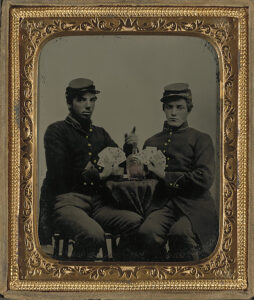
“Does it smell like rum and taste like it?” he asked them. He went on using other essences, prune juice, and raisin oil to make drinks that tasted like rye whiskey aged in charred oak barrels for three, five, and thirty years. The result from the demonstration was a product that as Veazey testified, “The average man’s unable to protect himself, not understanding these imitations . . . at the time of purchase . . . falsely represented to him.”
What Veazey produced for the congressmen was “directly related if not chemically identical” to what occurred in the natural process. It had the advantage of being more efficient and cost effective than producing whiskey traditionally. Congress disagreed. Despite the scientific evidence, they felt there was something about the process of producing whiskey by using additives which seemed second-rate.
At the conclusion of the hearing, Veazey was recalled for additional testimony. He reported that the kinds of alterations he described earlier did not improve any liquor product. He went on to give the opinion that if it were up to him, he would abolish the issuing of licenses to rectifiers and make it a felony to use the products he demonstrated. He added that an aging period of five years should be required for all whiskey.
The U.S. House of Representatives produced a report on the hearings, but the end of the 52nd Congress was quickly approaching its end. The report was laid on the table, and no further action was taken. Because the Sherman Antitrust Act had only been enacted three years earlier, Congress did not yet have the necessary political motivation or legislative resources to proceed. In addition, bad press against the Whiskey Trust had already weakened it.
While Veazey’s testimony helped curb the Whiskey Trust’s practices (at least for a while), what wasn’t clear is what motivated a man who for many years sold and promoted the items and practices he testified against. The answer came years later when Veazey sued New York stockbrokers Henry Allen & Company for a million dollars.
Reviewed by a referee at the trial court of the New York Supreme Court, Veazey’s case was dismissed, but he subsequently appealed it to the New York Supreme Court’s Appellate Division, which upheld the referee’s dismissal. Finally, Veazey appealed the case to the Court of Appeals of the State of New York in “Veazey v. Allen” (1903).
In the appellate court case, Veazey claimed that Allen owed him money because he had helped to inaugurate the Judiciary Committee investigation into the Whiskey Trust. He stated that he had consented with Allen & Company to bring about an investigation for the purpose of causing the stock of the Distilling & Cattle Feeding Company to drop. In an example of short selling, Allen & Company’s plan was to borrow shares of trust’s stock, then sell those shares in the open market. Then, following the hearings that Veazey helped initiate, the trust’s stock would drop. Allen & Company would subsequently buy the shares back at a lower cost. The company could then return the stock, pay some interest and keep the profits. Veazey’s contract stated that, for his efforts, he was to receive fifty percent of the profits, which according to Allen & Company, amounted to $6,237.81. Veazey thought it should be more and sued.
The Court of Appeals’ ruling clarified the fine line of the case between legal and ethical behavior:
“That such a contract is one which, in its object, operation and tendency, is calculated to be prejudicial to the public welfare, ought not to be doubted for a moment. Why? Not because the plaintiff was in fact necessarily dishonest or corrupt in instituting and prosecuting the investigation; nor yet because the charges preferred against the offending corporation were not true, but because the plaintiff voluntarily acquired a pecuniary interest in the result of the investigation, which might subject not only him, but through him others, to the temptations and allurements which human experience has proven to be potent in sacrificing sound morality and honesty to that greed and cupidity which not infrequently beget perjury, bribery and other moral delinquency, incompatible with the public weal” (“Veazey v. Allen,” https://www.casemine.com/judgement/us/5914cf15add7b0493481ef76)
Trusts, manipulation of the stock market, and short selling of stocks were more common practices in the late 1800s than generally studied in American history. In an economy growing by leaps and bounds, greed afforded the opportunity to make money at the expense of others. The Gilded Age, as it was called, was aptly named.
Michael O’Bryant was born in Dayton, Kentucky but grew up in Mason, Ohio, when it was still a farming community and the first day of rabbit hunting season was an unofficial local holiday. Earning his undergraduate degree in Education from the University of Cincinnati, he taught at Mason Public Schools, where he was asked to inaugurate their junior high football program. He later moved to the high school level, teaching English and Social Studies. O’Bryant took temporary leave to attend Morehead State University where he served as an assistant track coach and earned his MA. Returning to Mason, he taught and served as an administrative assistant and Social Studies Curriculum Leader. For more than twenty years, he has worked in publishing, including Orange Frazer Press in Wilmington, Ohio, as well as the textbook company Cengage Publishing.
Paul A. Tenkotte, PhD is editor of the “Our Rich History” weekly series and Professor of History at Northern Kentucky University (NKU). To browse more than ten years of past columns, here.
Tenkotte also serves as Director of the ORVILLE Project (Ohio River Valley Innovation Library and Learning Engagement). For more information see orvillelearning.org/. He can be contacted at tenkottep@nku.edu.