














By Howard Whiteman
Murray State University
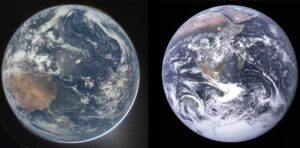
Half a century ago, three astronauts took a long look at the Earth from space on their way to the moon. A month ago, four astronauts did so again, the first time humanity experienced being that far away from the planet since the Apollo missions ended in 1972.
The photographs that both missions took show a fragile blue and white orb alone in the vastness of space, a reminder that no matter what our differences, all of us on the planet, from bacteria to humans, have the same shared home.
But when the Artemis astronauts splashed back to Earth, they returned to a very different planet than any of the Apollo astronauts did, one that a photograph cannot possibly reveal.
In 1972, the human population on Earth was 3.84 billion. Now, we are over double that — 8.14 billion and growing. The estimated carrying capacity of the planet, the number of humans that the Earth can maintain, varies widely, but been estimated between 8 and 12 billion. Some scientists believe that we can continue to increase the carrying capacity with technology, as we clearly have in the past, for example by growing food more efficiently. However, given we live in a finite world, it is unlikely we can continue that trend much longer. At some point, given our current population growth rate, we will surpass our own carrying capacity — and maybe we already have.
The evidence that we are closing in on our carrying capacity surrounds us. As our populations approach that threshold, basic resources have become scarce, including the freshwater we need to survive. Drought and famine are common, and food insecurity is rampant throughout the planet. We fight over oil, water, and the movement of people seeking more abundant resources. None of these things would be happening if we were not approaching our carrying capacity.
Although our population growth and resource use has had many effects on the planet, the greatest of these is how we have changed the atmosphere. Carbon dioxide concentrations have increased 31% since the last Apollo astronauts returned, producing a new atmosphere of greenhouse gases that have made the planet that the Artemis crew came back to a bit over 2 Degrees F warmer than the world that the last Apollo crew called home.
We have all experienced the effects of our warming planet. Droughts and wildfires, violent storms, melting ice caps and glaciers, sea level rise, and changes in ocean currents are all consequences of our greenhouse gas production. Species of every kind, including humans, are migrating — if they can — to find cooler, more hospitable environments like the ones they had when the last Apollo capsule came home.
The photos might look the same from space, but the planets, separated by 50 years, could hardly be more different. But how much different will Earth be in the future, when Artemis, like Apollo, finally ends? What will the world be like in 2046, when that last Artemis crew returns home?
If we continue to grow the way we have in the past, there will be 9.5 billion humans competing for even fewer resources. With our inability to control our addiction to fossil fuels, greenhouse gas concentrations will continue to rise, and we can expect warming of another 0.7 to 1.8 degrees F, triggering even worse drought, fires, storms, and sea level rise, that will continue to get worse for generations to come.
Now imagine if we projected another 50 years, the time since Apollo ended, rather than just 20.
The global changes we have seen since Apollo and the projections for just the next two decades, are why we must change course now and not wait another second. Since the Apollo program, we have passed environmental laws like the Clean Air and Clean Water acts, signed climate change treaties, and promoted alternative energy. We are better at creating biodegradable waste and recycling than ever before. Was it enough? Unfortunately not. Why?
Our culture didn’t change. We made incremental improvements to how we affect our environment, but we didn’t control our population growth and we have continued to consume our finite resources at an exponential rate. We can’t recycle our way out of a culture that always wants more; we have to change the culture of growth and consumption.
Making such a change will take time, and yet we have little to spare. When populations start growing, it takes time to slow them down, because all of the children born today create an inherent time lag for population growth—they won’t mature for years. Climate change is similar, because the concentrations of greenhouse gases we have already added will continue to warm the planet for decades, unless we can learn how to clean the atmosphere.
In this way, our culturally-induced population growth and resource use, and the climate change we have produced, are like the rockets that took the Apollo and Artemis astronauts to the moon. No matter how much we would like to, you can’t stop them on a dime because of the inertia their movement creates. Our environmental problems are a space ship that is currently hurtling out of our control into the abyss of space, one that our children, grandchildren, and their ancestors will inherit from us.
Imagine being astronauts that are arguing about how quickly they should slow down their ship, or whether they should slow it down at all, as it hurtles deeper and deeper into space, with only limited resources available on board. That is where we find ourselves today on Spaceship Earth, whether we like it or not.
As a human society with one planetary home, we need to come together to face the problems we have created for ourselves. We need to make the cultural changes needed to limit our populations, reduce our consumption, and particularly reduce our carbon footprint. We also need to find ways to change our planet’s atmospheric chemistry, not to how it was when those final Apollo astronauts returned, but further back, perhaps to when the Industrial Revolution started, because that is when we launched the climate change rocket.
All of that may sound like science fiction to some, but so did space travel just a few generations ago, a problem we solved because we invested our hearts, mind, and treasure into it. As I tell my students, we already have the solutions to all of our environmental problems. From birth control to sustainable agriculture to alternative energy, we could make the world a very different, and better, place when the final Artemis mission comes home. What we have always lacked has been the courage and leadership to do so.
I suspect that there is a time in the near future when we will be forced to figure out a better path forward, if we do not choose one now. I only hope that it doesn’t take another half century to realize that no matter how much we think our planet looks the same from space, humanity continues to change the Earth beyond recognition. Let’s not only hope, but work to promote the changes that need to be made now, so when that final Artemis crew comes home, Earth is a better, not worse place to call home.
Dr. Howard Whiteman is the Commonwealth Endowed Chair of Environmental Studies and professor of Wildlife and Conservation Biology at Murray State University and an occasional columnist for the NKyTribune.