












By Isabella Schultz
NKyTribune reporter
A recent Thomas More University alumna is discovering the way for how food can have an effect on the immune system of humans.
During the fall semester of the 2025 school year, incoming medical student MaryKay Birtcil started to work on a research project about how amino acids affect the human immune system on the gene expression level. She later went on to name this research of hers, the “Effect of L-Ariginine on Gene Expression in Human Macrophages.”
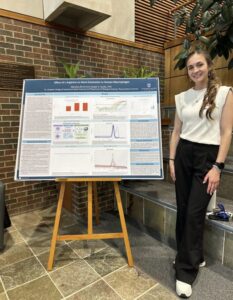
Working with Dr. Joseph Qualls of then Thomas More University and now Xavier University in the immunology lab, or “Qualls Lab”, she discovered how the pro-inflammatory cytokine, Interleukin-6 (IL-6), produced by macrophages, responded to infections.
“Big picture, the idea is that maybe the food we eat can have an impact on our immune system,” said Birtcil. “The nutrients we put in our bodies can help those cells. And so I was looking at the macrophages at the gene expression level. . .When I gave the cells arginine, they were actually producing more of a gene called IL-6, which is essentially just an inflammatory marker that tells us the macrophages are finding an infection.”
Birtcil presented this information at Thomas More University Research Forum in April of 2026, where she explained in her conclusion that her research was not totally complete by then and that she still had a piece of the puzzle missing. She mentioned how she strived to be the first Thomas More University student to use a machine called the real-time PCR machine.
A real-time PCR machine is a way for researchers to make copies of molecules such as DNA and RNA.
In addition, the real-time PCR machine Birtcil used at Thomas More University was donated by St. Elizabeth Healthcare for the university’s students to expand their knowledge on topics such as Birtcil’s research on molecular biology.
“I ran my experiment one more time, so from the time that I actually was at school every day from finals till before graduation, finishing my research,” said Birtcil. “The day before graduation, I ran my last test on the real-time PCR machine. And I’m, so far, the only student at Thomas More that has used it…. I can look at the genes in the cells that I extracted RNA from. I don’t think there was a significant difference yet with the arginine, but the experiment definitely worked because cells that weren’t infected didn’t produce IL-6, which is what we want to see.”
As Dr. Joseph Qualls starts in his new role at Xavier University, he can also take Birtcil’s research and have current medical students at the university expand on it themselves while also using her data and notes. While this research project was important for how Birtcil grew as a researcher, she knew that she wanted to grow in learning more about sustainability outside of Thomas More University.
In December of 2025, she had an idea for a patent for food packaging and how to prevent food waste.
“I was thinking about how quickly shredded cheese goes bad after it’s opened, and so I just kind of racked my brain for ideas,” said Birtcil.
Since she figured out what all her patent entailed, she began to learn how to correctly file for a patent through USPTO so that she could now own her own idea, license it, and reach out to companies about using it.
Through Thomas More University, Birtcil has been able to connect with other alumni who work in companies that handle sustainability and reach out to them about potentially using her patent.
“The cool thing is that Thomas More alumni services have connected me with a lot of people who are in positions that could make some sort of change in their companies,” said Birtcil. “So it’s just been a process of getting to meet with people, set up those meetings, and see where it goes.”
Birtcil hopes to take this patent with her and expand on it while she is in medical school, where she hopes to learn more about cellular and molecular biology and how her research can help others.