
















By Patricia A. Scheyer
NKyTribune reporter
The Committee on Form of Government Transition in Covington met last week to fine tune a final report on their progress to submit to the Mayor and Commissioners.
The idea to change Covington’s form of government from the current Mayor/Commission form to a Mayor/Council form was first introduced two years ago, and the issue was placed on the ballot for residents to decide. The result was that 61 percent of the city’s population thought it was a good idea to change the form of government.

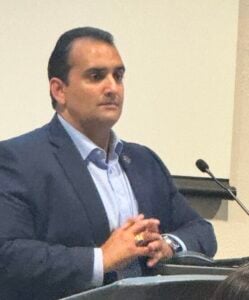
“This doesn’t happen very often, changing a form of government,” said Sebastian Torres, Director of External Affairs and Senior Counsel for the city of Covington. “There is a lot involved in a change like this, but ultimately the people thought it would be better for the city.”
The committee consists of residents Michael Beeby, David Davidson, Ginger Dawson, Ella Frye, Billie Mocabee-Kegley, Fritz Kuhlmann, and Angie Taylor. Present but not voting were Mayor Ron Washington, Sebastian Torres, CAO Sharmili Reddy, Attorney Frank Schultz, and City Clerk Susan Ellis.
The discussion on code review included rules directly from the Fire Chief. One of the items was regulating fireworks stands, and several other issues that hadn’t been a problem before, but are rules that the fire chief wanted to tighten up. They talked about Park rental, and how taxes are administered.
Another issue was whether to take out a chapter of the rules that dealt with pay phones in the city, and the committee voted to take the entire section out because it had been rendered obsolete by the extensive use of cell phones.
“The committee has already decided on how many council members we will have, and that number is 6,” said Torres. “The current 4 commissioners are not automatically in line for the council positions. One commissioner is not running, but the other three will be on the ballot in November. I believe we might have 9 people running for the six seats, but I am not sure.”
The commissioners who are on the ballot are Tim Acri, Tim Downing and James Toebbe.
The schedule for the committee to meet was on the list for December 2 at 5:30 p.m., but members of the committee wanted another meeting. Mayor Washington agreed to set a meeting for August, and he said if they didn’t need it they could always cancel it.
Subcommittees were set up to work concurrently with the committee because Torres said there were so many issues that were incredibly big, they needed the subcommittees to sort out the finer points and then report back to the larger committee.
Changing a government from a commission to a council shifts the balance of power. In Kentucky, the rules to change the government are regulated by KRS 83A.160, and it creates a clear separation between an executive mayor and a legislative council.
The legislative duties of passing ordinances, levying taxes, and adopting budgets are strictly managed by the new council, while the mayor becomes the chief executive, taking care of day-to-day administration, overseeing personnel, and having veto power over council legislation.
The corporate identity of the city does not change, and all the city ordinances, resolutions and orders stay in effect unless they are repealed, or modified in some way by the new council.
The KRS also specifies that once the form of government has been changed in any given city they are restricted from changing it again for 5 years.
“It is important to direct the accountability for every little thing within this new form of government,” said Torres. “I think it is a win for the people.”