














By Paul A. Tenkotte, PhD
Special to NKyTribune
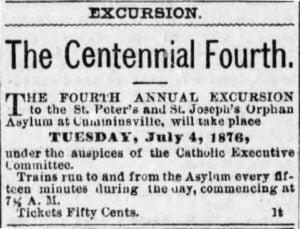
On July 4, 1876 — the centennial of the signing of the Declaration of Independence — residents of Covington, and the surrounding area celebrated in style. Flags furled from houses and shops, as citizens awoke early to participate in the activities.
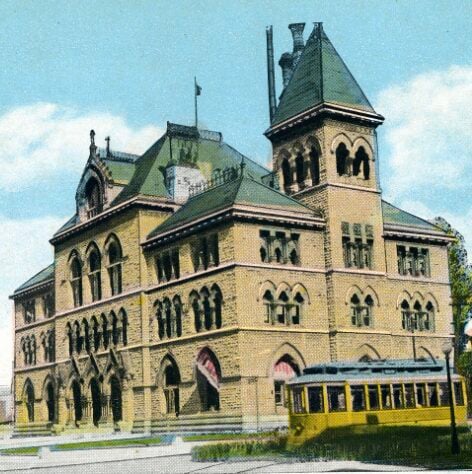
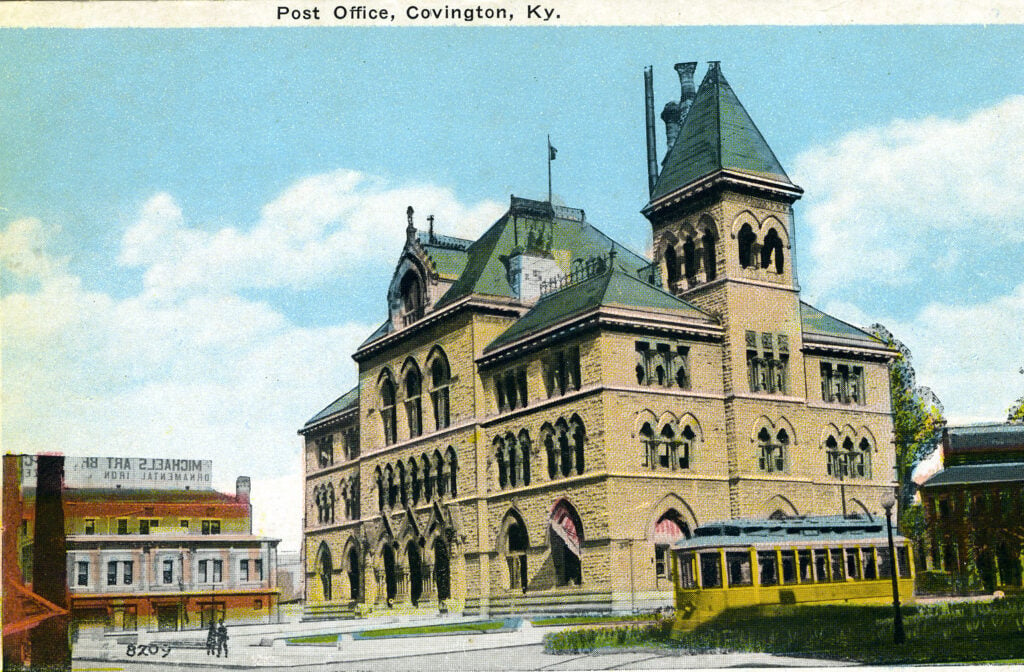
At 9 a.m., a long parade began, winding its way throughout the city. Two bands played music, while political officials, government employees, residents, fraternal organizations, and the police, fire, and waterworks departments marched to Third and Scott Streets. There, officials laid the cornerstone of Covington’s new United States Courthouse and Post Office (“How She Celebrated the Centennial—Speeches, Music and Other Pleasantries,” “Cincinnati Daily Enquirer,” July 5, 1876, p. 8).
Next, the crowd processed to Park Place Grove at the corner of 4th and Garrard Streets near the Newport and Covington Suspension Bridge across the Licking River.
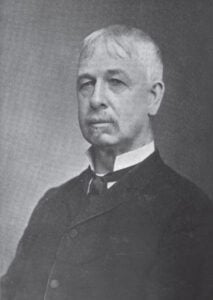
After an opening prayer and a reading of the Declaration of Independence, “Honorable William E. Arthur” delivered a long address. Facing “impending inclemency of the weather,” the festivities ended with the audience singing the national anthem, accompanied by a band and the booming of a “large cannon.” Postponed by rain, historian Richard H. Collins delivered a history of the city and county indoors at the Odd Fellows’ Hall at Fifth and Madison in the evening. That evening also featured bonfires and fireworks.
Speaking at the cornerstone laying, William E. Arthur (1825–1897) defined history as “philosophy teaching by example,” underscoring the need to present history as truth, realizing that while our American heroes were “idealized, no doubt,” that nonetheless they were “real.” The was “no mirage to obscure — no optical illusion to deceive” (“The Fourth! Covington Centennializes,” “The Commonwealth,” July 6, 1876, p. 1).
To Arthur, history was a progression forward, a “functional mass of causes and effects,” a “forward march,” yet one marked by “obstacles and disasters.” He quoted medical doctor, scientist and historian John William Draper (1811–1882), who in his 1863 book “A History of the Intellectual Development of Europe,” claimed that “Empires are only sand-hills in the hour-glass of Time; they crumble spontaneously away by the process of their own growth” (John William Draper, “History of the Intellectual Development of Europe.” New York: Harper & Brothers, 1863, p. 13).
Arthur’s speech reflected his familiarity with Draper’s philosophy. Reprinted in 1875, Draper’s book was popular at the time, engaging American readers who had just experienced the horrors of the Civil War. Impermanence was on many people’s minds, and most certainly that was the central theme of Draper’s work:
“A nation, like a man, hides from itself the contemplation of its final day. It occupies itself with expedients for prolonging its present state. It frames laws and constitutions under the delusion that they will last, forgetting that the condition of life is change. Very able statesmen consider it to be the ground object of their art to keep things as they are, or rather as they were. But the human race is not at rest; and bands with which, for a moment, it may be restrained, break all the more violently the longer they hold” (Draper, p. 13).
Tracing the history of the American Revolution, the French Revolution, and the Napoleonic Era, Arthur underscored how events could unfold unexpectedly and rapidly, destroying old forms and replacing them with radical new ones. In terms of Africa, he shared the racist perceptions of his day, viewing it as the “pariah of continents and the unresurrected [sic] dead body of a civilization debauched and lost” (“Commonwealth,” p. 1).
According to Arthur, Asia — with its “senile system of absolutism” — was already falling “under the control of Great Britain and Russia, and many flourishing settlements have been made there by the French, the Portuguese and the Dutch.” And in a condescending manner, he declared that Asia had “originated” “incantations and sorceries, in forms of perverted conscience and unhallowed faith; hindooism [sic], pantheism, Buddhism, monotheism, dualism, Mohammedanism, babism and other mysteries and rites, which, in the sacred name of religion, have enslaved and destroyed whole generations past.”
Likewise, Arthur criticized our southern neighbor, Mexico, claiming that it was “the spoiled child of nature, and the mockery of men.” There, Arthur proclaimed, “all the frantic races, with their inherent vices of dissension, war, and rapine, amalgamated into that fruitful progenitor and propagator of revolutions, the Mexican of the nineteenth century.”
In complete contrast, Arthur proclaimed that the United States formed a “civilized continent” — a “continent of free states in the bonds of peace, and let me say, in the communion of love, in the uninterrupted enjoyment of all the stupendous results of the American system of liberty and order.” Unlike other nations and empires, however, Arthur claimed that our nation was built upon “truths” that “are not of the forms which vanish,” but are inseparable from “immutable” laws (“Commonwealth,” p. 4).
Arthur’s vision of a “communion of love” was, of course, far removed from reality. Even so, the hypocrisy embedded in his argument—coming directly after his long, patronizing catalog of the supposed inferiority and childishness of most of the world’s peoples—was likely lost on his audience.
Newspapers recorded that his speech was well received. Many of those who heard him would have likely shared his views about non-Christian, Asian, Black, and Brown empires and nations whose imagined decadence and limited understanding of capitalism contrasted with the liberty and prosperity of the United States. Already, the roots of U.S. exceptionalism — with its concomitant doctrines of racial, religious, and economic superiority — had set roots in Covington.
However, the handwriting was already on the wall. By July 1876, the Reconstruction Era had become unpopular, as “Redeemers” — a southern coalition of Democrats — sought to regain political control of their states. They wanted to remove Republican power in the South, including both their “scalawag” Southern supporters and their Northern “carpetbaggers.”
Arthur himself was a Democrat, serving as commonwealth attorney and later judge of Kentucky’s Ninth District. In 1871 he had been elected to the U.S. House of Representatives from the Sixth Congressional District in Kentucky, serving until 1875. His stance on Reconstruction has not been preserved in the historical record.
Just four months after Independence Day, Americans went to the polls to choose between Rutherford B. Hayes, the Republican governor of Ohio, and Samuel J. Tilden, the Democratic governor of New York. For a variety of reasons, the contest became one of the most disputed elections in U.S. history. In the political settlement later known as the “Compromise of 1877,” a congressional Electoral Commission ultimately awarded the presidency to Hayes. In return, Hayes withdrew the remaining federal troops from the South, effectively ending Reconstruction. The former Confederate states soon became reliably Democratic, and the Jim Crow era ushered in widespread Black disenfranchisement. The nation retreated from the promises it set forth in the Declaration of Independence.
Paul A. Tenkotte, PhD is Editor of the “Our Rich History” weekly series and Professor of History at Northern Kentucky University (NKU). To browse more than ten years of past columns, click here. Tenkotte also serves as Director of the ORVILLE Project (Ohio River Valley Innovation Library and Learning Engagement). For more information see https://orvillelearning.org/. He can be contacted at tenkottep@nku.edu.