










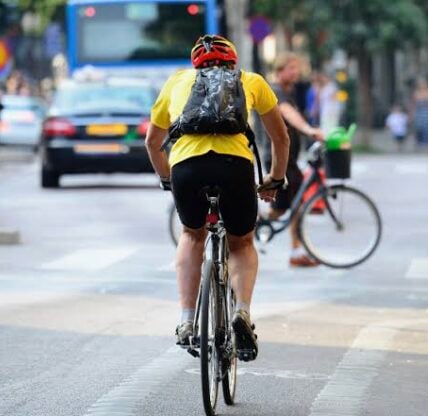


Pedestrians and cyclists make up a small share of traffic crashes in Greater Cincinnati, yet they account for a far larger share of serious injuries and fatalities, according to a new study from the Ohio‑Kentucky‑Indiana Regional Council of Governments.
“People walking and biking are involved in a small number of crashes, but the consequences are far more severe for them,” said Elizabeth Niese, Ph.D., OKI senior data analyst and author of OKI Vulnerable Road User Crash Analysis 2015-2024. “Our analysis shows that speed, lighting and roadway design strongly influence whether someone survives a crash.”

The study examined ten years of bicycle and pedestrian crash data across the region. It reviewed the most recent records from ODOT, KYTC and INDOT and focused on incidents occurring within the eight counties that make up the OKI region.
Although vulnerable road user (VRU) crashes accounted for less than 2% of all crashes each year, they made up roughly 12% of all fatal and serious‑injury crashes. Overall, about 2% of motor‑vehicle crashes resulted in a fatal or serious injury. By contrast, nearly 20% of crashes involving pedestrians or cyclists had severe outcomes.
Census tracts with high shares of households without vehicle access account for 18% of the region’s population but 42% of fatal and serious VRU crashes. Higher crash rates also occur in areas with more older adults, people with disabilities and low-income households.
OKI serves nearly 2.2 million tristate residents and is responsible for prioritizing federal transportation funding and long‑range transportation planning. Its member counties include southwest Ohio (Butler, Hamilton, Warren and Clermont), southeast Indiana (Dearborn) and northern Kentucky (Boone, Kenton and Campbell).
Niese said the report is designed to help “OKI communities identify safety concerns and reduce deadly crashes, which is consistent with the Federal Highway Administration’s Vision Zero goal of eliminating traffic fatalities.”
During the ten‑year period (2015–2024), the region recorded 1,727 bicycle‑involved crashes, resulting in 29 deaths, and 6,117 pedestrian‑involved crashes, resulting in 259 deaths.
Since the COVID‑19 pandemic began in 2020, serious bicycle crashes have increased. Serious pedestrian crashes declined in 2019 and 2020 but have since remained higher than pre‑pandemic levels.
Most crashes involving pedestrians and cyclists were between 3 p.m. and 8 p.m., when traffic volumes are high and visibility drops at dusk. Pedestrians also saw elevated crash rates during the morning commute.

An analysis of crashes occurring between 6 p.m. and 8 a.m. found that while most nighttime VRU crashes happened on roads with streetlights, better lighting was associated with less severe outcomes. On roadways with fewer than 16 streetlights per mile, 27% of VRU crashes resulted in a fatal or serious injury. Where at least 53 streetlights per mile were present, that figure fell to 15%.
“What we see in the data is that lighting doesn’t necessarily prevent crashes, but it does play a meaningful role in how severe those crashes become,” Niese said. “When roadways are better illuminated, drivers and vulnerable road users have more time to react, and that additional visibility can be the difference between a minor injury and a life‑altering one.”
But among all factors, vehicle speed remains one of the strongest factors influencing pedestrian and cyclist safety. When a pedestrian is struck by a vehicle traveling 25 miles per hour, there is about a one‑in‑five chance of a fatal or serious injury. At 35 miles per hour, the risk increases to 50%.
Similar patterns exist for bicycle crashes, but the speed of the bicycle adds additional risk. E-scooters and E-bikes are not identified separately from pedestrians and bicycles in crash reports, but the higher speeds of these devices elevate safety risks.
“The faster a vehicle is moving, the more dangerous the outcome becomes,” Niese said. “Even small increases in speed sharply raise the risk for pedestrians and cyclists, which is why high‑speed corridors remain such a critical safety concern.”
Local streets make up more than 70% of roadway miles in the region but experience fewer serious pedestrian and bicycle crashes. Arterial roadways — major roads that carry high volumes of traffic at higher speeds and connect different areas of a city — make up only about 10% of roadway miles but account for roughly 50% of all fatal and serious VRU crashes.
“The data make it clear where change can have the biggest impact,” Niese said. “Slowing traffic, improving lighting and investing in safer arterial roads — especially in communities that rely most on walking and transit — can significantly reduce serious injuries and deaths.”