

















Age is just a number — like your Wi-Fi password, nobody really needs to know it. What matters is how you feel, not how many candles you can fit on a cake without starting a fire hazard.
At my age I view wrinkles are just laugh lines in disguise, but when it comes to ladders my perspective has changed over the years.
Earlier in life as a natural born risk taker, heights and ladders never once concerned me, and like many people I had a my fair share of some minor incidents falling off of a ladder or missing a step and I would bounce back up like a rubber ball, being more worried if anybody saw the mishap than the bruise it may have left.

But after decades in the insurance industry I have come across my fair share of ladder incidents some of the severe and fatal, changing my perspective realizing that gravity is not just a good idea—it’s the law. And it’s always bringing us down.
The law of gravity is just proof that the universe wants us to be grounded and what goes up must come back down, and often times with a big thud.
Statistics don’t lie — especially when it comes to ladders. Every year over 500,000 people are treated in the US emergency rooms yearly from ladder-related injuries, and around 300 people die annually from these type of accidents. Yes the height of your fall will factor in to your survivability from a fall of a ladder. So before you think you’re safe sticking to step stools, remember that 35 deaths occur annually from falls from step stools.
Statistics have no sense of humor, but ladders sure do — usually at our expense. If numbers could talk, they’d probably say, “Gravity always wins.
Now that I have your attention, its important to note that age plays a factor in these statics as the older you are the higher the probability of a ladder accident.
As people age, physiological changes increase ladder fall risk. Declines in balance, proprioception, and vision impair stability and depth perception. Muscle loss and slower reaction times reduce the ability to recover from slips, while joint stiffness limits movement.
Cognitive changes affect attention and hazard awareness. Additionally, reduced bone density means injuries from falls are more severe. Together, these factors make older adults more prone to accidents and serious harm when using ladders.
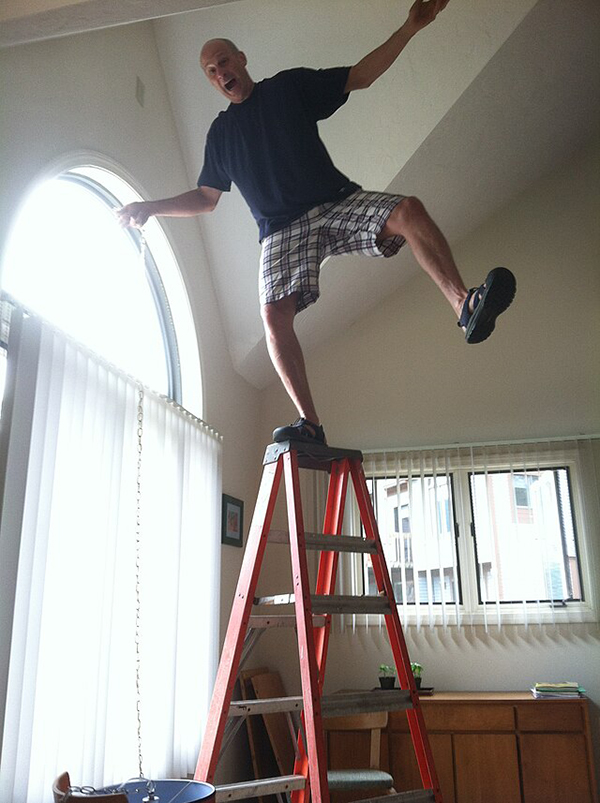
Most of us will use a ladder to accomplish tasks around the house, whether that’s hanging up photos, placing or removing off of shelving, changing light bulbs, hanging holiday decorations, fixing cleaning gutters, or dusting ceiling fans.
So the question is, what is the best age to stop using a ladder or encourage that family member to start delegating or hiring such work out?
It really depends on the individual. However, some factors, like underlying health conditions and mobility issues, should be taken into account when making this decision.
It’s really a case-by-case situation. Some folks are still climbing ladders like Olympic athletes, while others should probably stick to ground-level. But if your knees sound like popcorn in the microwave, maybe its time to let someone else hang those holiday lights.
So, it really depends on the individual. If you’ve got health conditions or mobility issues, it might be time to pass the torch — and the step ladder — to someone else.
When it comes to using a ladder as you age into a senior citizen, there are some considerations and precautions you’ll want to keep in mind.
Ladder Setup Precautions:
 Keven Moore works in risk management services. He has a bachelor’s degree from the University of Kentucky, a master’s from Eastern Kentucky University and 25-plus years of experience in the safety and insurance profession. He is also an expert witness. He lives in Lexington with his family and works out of both Lexington and Northern Kentucky. Keven can be reached at kmoore@higusa.com
• Always follow the manufacturer’s recommendations for safe operation, including the user’s height and weight limitations, maintenance guidelines and proper ladder set-up.
• Make sure that you select the right ladder for the task you are doing by checking the length of the ladder and its duty rating.
• If you are doing work near power lines, never use a metal ladder because they conduct electricity.
• Before using a ladder, inspect it for damage to the rungs, spreaders and safety feet.
• Do not place a ladder in front of a door that is not locked or guarded.
• Place ladders on steady surfaces that are flat and firm.
Ladder Usage Precautions:
• Don’t use a ladder alone and if possible, have somebody help you hold the ladder while you are using it.
• Wear non-slip footwear and avoid slippers or bare feet and make sure none of your clothes are loose enough that they could cause you to trip when climbing the ladder.
• Do not be in a rush to finish a job, especially when working up high.
• Make sure that the weight your ladder is supporting does not exceed the maximum load rating.
• Do not allow more than one person on a ladder at a time.
• Stay centered between the rails of a ladder at all times and do not lean too far to the sides when working.
• Never step on the top step or stand on the rear section of a stepladder.
• Come down from a ladder if you start to feel dizzy or tired.
Remember when trying to determine whether or not to use a ladder, take a moment for a reality check check — literally. If you have been feeling unsteady or have a history of falls, it’s best to avoid these activities and consider alternatives for reaching your objectives.
At the end of the day, ladders don’t care how young you feel—they only care about physics, and gravity never takes a vacation. Whether you’re a seasoned DIY daredevil or just trying to change a lightbulb without calling the fire department, remember, safety comes first, tuck your pride away, and your bones will thank you for keeping both keep on the ground.
Be safe my friends.