










By David S. Rotenstein
NKyTribune staff writer
Covington has some spectacular historic architecture. There’s lots to choose from for fans of Victorian houses, stylish commercial buildings and historic cemeteries. Plus, there’s a John A. Roebling suspension bridge spanning the Ohio River. But it’s the city’s alleys that many architectural historians, preservationists and urban planners find alluring. Once hidden and utilitarian, Covington’s ancient alleys are becoming relevant as new generations of residents and planners discover them.
“They have a certain aesthetic appeal,” said planner Christian Huelsman, founder of Cincinnati’s Spring in Our Steps, about Covington’s alleys. “They’re certainly appealing from a transportation perspective because they provide an alternative that’s away from busy streets.”
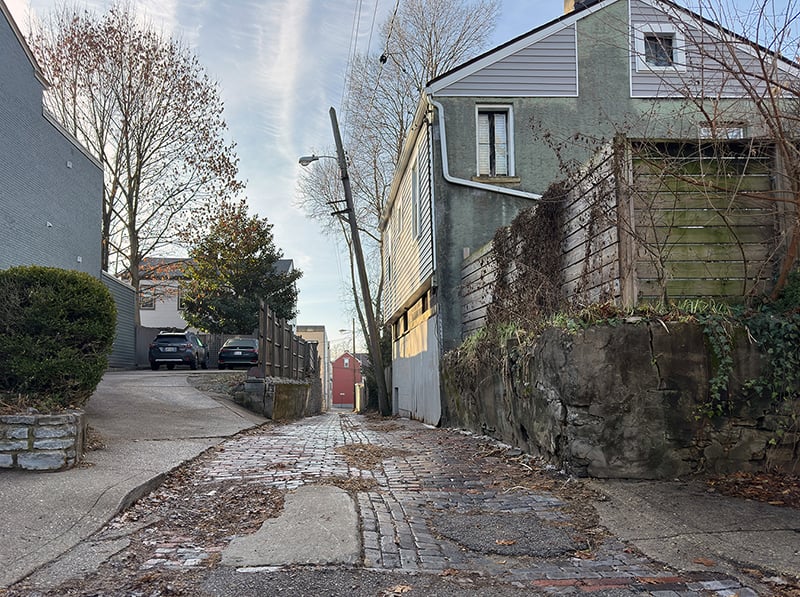
Covington is one of many American and Canadian cities where founders designed transportation grids with streets and alleys. They are found in Philadelphia, Pittsburgh, Cincinnati and Toronto — all 18th century cities with alleys delineated in their original plans.
Founded in 1815, Covington’s original plan included streets that were 66- and 50-feet wide and blocks divided by 16-foot alleys. They were the spaces where privies were hidden and where coal and ice were delivered to homes and businesses.
“Covington’s alleys are largely unnamed,” Huelsman said. “There are a few in the MainsStrasse area that have received names throughout their history, but they’re pretty inconsistent in terms of where you would see them named from block to block.”
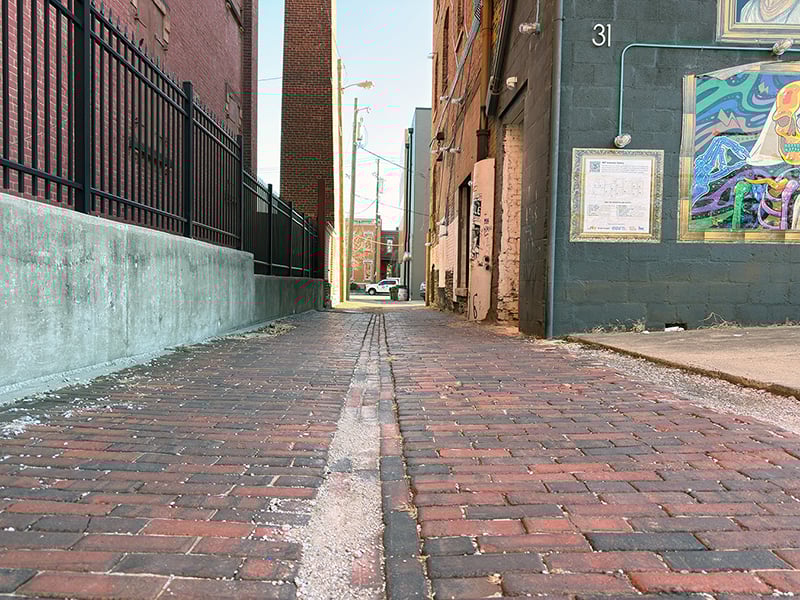
For Huelsman, alleys are a window into a city’s past. Because they’re out of sight, they’re typically less susceptible to changes and upgrades. Covington’s main thoroughfares which once were paved by stone blocks and bricks have mostly been resurfaced with asphalt. An alley, Huelsman said, “lends itself to be a much more dynamic, texture-rich environment.”
Robin Williams is a Savannah College of Art and Design architectural history professor. He has spent years documenting historic roads and alleys. Williams photographed Covington alleys in 2017 — look closely at his website and you’ll find a Covington alley.
Williams compares urban alleys to drop ceilings that conceal the infrastructure that makes buildings work.
“These corridors are absolutely essential to keeping the urban order of the front streets where houses or buildings front, having a backspace where garbage trucks, sewers, utility poles, electricity, all those utilities typically are located,” Williams said in a phone interview from his Savannah, Georgia, home.
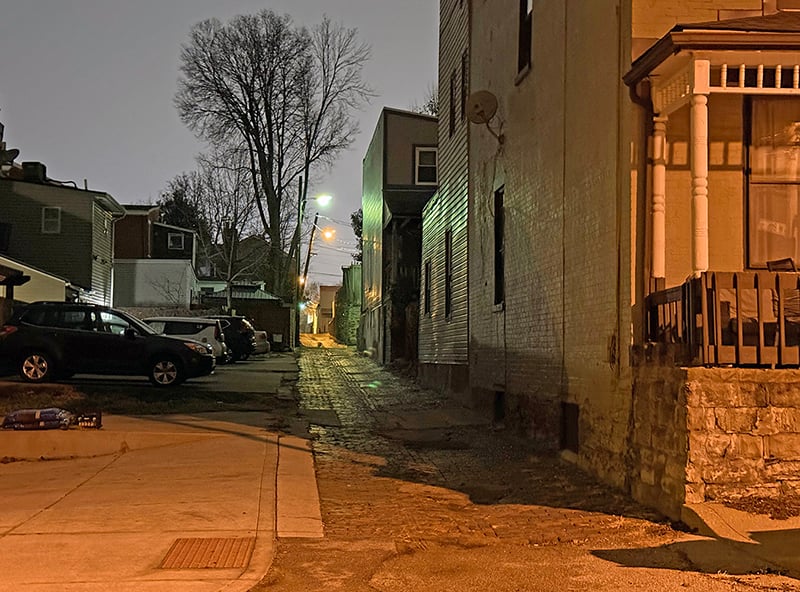
Urban planner and Ride the Cov leader Nate Weyand-Geise loves Covington’s alleys. “I think alleys in Covington tell the history of our city before the cars and trolleys and all sorts of other transit took over,” he said. “It’s the story of walkability and how do we make our city as walkable as possible.”
Ride the Cov leads group bike rides through Covington and neighboring cities, including Newport and Cincinnati. Many of the rides have themes: gardens, water features and public art are some of the ones featured in 2025.
In 2024, Ride the Cov rolled through Covington’s alleys. Weyand-Geise is a former Spring in Our Steps board member and he fell in love with alleys while helping to restore Pete’s Alley in Cincinnati.
“Covington has a great network of alleys because of our terrain. It’s a fairly flat city,” Weyand-Geise explained. “And so you can take for blocks on end these alleys as secondary roadways.”
Covington’s alleys offer a lot more than alternative transportation routes. They are steeped in nostalgia and ripe for new uses now that homes and businesses have indoor plumbing and no longer require coal and ice deliveries.
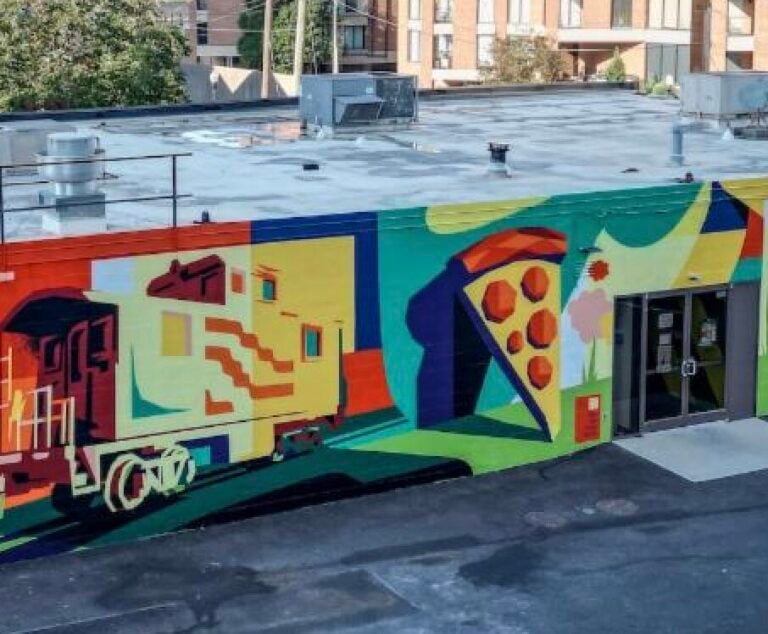
Starting in 2016, the city began working with local artists and businesses to reimagine alleys as destinations and as public art spaces. Huelsman singled out Innovation and Tobacco alleys as good examples of historic alleys being repurposed.
Innovation Alley’s transformation began in 2016 when the city gave an alley between Russell and Washington streets a name and announced adjacent buildings would become a new entrepreneurship hub. In 2022, artists installed a history-themed mural featuring 13 Northern Kentucky innovators.
In 2024, a Covington art collective transformed Tobacco Alley between Madison Street and Electric Alley into an immersive, three-dimensional artwork. The alley features traditional murals along with cabinet doors that open to reveal bookshelves and the interior domestic spaces in what creators dubbed the “Wenzel House.”
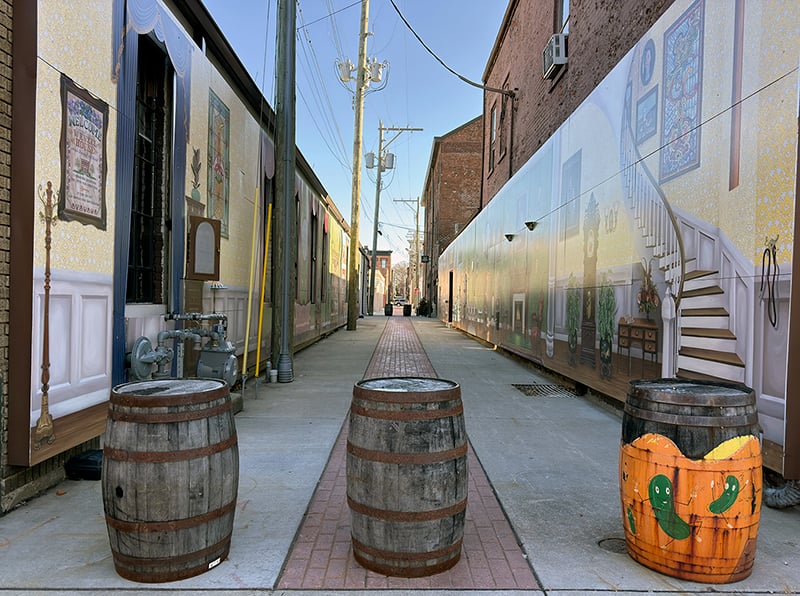
There’s also a scavenger hunt that adds to the experience. Its design, creators told the NKyTribune in 2024, is to make people feel like they are “immersed in an extravagant Victorian shotgun home.”
The recognition that alleys are important features in Covington’s urban landscape goes beyond the city’s commercial districts. The Covington City Commission at its Jan. 13 meeting approved a $5,000 Neighborhood Grant Program award to the Residents of MainStrasse Association (ROMA) to rehabilitate a block-long stretch of an alley that runs between 7th and 8th streets.
ROMA plans to clean the alley and clear trash, plants and other debris ahead of a spring community block party. “I think we have the most beautiful historic neighborhood in the world,” said ROMA Vice-President Missy Spears. “There’s just so much history when you walk down there.”
Spears explained that this year’s alley project is a test case. If it goes well, additional alleys will be targeted for beautification projects.
“So I’m hoping that after we do this one and we kind of get our feet under us on how to rehabilitate these alleys that every year we’ll be able to have a group project and just continue to go through the neighborhood and just slowly do one alley at a time,” Spears said.
Chances are if you are walking through one of Covington’s older neighborhoods, you can get off the sidewalk and into an alley on the way to where you are going.
“I always point to their sensory-friendly qualities,” Huelsman said. “It shields the flâneur or wander of alleys from a lot of that road noise. And so for people who have sensory sensitivity, but also people who don’t necessarily, who just want a quiet place to think, to walk, or even to talk with a friend.”