













By Jim Dady
Special to NKyTribune
After flying all night from Kennedy, we landed at unhurried Dublin Airport, climbed a bus to get us to Cork Airport, where we rented a brand-new Audi. The roads from there down to Schull were narrow and aimed through high hedges, often of a tough, woody rhododendron, and often concealing old stone walls, which are omnipresent. Also much in evidence was a tough, yellow-topped vine called gourse. My brother John, the musician and tour host, says that it is so invasive that it is cut and burned two or three times a year.
In America much has given way to the path of the automobile. The siting of roads in Ireland appears to be the product of a negotiation between travel advocates and the popular sentiment to preserve the country’s ancient look and the thousands of small plots of land, many of them given over to sheep-herding.
Schull (say ‘Skull’) is a seaside village on the peninsula leading to Mizen Head, the most southerly point of mainland Ireland. A historic marker on the Schull waterfront claims that Bing Crosby’s ancestors emigrated to America from Schull’s sheltered harbor leading to the open sea. There was a buzz of social life among the townsfolk, who seemed to be well-acquainted with each other. We visited with my brother Bill, whom I had not seen in 39 years. It was a happy moment. Bill’s apartment reminded me of a French Quarter set-up: a business facing the street, with apartments secluded behind. Bill’s is the rear unit, and he gardens exotic flora in pots on a patio. One evening, partyers were enjoying the advent of the warmer season grogging, singing, and carrying on at a pub next door just over a wall. The neighbor on the other side is St. Mary’s Church, built in 1826 and from which Angelus bells emanate at irregular intervals.
On a sunny day, we motored out to Ghugan Bara. This is a scenic lake shadowed by the Shehy Mountains in southwest Co. Cork. The lake is the source of the River Lee, and on an island in the lake are the ruins of a monastery founded in the Sixth Century by St. Finbar. The place was beautiful perhaps because it is holy, or is it holy because of its beauty?
We stopped for lunch at a pub in Glengariff. Jocular Johnny Dady engaged a gent in music talk and while we were having lunch alfresco, the man was dialing up Dady Brothers numbers on You Tube.
Dublin. Johnny arranged for us to spend four days and nights in the capital, set up at a good hotel near its epicenter. I am a collector of cities, an aficionado, and Dublin had me with my first view of the quays along the Liffey. In our first evening, Johnny took us to Dublin Castle. This was the site of British rule from the thirteenth century until 1922 when the Irish Free State was wrought from centuries of Irish agitation against British hegemony, rather like sand making itself into a pearl. We strolled through some of the teeming nightlife of Temple Bar and braved a stiff wind coming up the river. I made a picture of my travelling mate with the river bridges in the background, and posted it on Facebook. The next day I bought a copy of James Joyce’s “Dubliners” for a few euros. I wanted to read what the genius had written about what I was seeing, and here is how he described the same meteorological condition more than a century ago: “A keen east wind hit them, blowing from the mouth of the river.” A “keen” wind. Of course. Perfect. Or, ‘parr-fict’ as it sounds as said by the kind young women in the hotels.
I mailed postcards to American friends from the General Post Office on O’Connell Street. There republicans and crown forces traded rounds during the Easter Rising in 1916 and their marks are still in evidence in the Corinthian columns out front. The scene is reenacted in the 1996 film, “Michael Collins.”
We visited St. Stephen’s Green, a grand urban greenspace named for the protomartyr – that is, the first after Christ, who was stoned to death after insulting Jewish authorities who had accused him of blasphemy. The park is a high-concept urban oasis of about nine hectares — around twenty-two acres. Even on a cool day, it was a delight to sit in this park and observe the strollers, the plantings, the ample avian life.
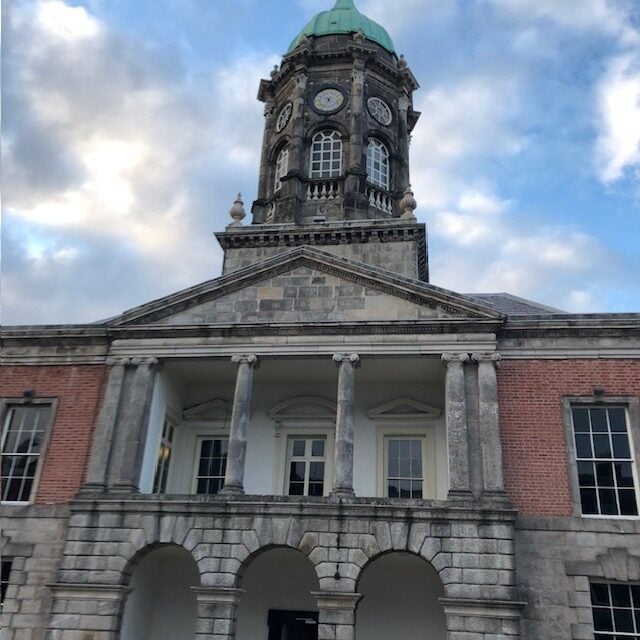
St. Stephen’s Green, or simply ‘Stephen’s Green,” was used until 1663 for grazing. The area was surveyed and enclosed within a wall. Residential development around the Green became popular in the eighteenth century. Most residences are behind short setbacks, linked by party walls, relentlessly regular window treatments, and fanlights over entrances, many beautiful and original, in the Georgian style. The Green links Grafton Street, Dublin’s principal commercial lane to the north with its famous neighbors just to the south – Merrion Square, Fitzwilliam Square, and the Shelburne Hotel.
The Irish embrace the tourist. Tourism is a major industry, and Ireland is an increasingly popular destination for the Euro tourist as well as the Yankee. The Irish revere their gorgeous scenery and glorious history and their quaint and ancient ways, and they appreciate that the tourist does, too. The renewal of tourism following the pandemic was welcome by all we met in our time there of a little over a fortnight. We went to a pub to meet up with friends just off O’Connell Street. As lunch and prattle proceeded, I became aware of a young lady looking our way from a neighboring table. As we were leaving she approached us to express gratitude for hearing our Yankee accents. To her and to all I encountered in Ireland, I extend the sentiments of Sammy Kahn channeled by Sinatra – May I say to each of you most gratefully, as I throw each one of you a kiss – this is my kind of town.
I noted to a Dublin cabbie the presence of a plexiglass panel dividing fore from aft in his hack and inquired if it was there to keep crazed terrorists from reaching over to throttle him, or infect him with Covid on purpose. Yeah, that, and a splashguard, he said, protectant from the spontaneous emanations of overserved fares.
We ambled up and down the Liffey quays and the main arteries and side streets. There seemed to be no ruined buildings in central Dublin; only fully-used gems, or those awaiting love and care for new owners and for new chapters in their stories. A Dublin building is admired simply because it is old.
I hauled around two hardbound volumes of William Butler Yeats – his book of folk and fairy tales and a deluxe illustrated edition of his verse. I was thinking that reading in Ireland there would improve my understanding. Some such readerly silliness. Carrying the books, along with several others, caused my arthritic cervicals to sing. I could have brought up the work on the iPad and saved the strain. I’m often a silly billy.
I noticed an odd thing when I returned to the States. Yeats had become clearer, his lyric genius apparent. Either being in his native places gave me a better point of entry, or just being in Ireland transmogrified the books into comprehensibility.
• • • • •
My first immersion in the modern Irish condition began with Jimmy Breslin’s World Without End, Amen (1973). The novel is the story of a broken-down young New York cop who self-exiles to Ulster. Mr. Breslin’s brushwork, performed I’ve heard in a bar in Queens, brought forth a canvas of terrorism, murder, mayhem, and hatred. It is also about the cop falling in love with a beautiful revolutionary who felt very like Bernadette Devlin. I read around this time at the dawn of the Troubles that the Protestants in the North numbered around one and a half million; Catholics about half a million, but that with the Catholic tendency to larger families, they would eventually catch up.
In recent years, Sinn Fein, the IRA’s political department, attained a plurality in the parliament of Northern Ireland, and is trying to form a government in spite of flanking maneuvers by the British loyalists. This a tectonic shift. The day of substantial demographic parity in the North between Catholic and Protestant has arrived. I asked our canny tour guide Dennis Carroll what the result would be of a plebiscite in the North to unite with the Irish Republic. He gauged the count would be about 50-50.
I acquired in Killarney and read with interest Julieann Campbell’s “On Bloody Sunday – A New History of the Day and its Aftermath – by the People Who Were
There,” a collection of oral histories told by the survivors of the murders of 13 Catholics in Derry by British special forces on January 30, 1972. There was an inquiry within months of Bloody Sunday, which was a whitewash, and then the Saville Inquiry of 1998, which exonerated the Catholics on the scene and blamed the unruly British forces. For reasons a lawyer would understand, prosecution of felony crimes of decades ago is problematic.
“The situation is absurd: prosecution of a member of the British Army has halted because its own investigation was so flawed,” reports Nick Laird in his article in the New York Review of Books, March 10, 2022. “There is no truth and reconciliation process in Northern Ireland, and the only long-term plan seems to be to wait until the perpetrators die.” The Historical Enquiries Team, a unit of the Police Services of Northern Ireland, was formed in 2005 to investigate 3,269 unsolved murders. It was shut down by budget cuts, which means the government spent available funds on other things.
Ireland was partitioned between North and South in 1921. Discrimination against the Catholic minority in the North in housing, employment, voting rights, and employment was prevalent. The Northern Ireland Civil Rights Association was formed in 1967 to protest for civil rights, and rejected violence. The British Army was deployed in Ulster in 1969, and although conditions had improved with the enactment of the Housing Executive Act (1971), the Local Government Boundaries Act (1971), and the Employment Act of 1976, hostilities between the two immutable forces of British suppression and the guerilla warfare of the IRA and similar groups blazed for two generations.
I was brought up to believe that Ireland, the homeland, was holy because it was so very Catholic, and to believe that the Catholic cause in the Troubles was righteous because Catholics were being oppressed, as we have always been oppressed. I have heard before, and Mr. Laird brings vividly home, the proposition that many in the name of the faith gave at least as good as they got during the Troubles. Republican terrorists – the IRA, the Irish National Liberation Front, and others – accounted for 58.8 percent of the deaths during the Troubles, loyalists 28.9, and security forces 10.1. The IRA accounted for half the deaths on the Island and in the U.K. Mr. Laird dismisses reports to the contrary as propaganda that doesn’t meet the standards of decent journalism, law, or history.
• • • • •
At the end of the Second World War, two-thirds of Irish homes had no electricity. Nearly 75 percent of homes in the rural areas didn’t have plumbing. At least half had no fixed lavatory facilities at all. Albania got its first television station before Ireland. It was 1963 when Ireland acquired its first escalator.
In 1961, the population was less than half of what it had been in 1841 at the dawn of the Great Famine. Three-fifths of Irish children in the 1950s were destined to emigrate. Marriage rates were low: women emigrated at greater rates than men.
The Republic of Ireland early in my life was a theocracy. Church law on the issues of the day – abortion, birth control, women’s rights – was also civil law, and Catholic prelates such as John Charles McQuaid, the bishop of Dublin, wielded unchallenged political clout. “Bloomsday,” a theater piece developed from Joyce’s writings was to be presented at the Dublin Theater Festival in 1958. When Bishop McQuaid announced that its presence on the bill would mean he would not bless the event with his customary votive Mass, the festival was cancelled.
Ireland’s revolutionary cadre early in the twentieth century established ties between the new island nation and the forerunner of the modern EU. Ireland has come to enjoy the benefits of market capitalism and elude most of its snares. To do business, to trade, requires, first of all, that the trading partners meet up, find common ground, de-emphasize their differences, celebrate how they’re alike, begin to trust one another. My little Kentucky town thrashes around the issue of parking. It’s a good problem. Means people want to be here. John J. Reilly, a Cork City cabbie, was lamenting the price of things. It’s a better problem to have than mass starvation and demographic upheaval, 700 years of subjugation by a colonial power, a religious rivalry filed to a sharp edge into a holy war of murder and terror. High prices mean someone is being paid them and someone else can afford to.
In 2021, Ireland leaped to the rank of third richest country in the world, and first in the Euro Zone, except Luxembourg, a mini-country with a population of under a third of greater Cincinnati. Ireland’s economy grows at about eight percent per year. There are 1,000 multi-nationals with a presence in Ireland, including Google, HP, Apple, IBM, Meta, Linked-In, Twitter, Pfizer, GSK, and Genzyme. The entire world supply of botox is manufactured in Westport, Co. Galway.
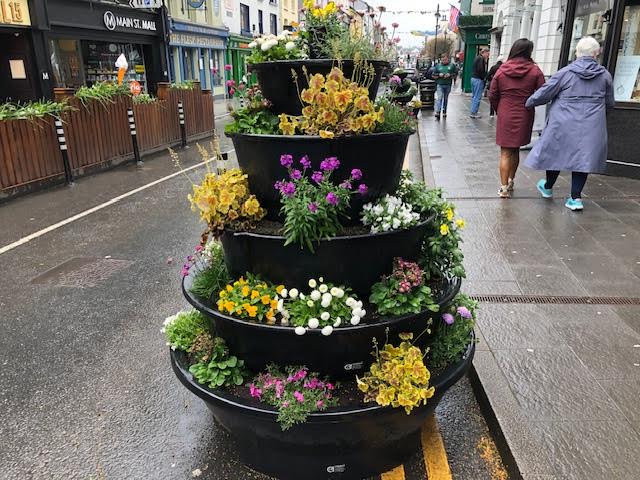
There was jingle all around where we went on the tour. The downtowns of Cork, Galway, Killarney, Westport, Ennis, Cobh, and Kinsale all sported a modern gloss on their antique beauty.
• • • • •
Ireland, it has been revealed in recent decades, was the scene of a full measure of Catholic clerical depredation. There existed gulags of schools, prisons, convents and work farms where unmarried pregnant women, wayward boys and girls, and other youthful offenders were dumped, and the use of the verb ‘dumped’ is advised.
The Sisters of Bon Secours operated Tuam Children’s Home in County Galway between 1925 and 1961 as a home for unmarried young mothers. Beginning in 2012 or so, it was revealed that some 800 children, some born and some unborn, were buried in a decommissioned sewage tank. In others among these institutions of infamy, children were subdued by regimes of terror that included flogging, burning, head shaving, beatings on the soles of the feet, and being made to sleep outside in winter.
The Bishop of Galway, Eamonn Casey, was revealed to have fathered a son, born in 1974 via a liaison with an American lover, Annie Murphy. Casey denied paternity right up until when he resigned and self-exiled to America to be with Ms. Murphy. It was revealed of Bishop McQuaid, the theater critic whose ring secular authority bent to kiss, had kept a telescope and a magnifying glass in his official residence so as to magnify the private parts of women who moved through the field of view at his official quarters in Dublin.
A poll of a few years ago, found that 80 percent of residents of the Republic count themselves as Catholic. Of those, 27 percent attend Mass, and the isolation and social-distancing regimes imposed by the Covid-19 pandemic may have permanently caused another 20 percent to lapse.
It is as if the Irish, who had fought fiercely for religious freedom for a millennium, finally got it, and when it arrived uttered a collective ‘meh!’
It may not happen in the time I’ve got left, but the trends are clear, in the Republic and in the North – prosperous, secular, and, sooner or later, united.
• • • • •
“Music is a pretty thing
In fine company.”
■ Mary Black, “The Holy Ground.”
Music is everywhere on the island. The love of music is general. Irish traditional and Irish contemporary music are heard throughout the world. Irish music moves fastest between the maker and the heart of the listener.
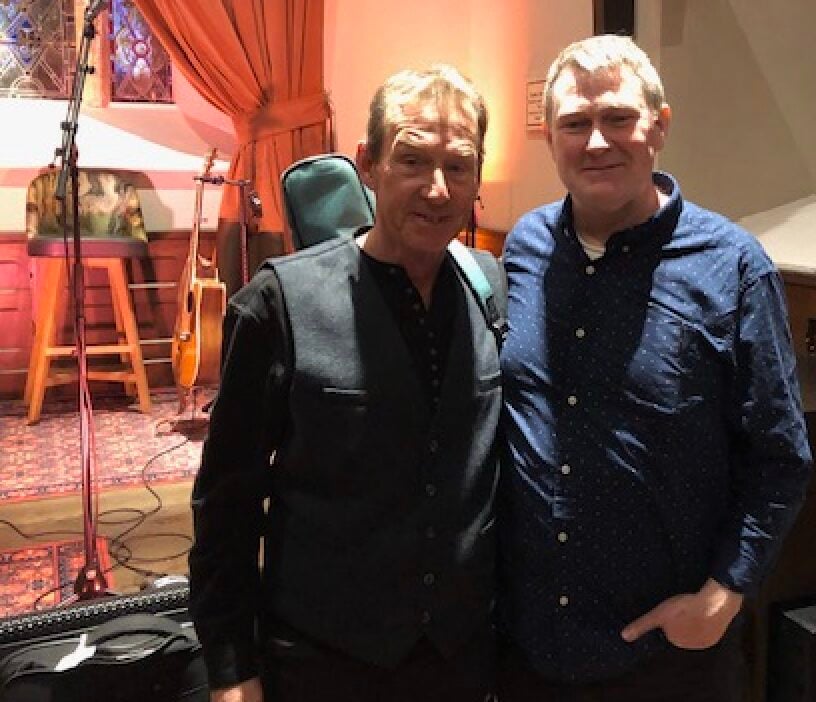
The Dady Brothers earned a cadre of devoted friends, fans, and followers over three decades of coming to Ireland. There was an elegiac quality to a number of encounters for brother John in our travels. All who knew him expressed that they miss Joe so since his death in 2019. We toured Tom Cussen’s banjo-making studio in Clairinbridge, Co. Clare. Tom and Joe were bonded in the banjo; Tom on his four-string jobs and Joey on the five. They forged a kinship over many sessions, one only musicians get to have. Tom presented John with a brand-new banjo, to be sold to benefit an endowment in Joe’s name at a New York conservatory.
John recalled that in one of the many trips across the ilsand, Joey said something like, “There, we’ve done it. We’ve been in all the counties.”
Pity those who don’t go in for live music. Johnny opened for Rory Makem and Donal Clancy at Sea Church, Ballycotton, a postcard-pretty little city in South Cork. His strum was impaired by a broken wrist still healing, but after a while he drew in an uberhip audience of perhaps 100, and by the time he got to “Lanigan’s Ball,” the house was singing along. Rory and Donal followed and Johnny joined them for their encore of “All Around the Blooming Heather.” Rory and John are mates, and they prized this chance to sing together.
There was a sheet of paper taped inside the windshield of our tour bus.
Ever the wiseguy I noticed one day that the sign read, “Dady Bros. Tour,” and said to the tour director, “Geez, Denny. If I wasn’t along, that sign would be a lie.”
He answered quickly. “Joe Dady and the Dady Brothers will always be remembered in Ireland.”
Our hotel in Ballycotton was atop a bluff overlooking the ocean. One very sunny afternoon, Johnny and I descended a staircase to go have a look. It took a bit of a clamber to get over some beds of rocks to water’s edge, but we both got to put our hand in the water. As we came back up the stairs, I heard a throbbing sound from Johnny. He was sobbing. He’d brought a pinch of his stash of Joey’s ashes and had just dropped them into the sea.
Jim Dady is a journalist, attorney, and gifted storyteller. He lives in Bellevue.