














By Al Cross
SPJ/Bluegrass chapter
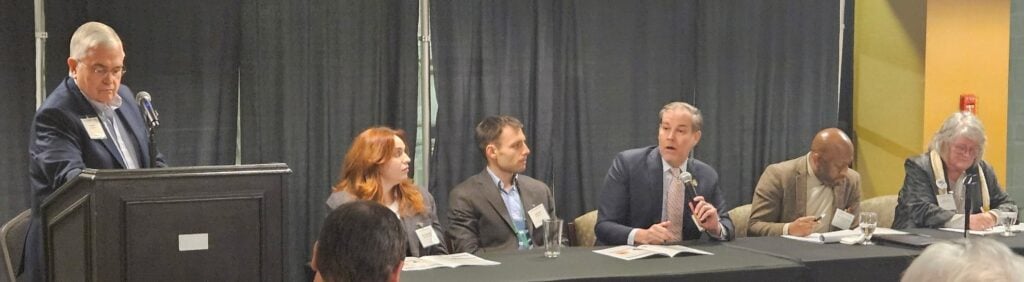
With the Kentucky General Assembly meeting in temporary quarters not open to the public and coming under increasing criticism for rushing legislation into law, the Bluegrass Chapter of the Society of Professional Journalists brought legislative leaders, their critics and journalists together recently to discuss coverage and transparency of the legislature.
New Senate Majority Floor Leader Max Wise was on the hot seat, responding to questions from journalists and the latest study by the League of Women Voters of Kentucky about maneuvers that put legislation on a track to passage faster than normal rules provide. League researcher Janie Lindle said “One-third to one-half of all bills are under this sort of rushing flow,” which limit the opportunity for the public to influence the process.
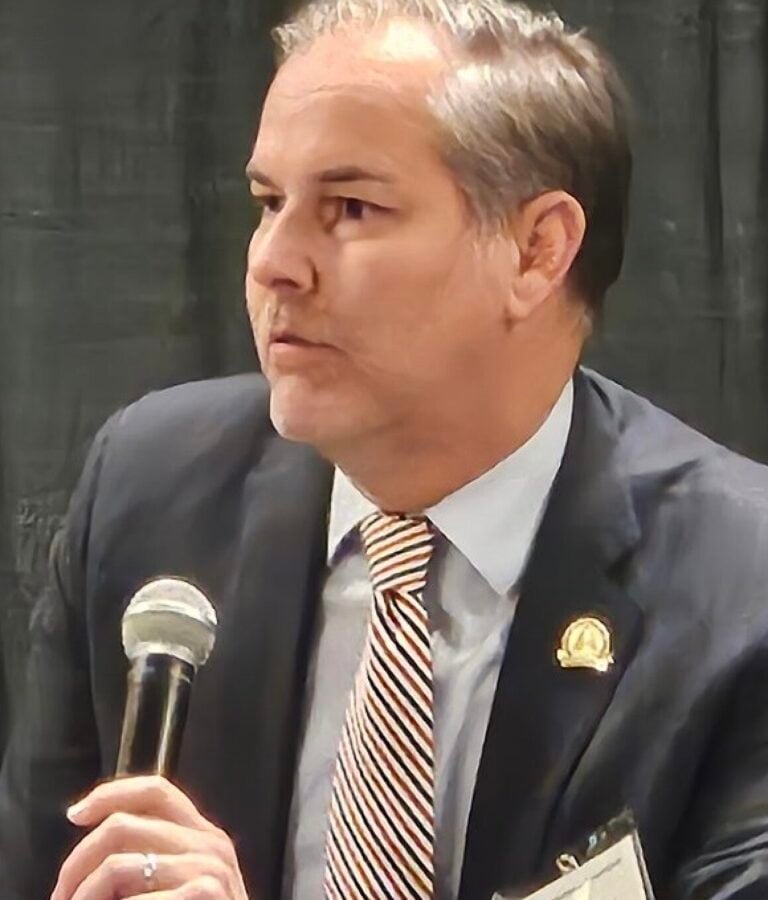
Wise noted that the share of passed bills that were “fast-tracked” in the Senate declined from 46 percent in the 2021 legislative session to 28 percent in the 2025 session. That was the first session in which the League found that the House fast-tracked a larger share of passed bills (31 percent). He said the Senate has tried to improve the process by urging committee chairs to hear no more than three bills per meeting and encouraging each senator to make no more than five bills personal priorities.
“We are very deliberate,” said Wise, a Republican from Campbellsville who has been in the Senate since 2015 and is in his first session in the legislative leadership.
Lindle noted that committee meetings, once usually allotted two hours each, are now limited to an hour, further limiting the opportunity for public participation. Wise said the time was shortened to give lawmakers more time to meet with constituents and have “really good, in-depth discussions” in the Senate Republican caucus, which meets privately.
That caucus is where Republicans figured out last year what exceptions to add to the state’s law banning abortion, using a “shell bill” that had been filed as a vehicle for major amendment after the deadline for filing bills. One of the journalists on the panel, Sylvia Goodman of Louisville, said the bill “really moved very speedily through the process, a very complicated bill, and when I asked lawmakers about it, they said ‘We’ve been discussing it internally for a long time’ . . . but the public has not had any time to digest it before it has now passed both chambers.”
Asked about that, Wise said, “Many times we have to come together as a family; sometimes you have to go behind closed doors to have family discussions.”
Goodman said such fast-tracking not only complicates the work of journalists, “I also think it complicates the work of legislators.”
The other journalist on the panel, Austin Horn of the Lexington Herald-Leader, brought up another problem for reporters covering the General Assembly: Committee members’ discussion and passage of substitute bills that are not made publicly available until after the meeting. Horn said uploading such bills to the legislative website “is a pretty simple thing to do, and I know legislators get printouts” of committee substitutes to consider at meetings. “It’s a fix that’s really not all that difficult.”
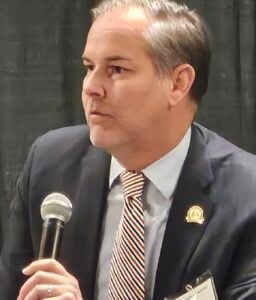
House Minority Caucus Chairman Joshua Watkins, the other legislator on the panel, said he has seen the motion to adopt a committee substitute come right after the roll call was completed and the chairman put the bill before the committee. “That’s terrifying to me, as someone who wants to be a good steward, who stays up many nights reading and researching,” he said. “And when you don’t know what you’re voting on . . . when it’s not even read into the record where people can understand what it is, I do find that alarming.”
Wise was asked how difficult it would it be to make committee substitutes immediately available, either paper or electronic, to credentialed news media at committee meetings. He answered, “We always could have the discussion; I think the problem becomes, is, in the time frame that we are here, and that we’re gaveled in, that legislation has still got to move. And with that, I’m sure that could be discussed as a better process for us of how to do things, but at the same time, we’re not year-round legislators . . . ”
Watkins countered later, “People want to know, they want to have a chance to communicate, and when they can’t do that because a meeting lasts an hour and 25 to 30 people are in the room and want to speak, “It creates an anxiety in the process that I think overall harms public trust.”
Watkins, a Democrat from Louisville, also said he wishes that he could pre-file bills before a session begins, as the legislature once allowed, and that there could be better public notice of special committee meetings, often held hurriedly in the closing days of a legislative session – a point that Liam Niemeyer of the Kentucky Lantern asked Wise about.
“You raise a very fair point, because it’s very difficult for us to get that notice out there to the general public,” Wise replied. He said reporters can post meeting alerts on social media, and noted that such meetings still have livestream feeds on the KET website. He said pre-filing of bills was abolished before he joined the leadership; asked if many bills were prefiled only or mainly to get media coverage, he said, “Could have been.”
The Lantern’s McKenna Horsley asked Wise if he had thought about the need to more promptly update the legislature’s website, to show action on bills on the day the action is taken. “I think all of us as legislators would be very much in favor of that,” Wise said. “That is an excellent point that I would be happy to bring up . . . That would be a very smart investment.”
The last question to Wise came from Horn, who noted that the Republican-led legislature had exempted itself from the state open-records law, but conservatives have used the law to reveal relevant information, “so it is a totally closed door that the legislature will remain shielded from the law?”
Wise said he sees value in having government records open, but hasn’t heard any discussion of doing that during his 12 years in the legislature; “I don’t think we are probably in any rush just to look at that as a priority issue right now.”
At the start of the meeting, held at the Capital Plaza Hotel, Lindle said the League of Women Voters tracks legislative transparency because it has a “democracy principle,” that “We the people have a right to participate in the decisions that affect us.”
Al Cross is secretary of the Bluegrass Chapter of the Society of Professional Journalists and moderated the panel discussion.