














Second of two parts
By Paul A. Tenkotte, PhD
Special to NKyTribune
It is one of the ironies of history that federal regulation of standard time zones in the United States, the vestiges of World War I-era Daylight Saving Time (DST), and Prohibition all paralleled one another in the 1920s and early 1930s. Interestingly, Americans seemed to dislike and defy federal control of time as much as they did the ban on the manufacture and sale of liquor. Further, they did so overtly and unabashedly, ignoring and sidestepping the rule of law. Different levels of government—city, county, state, and federal—actively opposed and undermined one another as each tried to shift the sands of time.

The 1918 federal Standard Time Act granted the Interstate Commerce Commission (ICC) the power to establish five official time zones in the United States. After World War I, the section of the act mandating wartime daylight saving time was repealed, leaving the option for DST to the states.
The 1918 act had placed the Cincinnati/Northern Kentucky metropolitan area—indeed all of Kentucky—within the Central Time Zone. However, the Cincinnati Chamber of Commerce, the city of Covington, the Civic Association of Middletown (OH), regional businesses, and some railroads were dissatisfied with the Central Time designation for at least two major reasons.
First, Central Standard Time (CST) placed Cincinnati/Northern Kentucky one hour behind the nation’s major commercial, banking, and political centers on the East Coast (Eastern Standard Time, EST), including New York City, Philadelphia, Baltimore, and Washington, DC. Second, many railroads across the Ohio River watershed preferred EST as well, to maintain consistent timetables for the valley’s major cities with East Coast urban areas.
One method of attempting to synchronize Central Time to Eastern Time—at least for part of the year—was by adopting Central Daylight Saving Time (CDT). In 1920 the “Cincinnati Post” led a crusade to adopt DST in Cincinnati, asking readers to complete a survey form and mail it to their editorial offices. For many weeks, the newspaper recorded the responses, which were decidedly in favor of more daylight hours in the evening to enjoy sports and entertainment, as well as gardening and other outdoor activities.
On Tuesday, April 27, 1920, Cincinnati city voters approved a daylight saving ordinance. The measure passed by “a majority of more than 6000.” Likewise, Covington and Newport, KY followed suit (“Election Results Here and Elsewhere,” “Cincinnati Post,” April 28, 1920, p. 1).

The following year, in 1921, Louisville adopted CDT from May 1st to September 30th. Unlike Cincinnati’s daylight ordinance, however, which was upheld by the Ohio Supreme Court, Louisville’s ordinance would experience backlash, both from citizens and also from the Kentucky General Assembly (“Daylight Law in City Passed,” Louisville “Courier-Journal,” April 20, 1921, p. 1, “Citizens Will Face Time Riddle Tomorrow,” Louisville “Courier-Journal,” April 30, 1921, p. 5).
At its February 1922 session, representative Harvey Meyers of Covington introduced a bill into the Kentucky House banning daylight saving time by any government entity other than by proclamation of the state governor. Passing the House by a vote of 68 to 17, the bill moved to the Kentucky Senate. The Louisville “Courier-Journal” of February 10, 1922, was dismayed by the fact that “Representative S. W. Adams, also of Covington, fought the measure on the ground that ‘daylight saving’ time in Cincinnati forced Covington and Newport to adopt it.”
The anti-daylight saving bill (House Bill 134) cleared the Kentucky Senate, but apparently only after it underwent revision, with the support of General Assembly senators from Louisville opposed to that city’s recent DST ordinance. In fact, the final bill only applied to cities of the first class in terms of population, of which there was only one at the time in Kentucky—Louisville. It permitted “cities of the first class to adopt daylight saving only by proclamation of the Governor on application of the city.” In April Louisville City Council repealed the DST ordinance (“Morrow Signs Measure. Daylight Savings After June 15 Can Be Only by Proclamation,” Louisville “Courier-Journal,” March 22, 1922, p. 2).

Covington, a second-class Kentucky city by population, was not affected by House Bill 134. Its city commissioners continued to respect daylight savings “for the convenience” of its residents “who work in Cincinnati” (“Covington to Operate with Daylight Saving,” “Louisville Herald,” April 20, 1923, p. 2).
However, daylight saving time was not enough for many Cincinnatians. At its August 10, 1926 primary election, Cincinnati City Council asked voters to consider an ordinance “For the establishment of Eastern Standard Time in the City of Cincinnati.” Approved by the Cincinnati electorate, the immediate consequences meant that clocks would not be turned back to Central Standard Time (from CDT) “on the last Sunday of September.” Instead, they would “continue to run on eastern standard time” (“Vote on Time,” “Cincinnati Post,” August 6, 1926, p. 23; “Eastern Time Is Adopted by Voters,” “Cincinnati Post,” August 11, 1926, p. 1).
Obviously, the 1926 Cincinnati ballot results would probably have led to voluntary cooperation only, as the city lacked the authority to actually change its time zone. Since the Interstate Commerce Commission regulated both time and the nation’s railroads, Cincinnati civic organizations and railroad interests pursued the next option, petitioning the ICC directly for reassignment from CST to EST time. This strategy proved successful.
On January 20, 1927, the ICC issued a decision approving the permanent change of Cincinnati and Northern Kentucky from CST to EST. According to the “Cincinnati Enquirer” of January 21, 1927, the new boundaries of the EST would run along “the line of the Baltimore and Ohio Railroad from Cincinnati to Toledo, and that portion of Kentucky along the Chesapeake and Ohio Railroad from Covington to Catlettsburg,” including Maysville and Ashland KY, as well as a small portion of West Virginia.
On March 3, 1960, the ICC issued another decision, this time extending EST from 18 Kentucky counties affected by the 1927 ruling to all or part of 63 central and eastern Kentucky counties, including the city of Lexington and the state capital at Frankfort. The new dividing line between EST and CST ran along the Kentucky River (dividing Carroll County) and then along the western boundaries of Owen, Franklin, Anderson, Mercer, Boyle, Lincoln, Pulaski, and McCreary Counties, as well as included three counties in Tennessee (“63 Counties Will Be on Eastern Time; I.C.C. Ruling Doesn’t Affect Louisville,” Louisville “Courier-Journal,” March 4, 1960, p. 1).
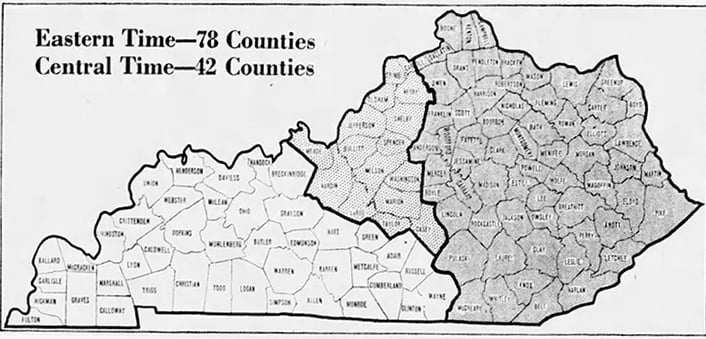
The 1960 ICC decision basically reflected reality on the ground in many parts of Lexington, Frankfort, and other Central Kentucky cities, which had basically defied their CST designation by adopting voluntary Central Daylight Saving Time year-round. Their city councils passed these ordinances, whereby their municipal offices and many businesses chose to operate on CDT—one hour ahead of Central Standard Time—thereby synchronizing their clocks with Eastern time.
Louisville, however, was left out of the new EST designation. Like their counterparts in Cincinnati and Covington had done years prior, officials and businesses in Louisville petitioned the ICC for a change to EST. Their request would not take long. On June 9, 1961, the ICC issued a new decision whereby Louisville and Jefferson County, and part or all of 15 other Kentucky counties were transferred officially from Central time to Eastern time. The ruling also affected Louisville’s Indiana suburban counties of Clark and Floyd (“Eastern Time Is Ordered for Louisville, 15 Counties,” Louisville “Courier-Journal,” June 10, 1961, p. 1).
As early as the 1927 ICC decision, the Cincinnati/Northern Kentucky metropolitan area fared well in the shifting sands of time that plagued much of the nation. It would take longer for Lexington, Frankfort, and Louisville to achieve their preferred EST zone. In the decades between, the battle for the control of time fractured much of the nation. Along with Prohibition, it fed distrust of the federal government and led to growing chasms at the local and state levels.
Paul A. Tenkotte, PhD is Editor of the “Our Rich History” weekly series and Professor of History at Northern Kentucky University (NKU). To browse more than ten years of past columns, click here. Tenkotte also serves as Director of the ORVILLE Project (Ohio River Valley Innovation Library and Learning Engagement). For more information see orvillelearning.org/. He can be contacted at tenkottep@nku.edu.