









The riverboat captain is a storyteller. Captain Don Sanders shares the stories of his long association with the river — from discovery to a way of love and life. This a part of a long and continuing story.
By Capt. Don Sanders
Special to NKyTribune
Who killed Richard Bedard?
Richard and a friend, both Canadian citizens, signed aboard the DELTA QUEEN at New Orleans in the steward’s department during the Spring of 1972. The two, both university students, were hitchhiking across the states before returning to their studies in the fall. The Mississippi River and the illustrious DELTA QUEEN would surely become memories of a lifetime.

The Spring of 1972, also a personal memorable year, was the year I tested for, and received my U.S. Coast Guard Unlimited tonnage master’s license for Rivers and 1st class pilot’s ticket upon the Ohio River from above Coney Island Amusement Park to the mouth of the river where the Ohio joins the Mississippi at Cairo, Illinois. Captain Ernest E. Wagner, my long-time mentor since I was a 17-year-old deckhand on the excursion steamboat AVALON, was the master, or captain of the DELTA QUEEN. I was his First Mate and soon to become the alternate master of the QUEEN with “Big Cap,” as the crew fondly called him.
On Tuesday, April 23, 1972, at 3:05 p.m. central time, the DELTA QUEEN departed Poydras Street Wharf, New Orleans, with 142 passengers for its first trip to Cincinnati that year. On my deck crew, Preston “Red” Lunsford, formerly a circus bareback rider until he was thrown from a horse, crippling both legs, was the lead deckhand on the front watch. While Cincinnati-born and bred, Ed Duemler, banjo player and singer, was the lead man on the backwatch with me. ‘Big Cap’ had the front watch from 6 a.m. to noon and from 6 p.m. to midnight. I had charge of the boat the remainder of the time.
The DELTA QUEEN required at least eight deckhands, according to the U.S. Coast Guard’s Certificate of Inspection mounted for all to see on the cabin deck, which also displayed the licenses of every officer in the navigation and engineering departments. In the early 1970s, Big Cap and I usually hired our deckhands found along the way at the various ports-of-call for the QUEEN. Now and then, a likely candidate was sent our way from the company office in Cincinnati. But all the deck crew members were either former employees or hired, interviewed, and selected by Cap or by me in the Crescent City or at various points along the Lower Mississippi River.

The Vietnam War lasted another three years before it ended in April 1975 with the fall of Saigon City. Several of the young men hired on deck had been fighting in the jungles of Vietnam just 30 days earlier. One such fellow on my watch was a classic example. On his belt, a long K-bar-type knife hung in its sheath, and though the Rambo movie series was still a decade away in 1972, for the sake of a better name, I’ll call this deckhand “Rambo” for the rest of the story.
The trip upriver went well, even with the river rising. According to my handwriting in the QUEEN’s logbook, she was averaging over five mpiles per hour against the current. By noon on Wednesday, April 26, the DELTA QUEEN passed Natchez. She steamed on towards Vicksburg, where she landed for a quick two-hour visit before heading down the Yazoo Diversionary Canal, rounding up, and again, shoving against the current of the Mississippi at 8 p.m.
Sometime later that day, Big Cap told me of a meeting he had with Franklin Miles, chief steward. Mr. Miles, according to the skipper, had two Canadian nationals on his porter staff, hired in New Orleans, who apparently were not getting along with some of his other crew, and he wanted to put the fellows off at Memphis. It so happened that two deckhands unexpectedly left the boat at Vicksburg, leaving our deck crew short of two required hands.
“Ya figure we got a place for them boys, till we get to Cincinnat?” the captain suggested.
Although Captain Wagner made it seem like he was asking for my opinion, he was really ordering me to find a place for them. From experience, I knew it was better not to place close buddies on the same watch, so I split them between watches, and placed Richard Bedard on my after-shift with Ed Duemler, Red Rooster, and Rambo.

On Thursday morning, at 10:30 a.m., the steamer ran on a slowbell while the deck crew and porters carried huge rolls of laundry off the QUEEN and onto the WaterWays, Greenville, storeboat. From there, the immense collection of sheets, pillowcases, towels, and so forth would go to a Memphis laundry before heading to WaterWays—Memphis, a floating warehouse at the foot of Beale Street, cleaned, starched, ironed, and ready for reloading back aboard the DELTA QUEEN.
The next day, Friday, April 28, the Helena, Arkansas, Highway Bridge passed at 9:35 a.m. At 11:20 p.m, the steamer landed alongside the Memphis Waterways wharfboat and stayed just four hours, long enough to reload the laundry and take on necessary stores and such. By 3:40 am, Saturday, April 29, the DELTA QUEEN shoved off and, like a faithful, old hound returning home, the venerable steamboat resumed her long-established route back toward Cincinnati.
By that far along the trip, I was already experiencing troubles with Mr. Rambo — especially when it came to getting drunk on watch. The more he drank, the more belligerent the former combat trooper became. Alcohol consumption among the crew in those days was one of the DELTA QUEEN’s toughest challenges. If you ask where the general crew found alcohol on board, it was readily available and encouraged.
In the crew’s mess, for starters, canned Busch Bavarian beer dispensed from a company-owned Coke machine, sold for a quarter a can. Meanwhile, cheap, rot-gut Boone Country Whiskey, “aged in used cooperage for not more than 30 days,” according to their label, was watered down, trafficked in small “shorty” bottles, and readily available at inflated prices from a syndicate of bootleggers operating with impunity below decks. Rambo, as I soon discovered, was a favorite consumer from both sources.
When my deck crew and I came on watch at midnight, Sunday, April 30, the DELTA QUEEN was abreast Blaker Towhead Light, mile 844.0, within spotlight distance of Caruthersville, Arkansas. Settling down after exchanging information in the pilothouse with my after-watch partner, Captain “Handsome Harry” Hamilton, a veteran steamboat man and one of the most knowledgeable pilots on the lower Mississippi River I worked with, I had the two night watchmen change watch in the wheelhouse while I went below to assign my deck crew their nightly duties.

To keep the crew busy with productive projects, Ed and Rooster were assigned to clean and prep the “u-shaped” deck surrounding the engine room perimeter for painting. Rambo and Richard’s job entailed painting the upper, main deck boiler room. Once the two teams had their chores underway, I returned to the pilothouse to check on the pilot.
At 2 a.m., I made my usual walk around the boat. I found both parties on deck busy with their assigned projects before returning to the pilothouse to assist Captain Hamilton, as was the norm on a night steaming up the Mississippi. Again, I left for another round at 3 a.m., but this time, when I checked the progress in the boiler room area, the wooden deck was half-finished, with a partially full paint can, rollers, and brushes where Rambo and Bedard had abandoned them.
Immediately, I went aft to ask Ed and Rooster if they knew where the two errant deckhands went. Neither knew, but they joined me in my search for the missing men. On the bow, Rooster gave a shout:
“Here’s Rambo, sleepin’ in the VW.”
Rambo had both doors locked on the Volkswagen coupe, kept on board the DELTA QUEEN for running errands ashore. Ed flipped on the deck lights while I pounded the machine until Rambo finally roused himself from an alcohol-induced sleep.
“Where’s your bubby?” I shouted.
“He’s sitting in a chair on the bow,” Rambo drunkenly slurred before passing out again and rolling face down into the back seat.

On the starboard side of the bow, usually reserved as a work area for the deck crew, sat a lonely, empty chair pushed close to a large steel cavel used to tie the heavy lines running from the boat to shore during mooring operations. The steel deck on the opposite side of the deck fitting was bent and sloped from banging against lock walls and such. No way could anyone step onto that steel plate without going overboard.
The only entry in the DELTA QUEEN Log Book, made by someone other than myself, was:
“{Sunday, April 30. Crew Member (illegible) Bedard reported missing at 4 am. Has not been located on board.}”
Long story short — The DELTA QUEEN arrived in Louisville on Wednesday, May 3, at 5:30 p.m. for the Great Steamboat Race between the QUEEN and the BELLE of LOUISVILLE. The BELLE won the race, and after the ceremonies, Captain Wagner informed me he was getting off the boat to return home to New Richmond, Ohio, for family matters. I was to take his place — the first time I assumed command of the DELTA QUEEN with my newly acquired Coast Guard license.
No sooner had Big Cap left the boat than I answered a call about a problem with Rambo. Obviously, he had been drinking despite warnings of his dismissal if found intoxicated again. After receiving his pay to date and the cost of a bus ticket back to his place of hire, Rambo was escorted off the boat. Sometime later, he slipped back aboard and severely cut a porter with his signature Rambo-style knife before slipping back ashore and into oblivion.
Ten days later, I was in command of the DELTA QUEEN on my first trip as master, taking the steamboat to New Orleans and back to Cincinnati. Somewhere above Blythville, Arkansas, the local sheriff called the DELTA QUEEN on the marine radio.”
“Say there, DELTA QUEEN… you got a man missing off yer boat?”
When it was confirmed that we did, indeed, have a missing crewman, the sheriff continued:
“Well, we found a body a’ floatin’ in the river what the fish didn’t git, wearin’ a DELTA QUEEN tee-shirt and a hippie belt.”

We finally found Richard Bedard. Because his father worked for the Canadian Embassy in Washington, D. C., a State Department investigation was conducted, in addition to what the U.S. Coast Guard was already doing. Eventually, Bedard’s death was ruled “accidental.” Neither the company nor any government entities took further actions, nor have I ever been privy to the results of any autopsy reports concerning Richard’s death.
During this recall of the tragic event that occurred 54 years ago this week, I compared the DELTA QUEEN’s hour-by-hour locations during the midnight-to-6 a.m. watch on Sunday, April 30, 1972. For years, I suspected that Richard disappeared from the DELTA QUEEN abreast Tiptonville, Tennessee, at mile 872.0, near the site of Reelfoot Lake, which formed when the 1811 earthquake cut off the Mississippi River.
However, my recent analysis indicated that the DELTA QUEEN passed Tiptonville around 5 a.m., while the search for Richard was still in progress. A more accurate location would have been slightly before the QUEEN’s 3 a.m. location. Around that time, the DELTA QUEEN was above Island 14, Mile 859.9. That’s likely the general area where Richard Bedard stepped onto the slanted deck plate and fell into the river before being struck by the protruding lock guard attached to the hull.
Hopefully, his death was swift and painless. Regardless, his demise was unnecessary and preventable. Richard Bedard died as a result of illicit bootleg whiskey peddled by those seeking to make a quick buck off their fellow crew members.
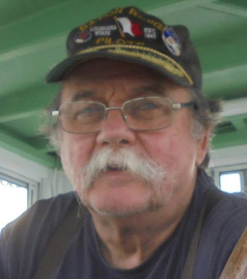 Captain Don Sanders is a river man. He has been a riverboat captain with the Delta Queen Steamboat Company and with Rising Star Casino. He learned to fly an airplane before he learned to drive a “machine” and became a captain in the USAF. He is an adventurer, a historian and a storyteller. Now, he is a columnist for the NKyTribune, sharing his stories of growing up in Covington and his stories of the river. Hang on for the ride — the river never looked so good.
Purchase Captain Don Sanders’ The River book
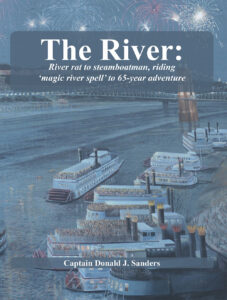
Capt. Don Sanders The River: River Rat to steamboatman, riding ‘magic river spell’ to 65-year adventure is now available for $29.95 plus handling and applicable taxes. This beautiful, hardback, published by the Northern Kentucky Tribune, is 264-pages of riveting storytelling, replete with hundreds of pictures from Capt. Don’s collection — and reflects his meticulous journaling, unmatched storytelling, and his appreciation for detail. This historically significant book is perfect for the collections of every devotee of the river.
You may purchase your book by mail from the Northern Kentucky Tribune — or you may find the book for sale at all Roebling Books locations and at the Behringer Crawford Museum and the St. Elizabeth Healthcare gift shops.
Click here to order your Captain Don Sanders’ ‘The River’ now.