






By Andy Furman
NKyTribune staff writer
He didn’t bring his guitar – but he entertained nevertheless.
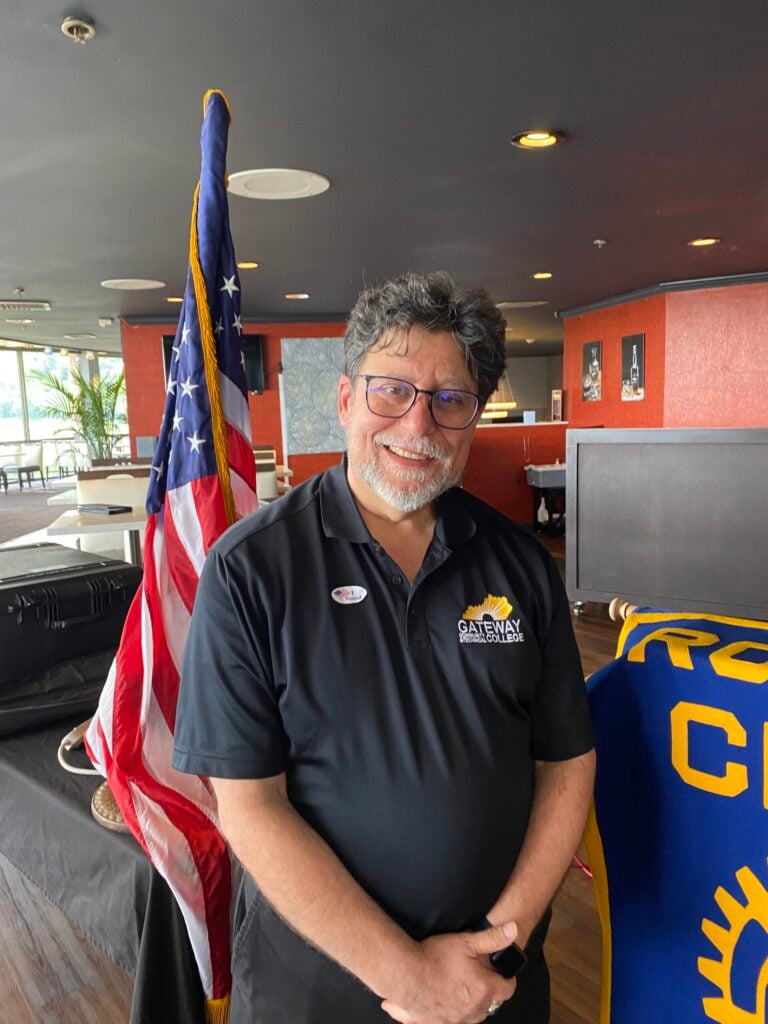
Dr. Fernando Figueroa enjoys playing guitar and recording and publishing his own music. His day job – president of Gateway Community and Technical College.
And he was singing the praises of his institution to the Covington Rotary Club at their Tuesday luncheon staged at the Radisson Hotel.
“We’ve had record enrollments the past two years,” Dr. Figueroa, who enters year 10 at the college, told the assembled group. “In fact, we had the largest graduating class of nurses just last week.”
Yet, Community Colleges, according to Figueroa are treated like, “A middle child – we’re not Elvis, and we’re not the baby.”
The history of Community Colleges is a unique one. The Junior colleges in America evolved from the late 19th-Century desire to expand higher education access. Originally designed as a two-year extension of high schools, or to help struggling small colleges, they became vital community pillars offering vocational training and affordable pathways to four-year degrees, according to Figueroa.
In fact, he said Joliet Junior College in Illinois was founded as the nation’s first public two-year college, originally enrolling just six students as an extension of the local high school system. That was in 1901.
In 1920, Figueroa continued, The American Association of Community Colleges (formerly the American Association of Junior Colleges) was established to organize and standardize the rapidly growing number of two-year institutions.
“And in 1999,” Figueroa said, “Kentucky and Louisiana adopted community colleges. They were built,” the Louisiana native said, “To serve the needs of the region.”
And Figueroa certainly was quick to point out the mission of his institution. “No football. And no basketball teams – we’re not known for that,” he admitted.
“We have welding, that’s our sport – we get people hired.”
The two-year college was certainly elevated during World War II and during the GI Bill.
“Our emphasis,” he said, “is trade and technology. And your focus, to find the kind of community we wanted to build. Good design leads tro good results.”

At Gateway, Figueroa stressed, “We work to connect, engage and inspire our community to reach its aspirations. Our mission is more than a statement.”
He says here at Gateway “we believe in the community and invest talents – and the region, also believes in the Gateway mission.”
“When Gateway succeeds,” he said, “the community succeeds with a trained workforce and productive citizens as well as economic prosperity.”
Figueroa says Gateway spends much time and effort on results.
“We have a division to help people in the workplace,” he said. “We work on Adult Education – earning a GED. In programming, we simply look to connect people to jobs and careers.”
The community is key for Gateway, he says.
“Northern Kentucky has some 39 to 42 cities and five to eight counties. All have a different feel. Florence doesn’t know much about Covington and Newport and Ludlow are strangers.”
So, Gateway has adopted a regional strategy, “We have our urban campus in Covington, one campus in Edgewood and a third in Florence on I-71-75, and we’re not done thinking out of the box.”
It has been said that Figueroa is the battery that provides all the energy that makes this community of Northern Kentucky run.
“How we focus with the types of jobs, looking at middle and skilled jobs – all have a certain level of technical skill.
“And what we do,” he said, “is invest in people, to become employees of value. We give them the tools for success, a place to test and apply them.”
And, as a reminder, he did clarify that Gateway for education is the best deal in town.
“You will, save 50 percent on your BA, after a two-year program at Gateway.”
That was music to everyone’s ears – even without his guitar.