







May marking National Bike Safety Month, and the Ohio-Kentucky-Indiana Regional Council of Governments is spotlighting an enhanced tool, data initiatives and major investments aimed at making cycling safer and more accessible across Greater Cincinnati.
OKI’s latest efforts come as communities nationwide look for ways to expand active transportation options and reduce serious roadway injuries.
A key enhancement is the agency’s interactive Bike Route Guide, which features a “comfort index score” that helps riders choose routes based on traffic levels, infrastructure and overall ride experience.
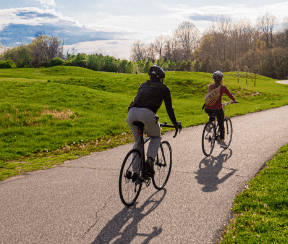
“We’ve transformed the guide into a more powerful tool that helps cyclists of all skill levels navigate roadway conditions with confidence,” said David Shuey, OKI director of information systems and analytics. “It’s designed as a regional resource for both commuters and recreational riders traveling across Greater Cincinnati.”
Shuey noted that while the tool “promotes safer riding, cyclists should still take appropriate precautions, obey traffic laws and assess conditions before heading out.”
Despite making up less than 2% of all crashes regionally, bicycle- and pedestrian‑involved crashes account for about 12% of fatal or serious‑injury incidents each year, based on OKI’s recent analysis of local crash data. Vehicle speed remains the most significant factor in injury severity.
To better understand how people move throughout the region, OKI is also expanding its nonmotorized data collection. A $124,000 grant from the Ohio Department of Transportation is funding a new bicycle and pedestrian counter pilot program.
“Seven permanent counters have already been installed across Ohio’s portion of the region, with three more coming online soon,” said Dr. Elizabeth Niese, OKI senior data analyst. “The data will guide transportation planning and inform strategic investments in bicycle and pedestrian infrastructure.”
OKI has invested heavily in active transportation for more than two decades. Since 2002, the agency has directed over $189 million toward bicycle and pedestrian infrastructure. Nearly $130 million of that has supported 117 multiuse paths in the past 15 years alone — representing 12% of OKI’s federal transportation funding.
“Communities across our region are telling us what matters to them, and that is safer, more accessible ways to bike and walk,” said OKI CEO Mark Policinski. “Our role is to listen and deliver, and that’s exactly what we’re doing by building a stronger, more connected network.”
Wade Johnston, executive director of Tri-State Trails, emphasized that OKI’s partnerships with local governments have played a crucial role in developing a robust network of bike and pedestrian trails.

“OKI has provided $28.3 million in federal funding to support the expansion of CROWN’s 34-mile trail loop since 2019,” Johnston said. “Most recently, they awarded $6 million to Great Parks to build the second phase of the Ohio River Trail/Oasis corridor and $1 million to Cincinnati Parks to repave the Ohio River Trail through the riverfront parks.”
Johnston also noted that OKI is playing a key role in advancing the Riverfront Commons trail in Northern Kentucky, completing the Great Miami River Trail in Butler County, establishing the Miami 2 Miami Connection between Butler and Warren counties, and creating a perimeter trail around CVG Airport, as well as funding other critical trail projects.
“Thanks in large part to OKI, many communities have been able to make meaningful investments in regional trails, stretching their local capital dollars further to maximize impact. Maintaining these funding streams through the anticipated federal transportation bill will be critical in our local governments’ ability to continue funding trail connections,” Johnston added.
Metropolitan Planning Organizations like OKI were created to ensure that federal transportation funds move directly to regions — not through state offices — giving local leaders authority to shape investments that reflect community priorities. Because of that structure, OKI holds final say over every federal surface transportation dollar spent in the region.
And while OKI has that authority, its member communities drive every decision. Every seed of a project that OKI supports begins with a local village, city, township, county or transit agency. The entire investment strategy is built from the community level up and never imposed from the federal level down.
OKI is a council of local governments, business organizations and community groups committed to developing collaborative strategies, plans and programs to improve the quality of life and economic development potential of the tristate.
Ohio-Kentucky-Indiana Regional Council of Governments