








By Steve Flairty
NKyTribune columnist
This week, I’ll share some random thoughts from the desk of a guy focused on Kentucky-related subjects:
The Flairty household’s multi-garden wildflowers are doing fine, but not without a lot of water-toting trips to quench their thirsts, as the amount of rain has been sparse until recently. So far, our blanket flowers (gaillardia) are the most stunning, but some up-and-coming baby’s breath (gypsophila) and a clump of huge, yellow-colored yarrows are pretty, maybe the best ever. With that, the bees are having a sweet fest pollinating the flowers, a sight to behold.
Wildflowers grow well in Kentucky if they get enough sunlight, and they are generally low maintenance.
Small Kentucky towns with good leadership and passionate people can accomplish great things. Wilmore just pulled off an amazing three-day event in tribute to America’s military veterans. I sat in a planning meeting of the town’s locals, some 25 people, and they were laser-focused on carrying out their responsibilities. The result was about 275 veterans were recognized powerfully, and that’s about as American as one can get.
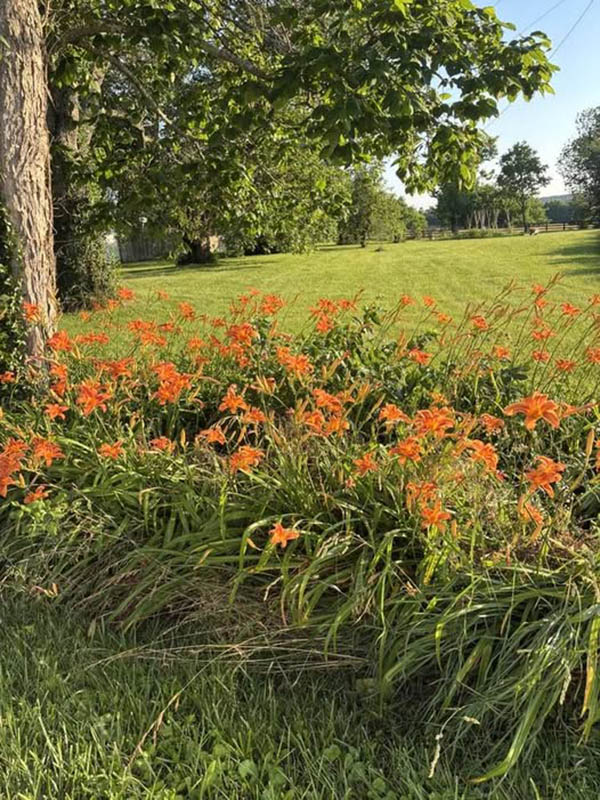
Seems like everywhere I go these days, I see orange day lilies along Kentucky roadsides, commonly called “ditch lilies.” According to my research, their botanical name is Hemerocallis fulva and are native to China. It is not a true lily in the genus Lilium, but the looks of them are similar. They tend to be invasive, but I’ve seen some in yards that are controlled and beautiful.
The blooms last a day, so are not good cutting candidates. I remember seeing them as a child in Northern Kentucky where I was raised. I’d love to get some pictures and heirloom stories of these bloomers from my readers.
On the literary side of things, I always have a pile of books beside me in various stages of process while doing reviews for Kentucky Monthly. Currently I’m writing one for Ann H. Gabhart’s Christian romance, A Chance for Kallie Mae, which I just finished reading. I just started a biography of one of the most celebrated high school basketball coaches in Kentucky’s history, Billy Hicks. It’s called Billy: Coach. Leader. Legend. Friend, and is authored by Dr. John Wiley Bryson.
Also, there’s The Confederate Gateway: Controlling the Rivers and Fighting for Justice in Civil Wat Paducah, by Ed Ford; The Final Word, by Jenny Taylor; Frail Blood by Edward Stanton; and Istanbul Dreaming by Northern Kentuckian Denise Derya Brandt. The last one I’ll mention has the longest title: The First Kentucky Derby: Thirteen Black Jockeys, One Shady owner, and the Little Red Horse That Wasn’t Supposed to Win. I’m a slow reader, so if one of these books is yours, just be patient. I’ll get to it.

On a recent rainy day last week, looking outside at the wet grass got me thinking about hunting nightcrawlers when I was a young teenager back in the 1960s. A Claryville neighbor of mine, middle-aged Ted Woeste, invited my brother and me to go “harvest” a bunch of those large, red wrigglers from Ted’s brother’s yard in nearby Alexandria.
Ted had mentioned that when the time was right, he would take my brother, Mike, and me on the big worm excursion. I recall it being about this time, late spring or early summer, when the optimal time came. Armed with a couple small buckets, flashlights, and an eagerness to catch some bait to use in Ted’s wonderful fishing lake, we headed to Alexandria to Ted’s brother’s large, lush and green lawn. A nice rain occurred but pretty much had stopped, and it was probably about 7:30 in the evening.
What the three of us saw, especially as the dimness of the night began appearing, was a host of those crawlers lying around at ground level all over the yard, and the pickings were easy for us to gather, slimy hands and all. Sometimes, interestingly, we were able to grab a couple of night crawlers at a time because, as Ted explained to us, ‘they’re mating.”
We filled our containers with those docile creatures, and though I don’t recall how the fishing taking place afterward was as productive, the experience sticks in my mind after almost six decades.
I’m a fan of podcasts about Kentucky history, and here are a few of my favorites. I’ll start with the Behringer-Crawford Museum (BCM) and it’s “NKY History Hour,” found on the museum website. Last fall, I presented a program on the site about Constantine Rafinesque, an eccentric botanist who was a professor at Transylvania University in the early 1800s. The site has an amazing variety of mostly Northern Kentucky related historical presentations.
The Lexington Public Library has a similar podcast series relating to Central Kentucky history, particularly Lexington, called “Tales from the Kentucky Room,” accessed at the library’s website.
The third Kentucky history podcast I like is “The Kentucky History Channel,” which emphasizes stories all over the state, especially from the 1700s and 1800s. You will find it at Kentucky History Channel.