















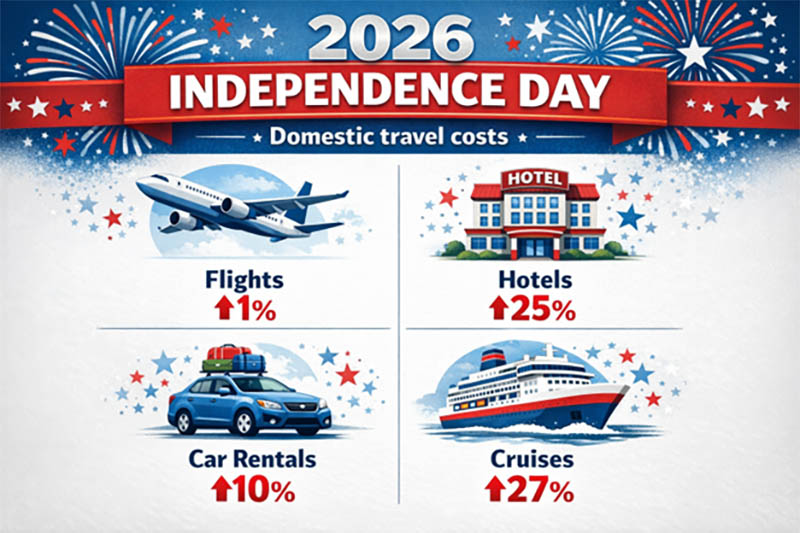
More than 72.2 million Americans will travel at least 50 miles from home for Independence Day between Saturday, June 27 and Sunday, July 5, according to AAA’s latest travel forecast.
This year’s domestic travel forecast surpasses last year’s record of 71.8 million travelers, but the increase (0.5%) is smaller than recent year-over-year gains. The number of travelers driving and flying to their destinations is relatively flat compared to last year, while travel by other modes, including cruises, is the category seeing the biggest increase.
“For many Americans, July 4th travel is a longstanding tradition, and that tradition remains strong this year even as prices rise for most modes of transportation,” said Lori Weaver Hawkins, public and government affairs manager, AAA Blue Grass. “Whether people are hitting the road, boarding a flight, or taking a cruise, travelers continue to make summer holiday getaways a priority.”

Independence Day travelers by mode of transportation
By Car: AAA projects 61.4 million people will travel by car over July 4th week, nearly the same number as last year when 61.3 million travelers took road trips. 85% of Americans traveling for Independence Day are expected to drive to their destinations, despite gas prices reaching four-year highs. Last year, the national average for a gallon of regular gasoline was $3.15. This year, prices are more than a dollar higher but remain lower than 2022, when the national average was $4.80 on Independence Day. Despite higher gas prices, filling up the tank during a road trip is still cheaper than purchasing flights for many travelers, especially for families with kids.
For travelers renting cars over July 4th, AAA car rental partner Hertz expects Thursday, July 2 to be the busiest pickup day. Hertz says Orlando, Denver, Boston, Los Angeles, and New York City are the cities with the highest demand based on advanced bookings. According to AAA booking data, domestic car rentals are 10% more expensive this holiday week compared to last year.
By Air: AAA projects 5.85 million travelers will take domestic flights over July 4th week, a 0.2% increase over last year. Air travelers make up 8% of the share of holiday travelers. According to AAA data, which is based on what travelers paid when they booked their Independence Day trips, roundtrip domestic flights to top destinations like Chicago and Denver are 5% more expensive. Domestic flights overall are averaging about $830 a ticket.
By Other Modes: Travel by other modes is seeing the biggest year-over-year growth compared to car and air travel. AAA projects 4.93 million Americans will take buses, trains, and cruises over Independence Day week, a 5.3% increase from last year. This year is also expected to surpass 2019’s figure of 4.79 million travelers, due in large part to the post-COVID cruising boom. Travelers are drawn to cruise vacations because they know how much the trip will cost upfront, and the ship offers all-inclusive dining, various entertainment options, and multiple destinations.
Top Independence Day Destinations
AAA members are heading to major U.S. cities over July 4th week and flying internationally to Canada and Europe. Alaska cruises are in peak season, that’s why Seattle, Anchorage, and Fairbanks are all top domestic destinations. Independence Day fireworks and festivities in New York, Chicago, and Boston also draw big crowds. Florida ranks high thanks to theme parks, beaches, and cruise ports. On the international side, Vancouver tops the list, followed by major European cities like Rome, Dublin, Paris, and London.

Summer Safety on the Road
July 4th week can be especially dangerous on the road with more teen drivers behind the wheel and a rise in impaired driving due to holiday festivities. That’s why AAA is urging drivers to commit to 100 Days of Safe Driving this summer. According to AAA crash data analysis, nearly one in three summertime traffic deaths involves an impaired driver. AAA, in partnership with MADD, reminds anyone who plans to drink or use impairing substances to arrange a sober ride before going out.
Drivers preparing to take road trips should also prioritize car maintenance and stay on top of routine oil changes, plus check battery condition and tire pressure. Last year during Independence Day week, AAA responded to more than 687,000 roadside assistance calls. Half of those required towing services, and nearly 30% of those calls were for battery replacement and flat tires.
Once on the road, AAA reminds drivers to Slow Down, Move Over whenever there are emergency responders and stranded motorists on the side of the road. By reducing speed and changing lanes, drivers allow roadside workers to do their jobs safely and help prevent tragedies.
Best/Worst Times to Drive and Peak Congestion by Metro
INRIX, a provider of transportation data and insights, says the second weekend of the holiday period will be the busiest on the roads, starting Thursday, July 2. But in certain metros, like Boston, Los Angeles, and Philadelphia, peak congestion is expected Saturday, June 27. Drivers looking to avoid the heaviest traffic should leave early in the day or consider traveling on Monday or Tuesday.
Please note the times listed below are for the time zone in which the metro is located. For example, Atlanta routes = ET and Los Angeles routes = PT.


Independence Day Holiday Travel Period
AAA’s Independence Day holiday travel period spans nine days and includes two weekends. This year, the dates range from Saturday, June 27 to Sunday, July 5. Historically, this holiday period included only one weekend. The expanded travel window was instituted starting in 2024 with historical results calculated back to 2019 using the new nine-day period.
AAA Blue Grass