











The riverboat captain is a storyteller. Captain Don Sanders shares the stories of his long association with the river — from discovery to a way of love and life. This a part of a long and continuing story.

By Capt. Don Sanders
Special to NKyTribune
Change never comes lightly. Although I am a staunch traditionalist and normally abhor change, one thing is certain — change is inevitable. For better or worse, change applies to steamboats as it does to everything else in an ever-changing world.

Recently, I’ve been posting pictures on Facebook of the DELTA QUEEN from over 50-some-thousand photographs and other graphic representations in my collection of riverboats and other river-related matter i’ve gleaned primarily from the internet. One thing I’ve noticed in response to my posts is the number of responders who say they prefer the QUEEN as she looked before what one fan called “the addition of circus-style foo-foo” after the historic “Save the DELTA QUEEN” year of 1970.
As the former First Mate of the DELTA QUEEN before, during, and after those radical changes, I am especially interested in hearing the remarks coming from much younger, but well-informed aficionados, several of whom are, or were, employed in the steam excursion vessel business.

Much of everyone’s attention focused on the dramatic changes around the celebrated DELTA QUEEN’s steam-powered calliope. This 1960 addition was not without its own controversy when Greene Line Board of Directors members Richard “Dick” Simonton and E. Jay Quinby suggested adding an original Thomas J. Nichols calliope. None other than Mrs. Letha C. Greene, Greene Line Steamers President and widow of Capt. Tom R. Greene opposed putting such a loud, boisterous, infernal contraption on board as she believed it would keep resting crew members awake while distracting from the public image of the prestigious overnight river cruiser.
During the 1971 spring layover at Avondale Shipyard, above New Orleans, in Covington, Louisiana, the addition of an extensive, elaborate geehawed addition around newly gold-plated whistles and the addition of something called a Una-Fon stood out most for criticism as the most prominent change from the old DELTA QUEEN to the new. The next most censured change was the addition of a new stern splashboard, facing the paddlewheel, from the hull to the Texas deck.
A year before these dramatic changes, an unbelievable amount of public support stirred interest in saving the DELTA QUEEN from the so-called “Safety at Sea Law,” which forbade any vessel constructed of combustible materials from operating on voyages originating in U.S. waters. Of course, one of the QUEEN’s finest structural attributes was her rare and exotic woods.

Following that exciting and eventful year, the DELTA QUEEN lay moored in the New Orleans Industrial Canal, uncertain of its future. Only necessary improvements and piecemeal maintenance had kept the boat going throughout 1970 and the preceding years. The general public was pumped up by the Save the Delta Queen campaign, but in reality, only with a glimmer of hope did those “in the know” expect the QUEEN to operate after 1970.
Bill Muster and Betty Blake had taken a wheelbarrow full of signed petitions to Washington, DC, where supposedly sympathetic Senators and Representatives had lined up to have their picture taken with the venerable pile of papers. Yet, as soon as the photo op was over, the Congress members were back in the Capitol building and left Betty and Bill with the stack of papers and not much else.

Then, virtually at the very last minute, Louisville, Kentucky, U.S. Senator Marlow Cook attached a rider to a bill that could not possibly fail confirmation, thereby saving the DELTA QUEEN. The DELTA QUEEN, itself, bobbing forlorn in the Crescent City backwaters, was in fairly shoddy shape.
Soon after the year passed into early 1971, essential crew members answered the call to meet aboard the boat at Avondale shipyard. Overseas National Airways (ONA), the company’s owners, committed $1 million to improving their investment in the boat now that it was exempt from the International Convention for the Safety of Life at Sea (SOLAS). One million dollars in 1971 had the same buying power as $7.9 million in 2026 dollars.
One of the first major changes was replacing the rusted and decrepit stern splashboard. I can’t count the number of times I stood in the engineroom looking through the stern bulkhead, watching daylight streaming through the holes, and wondering how long the transom would last. Seeing the new, handsome, fanciable transom in place, sporting two large round porthole windows and painted with swirling red-and-yellow trim, was like a vision materializing before my eyes. Those making the final decisions made sure the shipyard completed all essential repairs and replacements throughout the DELTA QUEEN before a few fanciful additions were approved and adopted.

Looking at old photos from the glory days of steamboats on the Mississippi River and its tributaries, I was often impressed by the display of the numerous flags flown on the boats. And, too, I was a great admirer of white chimney collars, which distinguished many of the earlier steam vessels. One of my contributions to the 1971 changes was adding a row of flagpoles on either side of the DELTA QUEEN’s roof. These became permanent fixtures, and they may still be in place over half a century later.
In addition, I had been a longtime fan of Commodore Frederick Alexander Laidley, who, like myself, was a steamboatman from Covington, Kentucky. Commodore Laidley, among his many achievements, was the owner of the Louisville & Cincinnati Packet Company, also known as the “White Collar Line,” for the distinctive white bands around the chimneys of steamboats belonging to that line. So on a Sunday during the crew’s time off in the shipyard, I enlisted the aid of my friend, 1st Engineer Kenny P. Howe, Jr., to help me paint a white collar around the QUEEN’s upper smokestack to honor the Commodore.

Any additions or changes to the QUEEN required approval from someone above my pay grade. It so happened that as Kenny and I were putting the finishing touches to the White Collar, two such people drove up to the boat in a tiny Volkswagen coupe. As soon as Captain Ernest Wagner and company president William “Bill” Muster wiggled out of the seemingly tiny clown car and saw our handiwork, they expressed their approval. However, the next day, when the paint shop opened, Mr. Muster had the shipyard painters change my White Collar into a Regal, Royal White Crown. This royal symbol became a permanent fixture crowning the DELTA QUEEN to this day.
A pity, though, that somewhere along the line, the regal White Crown became a lazy red substitute– most likely because someone became too slothful to maintain the symbolism of the queenly white garland encircling the challenging soot-belching smokestack.

Since that eventful year, 1971, many changes have greatly altered the appearance of the DELTA QUEEN compared to when it left Avondale Shipyard. The stern splashboard underwent a radical alteration within a decade. Gone are the graceful, round windows, replaced by awkward rectangular ones that look oddly out of place. The 1971 calliope decorations, including the Una-Fon, have changed or are gone. A new smokestack, looking more like a tall, thin candlestick encased in a dirty, red crown, long ago displaced the chimney I so often labored upon. Varnished cabin doors, instead of white-painted ones, are disputable. A dead-level, awkward-looking hull now encases the original floating platform that had form and grace in addition to function.
Although all the changes that came to the DELTA QUEEN over the years are often judged by their appearance, whether likable or not, function often takes precedence over form; the tall, skinny, candle-like smokestack is many times easier to raise and lower. Captain Mike Williams, a veteran DELTA QUEEN skipper, said the new stack draws exhaust smoke and fumes from the boilers much more efficiently than the old version I remember.

The reality is, however, that whenever we look at photos of the DELTA QUEEN, we are seeing her as she looked at a certain point in her 99 years. One of her first changes was the distinctive Navy Gray coating during her Second World War years.
As soon as Captain Tom Greene got her to the Mississippi System, he modified his new boat at Dravo Shipyard in Pittsburgh to function as a Western Rivers cruiser. Then came more changes over the years. Each new ownership, each new commander, and each new generation had their own changes.
As we said earlier, “Change is inevitable.” The only change I’d like, now, to the DELTA QUEEN, is to see her paddling up the river under her own steam with the whistle blowing, the calliope playing, as happy people hurry to the riverbank to wave and watch her passing by.
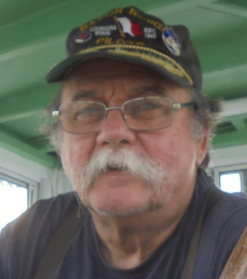
Captain Don Sanders is a river man. He has been a riverboat captain with the Delta Queen Steamboat Company and with Rising Star Casino. He learned to fly an airplane before he learned to drive a “machine” and became a captain in the USAF. He is an adventurer, a historian, and a storyteller. Now, he is a columnist for the NKyTribune and will share his stories of growing up in Covington and his stories of the river. Hang on for the ride — the river never looked so good.
Click here to read all of Capt. Don Sanders’ stories of The River.
Purchase Captain Don Sanders’ The River book
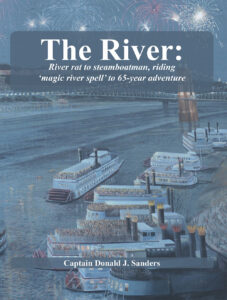
Capt. Don Sanders The River: River Rat to steamboatman, riding ‘magic river spell’ to 65-year adventure is now available for $29.95 plus handling and applicable taxes. This beautiful, hardback, published by the Northern Kentucky Tribune, is 264-pages of riveting storytelling, replete with hundreds of pictures from Capt. Don’s collection — and reflects his meticulous journaling, unmatched storytelling, and his appreciation for detail. This historically significant book is perfect for the collections of every devotee of the river.
You may purchase your book by mail from the Northern Kentucky Tribune — or you may find the book for sale at all Roebling Books locations and at the Behringer Crawford Museum and the St. Elizabeth Healthcare gift shops.
Click here to order your Captain Don Sanders’ ‘The River’ now.