















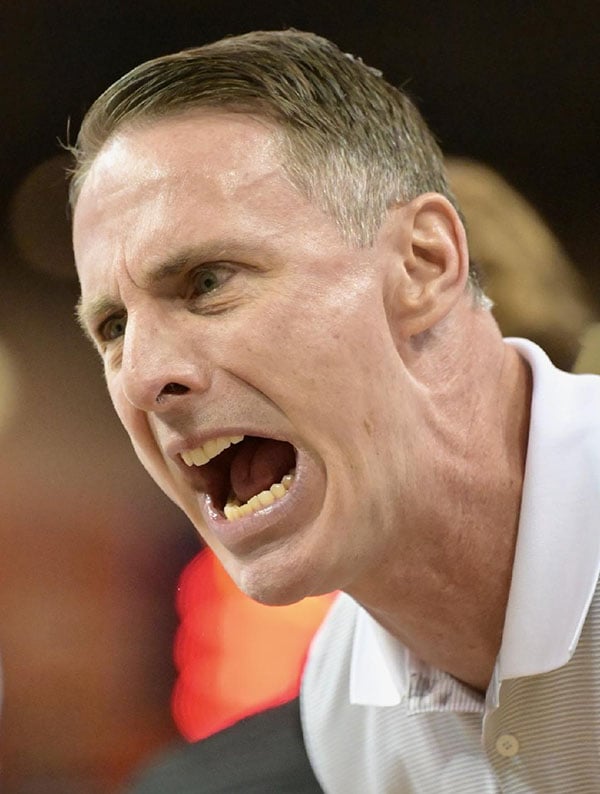
As NKU coach Darrin Horn challenges his players time and again in the three-on-three and five-on-five halfcourt scrimmages in the seventh week of summer practice, it’s clear how little college basketball has changed.
“Five guys guarding the ball,” Horn calls out, again and again. “I don’t think I did as good as I could last year,” he says of his talented veteran team slipping to 10-10 in the Horizon League and 20-14 overall.
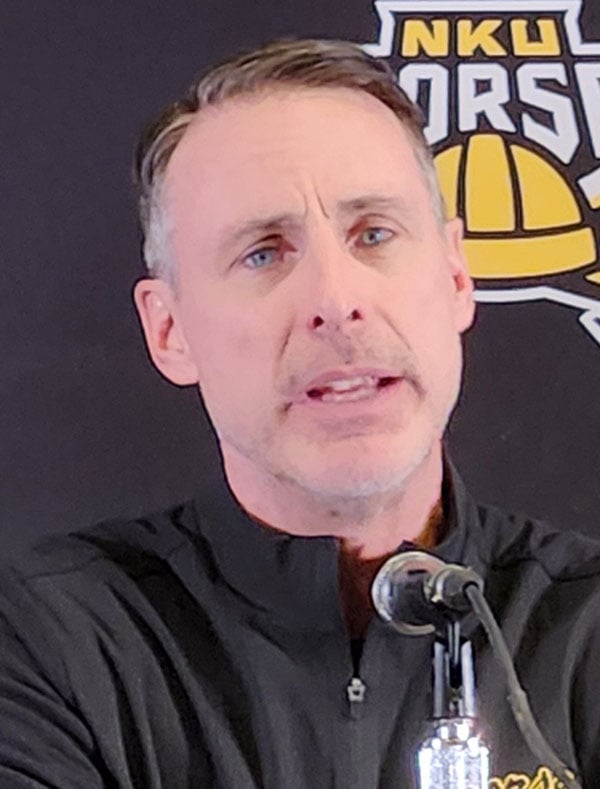
They didn’t play the defense he calls “the fist” the way they needed to play it. “It’s not a zone, it’s not a man,” Horn says of the defense that when played well, as it was in 2023, gave No. 1 seed Houston all it could handle in the NCAA tournament.
That’s the goal with this new-look team. “We’re adjusting, not changing,” he says of the way this almost entirely new cast of characters will be expected to play.
Just as always.
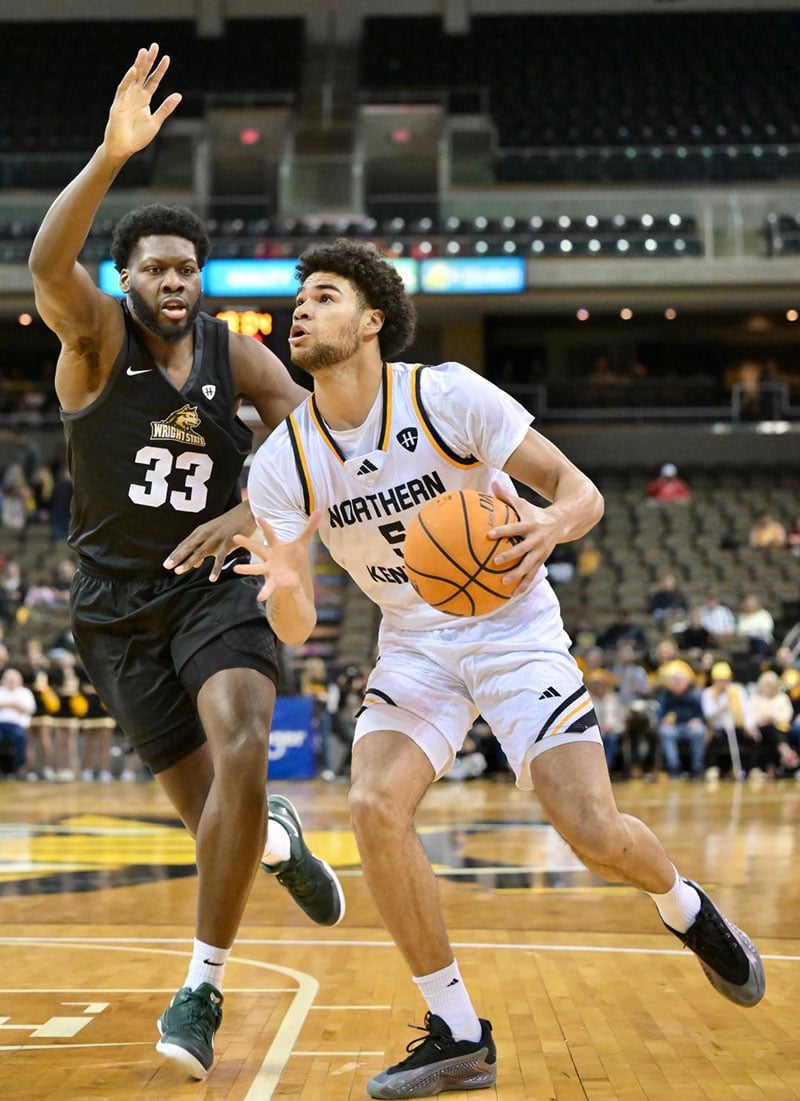
But one thing could not be more different. For those of us who were around a half-century ago when NKU started basketball with a team almost entirely of Northern Kentucky kids – and all from Greater Cincinnati – the roster is something unlike anything NKU has ever seen.
Seven are international players, four from the Southern Hemisphere. Six are transfers. The American players come from Connecticut, New York, St. Louis by way of California and Utah with a final two from Ohio. None are from Northern Kentucky.
“The challenge is not so much about what we do but what we do well and how do we work with them, how do we understand how to coach them,” Horn says.
The “them” here is the key to the changes in college basketball so perfectly reflected in the makeup of this NKU roster. “The pool is so much larger,” Horn says of a roster that says “large pool” with players from the island of Madagascar in the Indian Ocean and from the coast of the Tasmanian Sea in the South Pacific.
First of all, these 13 NKU players “all have agents,” Horn says, including one newcomer Will Shortt calls his “New Zealand dude named Stevie.”
And as much as Horn likes the way players can now be compensated for their name, image and likeness for what they do for their schools, it adds a real layer of complexity to college basketball, especially for programs like NKU’s where there are no billionaire boosters like say, at Texas Tech, who can buy players for the program.
“Nope,” Horn says with a shake of the head, none of those here. And with the positive of players getting paid, there is this negative that plays out in Northern Kentucky.
Life has become much more difficult for high schoolers to get themselves recruited. Teams have just so much money. NKU, for example, may have been sixth in the Horizon in terms of money for its roster a year ago and maybe as high as fourth this year.
But where does that money go? To untested high school prospects? Or to more mature transfers with a year or two of eligibility left from schools like SMU, Niagara and LaSalle?
And then how do you keep your veteran players from leaving? Here’s one shocker for NKU fans from Horn: Had Donovan Oday or LJ Wells, who will both be playing professionally in Belgium this year, gotten eligibility for this season at NKU, the NIL evaluation those players received was $700,000 to $1 million. It would have been “at least a minimum of $500,000 to keep them,” Horn says.
And then there’s the timing. “We’d love to get freshmen and develop them,” Horn says, “but we don’t know how many players are going to be back” since they can transfer with instant eligibility now.
So the high school recruiting has to wait. And then there’s the question of where to invest that limited pot of NIL money: in proven college players or high school prospects you hope develop?
“We talk about retention,” Horn says, “if they want to stay . . . and if the money works out.”
The plan for NKU, Horn says, is not necessarily to out-spend them – although jumping up to the next level of NIL dollars “would be significant in our league,” he says, “but to out-evaluate them.”
And then coach the heck out of them when they get here.
Which is the one place the game hasn’t changed.
Contact Dan Weber at dweber3440@aol.com. Follow him on X @dweber3440.