

















Author’s note: Following is the second of a four-part series called “My Favorite Kentucky Characters,” based on some largely unpublished writings of Kentucky’s state historian since 1980, Dr. James C. Klotter. He has graciously given me permission to use them as sources for this series, and I greatly appreciate the gesture. I hope you will both expand your knowledge of Kentucky history and also be entertained. I was. The ‘character’ discussed in this second part is Henry Clay, known nationally as “The Great Compromiser,” Henry Clay.
By Steve Flairty
NKyTribune columnist
Dr. James Klotter has a pretty strong bead on the life of Henry Clay, the second mentioned of his “My Favorite Kentucky Characters.” In 2018, he authored Henry Clay: The Man Who Would be President, published by Oxford University Press. Klotter’s nuanced knowledge of Clay comes through in his following remarks.
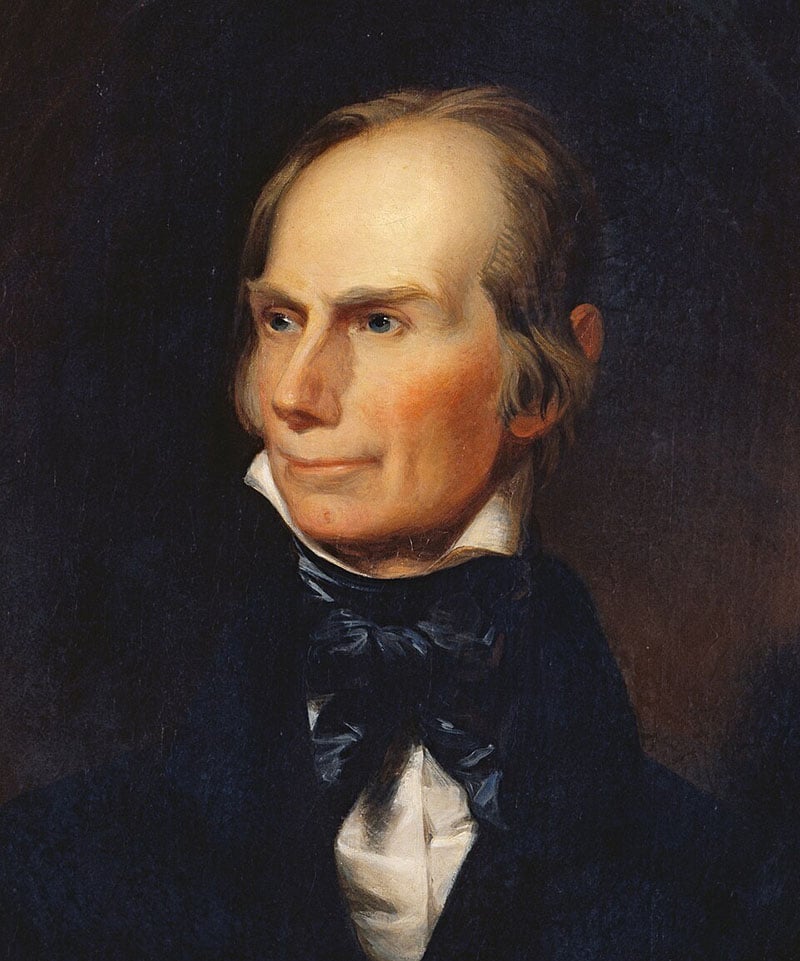
Unlike Daniel Boone, Henry Clay’s drawing card was as a politician and he was “neither humble nor modest,” according to Dr. Klotter. “But then, he had much not to be modest about. Henry Clay, the seventh child, born in 1777, served longer in the U.S. Senate than any Kentuckian until the middle of the 20th Century. He also was elected Speaker of the U.S. House on the first day he sat foot on the floor of that chamber, was the U.S. Secretary of State, and was known as ‘The Great Compromiser.’”
But as paradoxes happen, it’s often one’s point of view that matters most. “And he also was ‘The Great Rejected,’” wrote Klotter, “in that he ran for—and lost—the presidency three times. A man of great flaws. While he said he opposed slavery, he held other human beings in bondage, for example, all his life.”
But Klotter also emphasized Clay’s great strengths. “He is appealing for several reasons. First, he simply had a great personality and tremendous personal appeal. Now, when Clay would address an audience, he seldom used notes for talks that often went for three hours or more. When you peruse his printed talks today, they seem flat and ordinary.
“Yet in reading over contemporary accounts of those talks, you find people cheering, laughing, crying. He was like a great actor with a bad script, for he could make the words live and breathe. But even before Clay uttered a word, his eyes flashed with brilliance and burned with intensity, and he made all feel his passion and his power.”
And oh, Clay’s big pie-hole was amazing, too.
“In fact, his mouth was so large,” explained Klotter, “one contemporary said that when adoring ladies asked Clay for a kiss, he could rest one side of his mouth while the other side was doing active duty. And one writer recalled, ‘When he smiled, he smiled all over.’ That said it all.”

There was something really special about the way Clay spoke to audiences. “Most people called Clay the finest orator they had ever heard, and they stood in awe of his ability,” wrote Klotter. “His voice convinced them, enthralled them, seduced them. Listeners did not want him to stop, did not want the hypnotic moment to end, did not want to return to the dull, everyday world of reality.
“But it was not just the voice that convinced. He was effective as well because of the passion behind the words. When people listened, they became persuaded that he believed in his cause, and that they should, too. His emotions became their emotions, his heart, their heart, his will, their will.”
Clay was also good socially in smaller, informal situations. Klotter wrote that he was “full of life, full of stories, full of energy, and some said, full of it.” One report said that on one “particularly pleasing evening, he grabbed a violin, hopped on a 60-feet-long table, and fiddled and danced his way to the end, knocking off dishes right and left, to the amusement and applause of those present.”
It didn’t seem to matter that he had to pay $120 in damages for broken China—lots of money then—but Klotter said that for Clay, “it was worth it to him to see the enjoyment on the faces of his friends and to enjoy it all himself.”
Despite Clay’s flaws, as Klotter mentioned, it’s almost ironic that he never became the U.S. president. “When you combine all that was Clay in one person—the joy of living, the common touch, the uncommon charisma, the captivating charm, the brilliant oratory, the winning smile, the powerful personality—his appeal becomes evident,” wrote Klotter. “You can see, in part, why many people wanted him to be their leader.”
There is a very sad and tragic part of Clay’s life, Klotter revealed, as the following demonstrates:
• Henry and his wife, Lucretia, raised eleven children, but seven of them died before their parents.
• Of the six daughters, all died before Henry’s 58th birthday.
• Of the five sons, one spent most of his life in an insane asylum, and another went there briefly after having an emotional breakdown. A third would go to prison for not paying debts. A fourth one became a congressman but had a drinking problem. His namesake, Henry Clay Jr., a West Point graduate, was killed in the Mexican American War.
• Then, of course, there were the three defeats in pursuit of the American presidency.
Much admiration of the life of Henry Clay comes through in Klotter’s summative appraisal. “He could have retreated from a cruel world, angry over the hand that fate had dealt him. But Clay did not. Optimism and constructive action continued to mark his every move. Knowing as we do what Clay went through and how he reacted to terrible, debilitating tragedy, tells us much about his personal resiliency, his public character, and his private will.”
Perhaps people of his mid-1800s era didn’t fully realize what they had in Clay, but those in contemporary America, with perspective, do, Klotter observed. “As it turns out, history has treated Clay much better than his countrymen did. The U.S. Senate named Clay as one of the five greatest senators. Clay may have lost his presidential races, but he won the accolades of history, but perhaps the best monument to Henry Clay is the fact that the United States remains one country, one nation, one example of a successful democracy, still working, still changing, still trying to reflect the living spirit of Henry Clay.”
Before I close, please allow me to make a few corrections to last week’s part one story about Daniel Boone. I mentioned that Dr. Klotter has authored ten books, but actually he has been a huge part of at least twenty. Additionally, the quote: “Some 15,000 more would-be settlers had been killed in just the seven years before that” should be corrected to say “1500 more.”