














The riverboat captain is a storyteller. Captain Don Sanders shares the stories of his long association with the river — from discovery to a way of love and life. This a part of a long and continuing story.
By Capt. Don Sanders
Special to NKyTribune
OMG. It’s so hard to believe. I’ve been posting and writing on my Facebook page every day, getting over 50,000 views, and now I’m staring at this blank page, wondering what to write.
Why not, then, share a few things I’ve come up with lately?

The second Coney Island sidewheeler, ISLAND QUEEN (IQ), is upbound at the Cincinnati Yacht Club sometime in the 1930s. A decade later, as a little fellow, I rode the IQ several times, as most kids did then. My parents’ first date was on “BIG LIZ” in 1936.
According to steamboat history aficionado Frank Prudent, “The photo of the ISLAND QUEEN running upriver is from before the War. She still has the old ‘puddin’s’, or fancy tops, on her stacks and the pilothouse dome. They were later given to a WW II scrap drive. Dad said that the deckhands were happy when the copper dome went, as they no longer had to polish it or take it down during high water and then put it back up.”
Captain Ernest E. Wagner was the First Mate on her when the gracious steam excursion queen exploded and burned at the foot of Wood Street on Tuesday, September 9, 1947. Captain Wagner was back from World War II, facing a worse hell than he had experienced at the Battle of Peleliu in the Solomon Islands.
As soon as I got out of school later that afternoon and heard about the tragedy, I stayed by the radio and listened intently to every report. Life changed for the Greater Cincinnati community that day.

The MISSISSIPPI QUEEN at Nashville, Tennessee, August 24, 1995.
The MISSISSIPPI QUEEN was a genuine stern paddlewheeler with a wheel measuring 22 ft in diameter and 36 ft wide, and weighing 70 tons. The steamboat also featured a 44-whistle steam calliope, which was the largest on the Mississippi River system. The MQ was headquartered at Perry Street Wharf in New Orleans.
The MISSISSIPPI QUEEN was laid up there in New Orleans after being gutted, initially for renovation. Instead, however, the steamboat was sold for scrap in May 2009. She was towed for the last time to Morgan City, Louisiana, in March 2011 and butchered—another example of what happened to our modern steamboats after they fell into the hands of outsiders.

Several familiar relics from the DELTA QUEEN now grace the Ohio River Museum’s collection at Campus Martius in Marietta, OH.
The large wooden steering wheel dominating the exhibit is the DELTA QUEEN’s original wheel, which was removed in Cincinnati after problems with the tiller lines arose. The tall wooden chair is also a DELTA QUEEN pilothouse relic, as is the wooden box containing the QUEEN’s magnetic compass. That was the most uncomfortable chain, though. I can still hear it squeaking as the pilot squirmed around trying to find a comfortable position.
The magnetic compass was a navigational guiding instrument for the DELTA QUEEN when she ran between San Francisco and Sacramento on the Sacramento River. Once the QUEEN reached the Mississippi River System, however, I doubt that it was ever used to guide any Western Rivers pilots.
As late as 1970, Captain Wagner liked to say that the compass belonged to his son, Ernie Lee Wagner, but after that year,1971, when many changes came to the DELTA QUEEN, the compass and the pilot’s chair were two of several relics donated to the museum.
The steering wheel, however, found its way to the Campus Martius Museum in the 1950s, courtesy of the Greene Line Steamers, Inc., the original owners of the QUEEN on the eastern side of the North American continent. Captain CR Neale identified the two steam whistles as once belonging to the GREENWOOD (front), and the aft whistle served on both the packets HOMER SMITH and CHRIS GREENE.

Jamie Hansel, DELTA QUEEN Watchman…
Jamie Hansel, my next-door neighbor in Latonia, began as a deckhand on the DELTA QUEEN in either 1970 or ’71 and was soon promoted to Watchman on his own merits. He and later Capt. Greg Menke became quite a team as Night Watchmen, causing Capt. Harry Louden to label them the “Bobbsey Twins.”
Before applying for a job on the QUEEN, Jamie worked as a top-producing salesman at the leading teen clothing store in Greater Cincinnati. Jamie always wore the latest and greatest togs of any young person around. Soon after becoming a Night Watchman with Greg Menke, the two appeared on watch wearing their own matching duds, which they concocted into versions of their uniforms, topped off, though, with the traditional DELTA QUEEN embroidered “high-pressure” caps. Actually, they both looked swanky, yet “cool.”
Both Jamie and Greg were quite becoming and represented the DELTA QUEEN handsomely to onlookers, both aboard and those ashore who wished they were on board, too.
Several days after acquiring their custom uniforms, the DELTA QUEEN lay at Marietta, Ohio, for an extended stay before a late departure after midnight. The Ohio River, although high upon the cut riverbank in front of the old city landing, was calm– more like a lake than a river.
Across the landing stage connecting the DELTA QUEEN to the shore, a middle-aged woman who apparently stumbled down to the riverfront to view the QUEEN more closely, following an afternoon imbibing too much at a local pub, demanded that the stylishly attired young watchmen guarding the entrance to the steamboat allow her to cross and come on board.
Of course, her request was denied, but the inebriated lady refused to take their word for an answer and declared:
“If you don’t let me on that boat, I’m going to jump into the river!”
Again, the young fellows, sworn to safeguard the DELTA QUEEN, its passengers, and crew, stood their ground and reiterated that no visitors were allowed aboard. No sooner than their words reached the drunkard’s ears, then, SPLASH, into the Ohio River she went.
Milliseconds later, two more splashes followed as the “Bobbsey Twins” leaped into the river after her, saving the now more sober woman and getting her safely ashore. Immediately, I was on the scene, looking at the two sheepish, soaking-wet watchmen, who appeared more like half-drowned kittens than steamboat men.
The first words out of my mouth to them were:
“What’s wrong with you two… that’s a good way to get yourself killed.”
Later, of course, Jamie and Greg received the highest praise for their self-sacrificing bravery. They, and the intended victim, all survived. The only fatalities that evening were the two sets of rakish duds. From then on, the “Bobbsey Twins” dressed like “normal” Night Watchmen.

MISSISSIPPI QUEEN at Rabbit Hash-Rising Sun…
The MISSISSIPPI QUEEN was built by Jeffboat Inc. in Jeffersonville, Indiana, from 1973 to 1975. Her owner, the Delta Queen Steamboat Company, said she was the “fulfillment of Mark Twain’s dreams.”
The MISSISSIPPI QUEEN was launched on November 30, 1974, the 139th anniversary of Twain’s birth.
Until her christening on April 20, 1975, in Louisville, she was referred to as “Hull 2999”. She went into passenger service on July 20, 1976.
Roebling’s Covington-Cincinnati Masterpiece… ca. 1864-ish…

The bridge now known as the John A. Roebling Suspension Bridge was called the “Covington and Cincinnati Suspension Bridge” when it opened to pedestrians on December 1, 1866, and to vehicles on January 1, 1867. This name reflected its location between Covington, Kentucky, and Cincinnati, Ohio, and its function as a suspension bridge, as well as the fact that the primary promoters of a bridge between the two cities in different states were Covington, not Cincinnati, “movers and shakers.”
The Cincinnati business community feared that if the bridge directly connected streets on both sides of the river, it would jeopardize Cincinnati’s financial interests. That’s why the Suspension Bridge doesn’t connect directly to a street on the north side of the Ohio River.
Barely upstream of busy teams wrapping the bridge’s two new steel support cables lies the ill-fated sidewheel packet MAGNOLIA, built in Cincinnati in 1859 with a wooden hull, 200 x 31 x5.5 with engines, 22’s-6 ft. Three boilers, each 45″ by 24 ft., 5 flues. Built for James H. Prather, who commanded her in the Cincinnati to Maysville trade.
On March 18, 1868, heading upbound, the MAGNOLIA landed at California, Ohio, just below the future site of the Coney Island Amusement Park. As she was leaving the landing, the boilers exploded, resulting in the loss of 35 lives. Although the towboat PANTHER came to assist, the burning wreck floated to Columbia, Cincinnati’s first settlement, before sinking. Captain Prather’s body was never found. WAY 3698
So, here we are now at the end of once blank pages. That wasn’t so hard, was it?
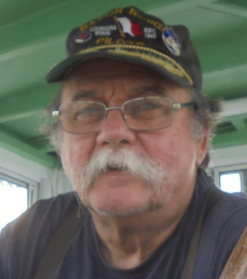
Captain Don Sanders is a river man. He has been a riverboat captain with the Delta Queen Steamboat Company and with Rising Star Casino. He learned to fly an airplane before he learned to drive a “machine” and became a captain in the USAF. He is an adventurer, a historian, and a storyteller. Now, he is a columnist for the NKyTribune and will share his stories of growing up in Covington and his stories of the river. Hang on for the ride — the river never looked so good.
Click here to read all of Capt. Don Sanders’ stories of The River.
Purchase Captain Don Sanders’ The River book
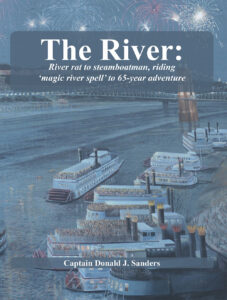
Capt. Don Sanders The River: River Rat to steamboatman, riding ‘magic river spell’ to 65-year adventure is now available for $29.95 plus handling and applicable taxes. This beautiful, hardback, published by the Northern Kentucky Tribune, is 264-pages of riveting storytelling, replete with hundreds of pictures from Capt. Don’s collection — and reflects his meticulous journaling, unmatched storytelling, and his appreciation for detail. This historically significant book is perfect for the collections of every devotee of the river.
You may purchase your book by mail from the Northern Kentucky Tribune — or you may find the book for sale at all Roebling Books locations and at the Behringer Crawford Museum and the St. Elizabeth Healthcare gift shops.
Click here to order your Captain Don Sanders’ ‘The River’ now.