














By Howard Whiteman
Murray State University
Sitting in our research tent in the West Elk mountains of Colorado one late afternoon, I heard a faint howl, almost too faint to hear, coming from the wilderness to the northeast. I looked up, and could tell that one of my students had heard it too.
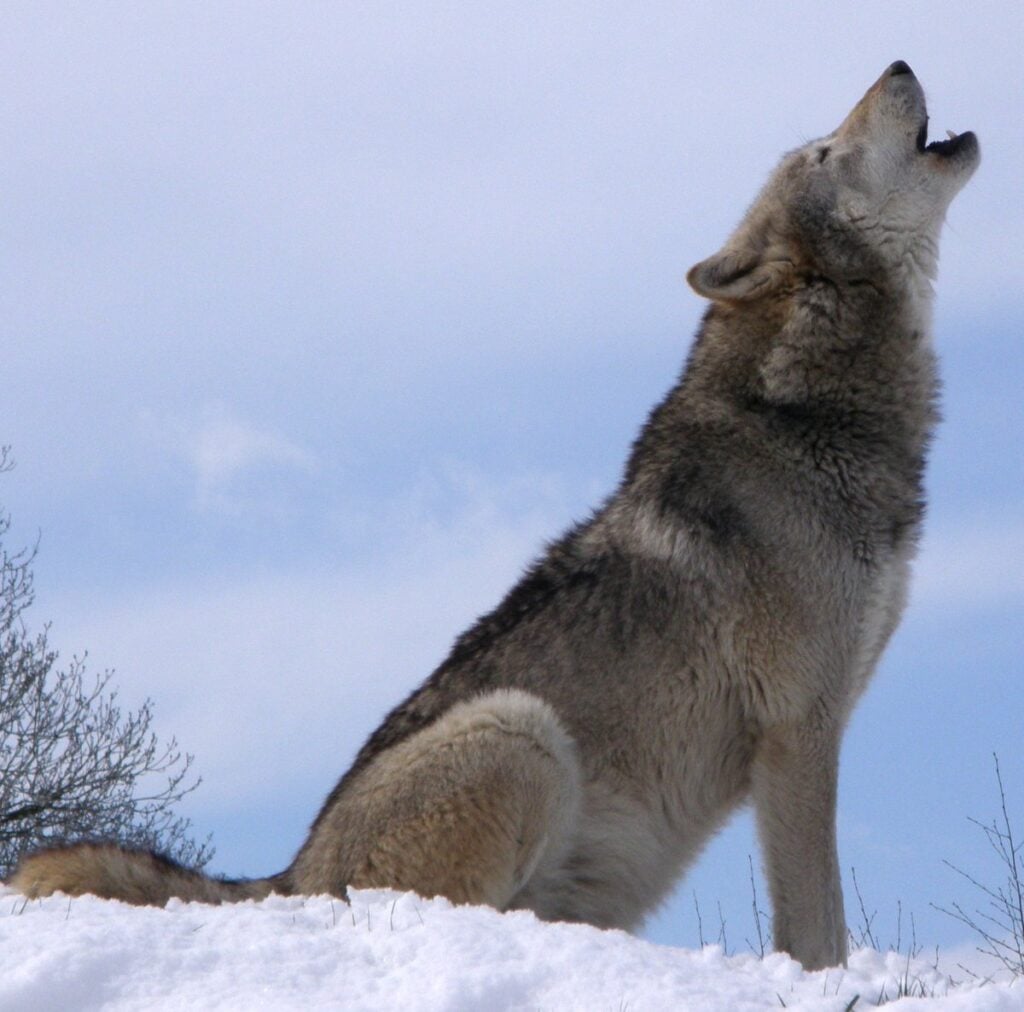
It was an odd howl for a coyote, but it was so faint that I was eager to hear it a second time. It never came. And that led to some interesting and uniquely happy uncertainty among my research crew.
Two years ago, we all would have known what animal made that howl. Of course, it was a coyote. But now we weren’t so sure. Without a second, perhaps better call from the abyss behind us — well, now there were options.
I’ve been following the ups and downs of the wolf reintroduction in Colorado closely, and I’ve been teaching it to my wildlife students for years — first as a hypothetical exercise, then as a conservation plan, and now as reality.
As my students learn, there is a lot of uncertainty that surrounds wolf howls. Ranchers are rightly concerned about their livestock and economic costs. The general public, often unnecessarily, worries about their pets or their own well-being. Politics are deeply involved: the Colorado restoration was driven by ballot initiative, but has been affected by both state and federal interference. Colorado Parks and Wildlife (CPW) somehow courageously navigates all of it to keep wolves on the landscape, with the help of other governmental agencies and a number of non-profit conservation organizations. It is an excellent example of conservation biology, where ecology, sociology, economics, political science, and other disparate fields all intermingle to produce a conservation outcome.
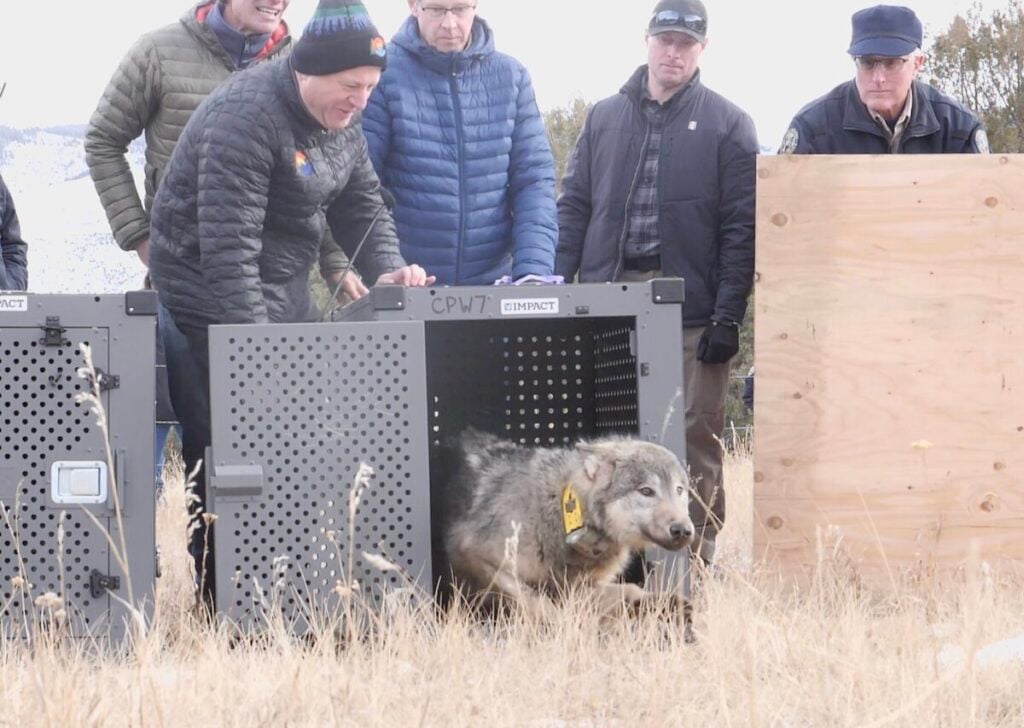
Conservation efforts are never perfect, as the livestock damages and wolf control efforts in Colorado and other western states have already shown. Restoration involves trade-offs, and there is always uncertainty about the outcome, the costs, and the benefits. Yet the wolf restoration in Colorado, at least from a conservation point of view, has been an amazing success, following in the footsteps of CPW’s other major predator release, the Canada Lynx.
The most recent news of local wolves came from friends in Gunnison, who relayed the confirmation of sightings in the basin by CPW. They also showed me the most recent wolf distribution map, which is based on the tracking of radio-collared individuals. For the first time, the map covered my study site, making that single howl even more uncertain.
I heard my first wolf howl last fall, when I was hunting with a friend in Wyoming’s Greater Yellowstone Ecosystem. Wolves, restored there for decades, called to each other from a nearby ridge and yes, the hair stood on the back of my neck. That singular event made my whole trip worthwhile, and tears welled in my eyes, because wolves represent so much more than an apex predator to me. They are hope; hope for a better day when our ecosystems are whole again, a moment that hasn’t occurred since the most recent extirpation of North America’s wildlife began.
Yellowstone has benefited in numerous ways from wolf reintroduction, including the cascading effects that top predators have on the environment. Such predators can make ecosystems whole again, by controlling prey populations and manipulating the behavior of species such as elk or deer, which otherwise graze with abandon. Additionally, predators often target the sick and weak, such as diseased animals. That, along with data showing carnivores remove chronic wasting disease (CWD) prions from the environment via consumption, suggest that wolf restoration may also help battle CWD and other diseases in deer and elk herds. Scientific studies suggest that all of this is true, yet the degree to which any particular wolf restoration will experience these benefits is uncertain.
These realized and possible gains are not just for Yellowstone and Colorado: it’s both amazing and inspiring to know that wolves now run free throughout most Rocky Mountain states as well as Washington, Oregon, and parts of California. Only time will tell whether we will see changes in our wild ecosystems and healthier deer and elk herds.
This epic restoration of a top keystone predator makes me wonder how different eastern forests and the people that live in and near them would be if we could somehow restore wolves east of the Mississippi. Wolves currently persist in Minnesota, Wisconsin, and Michigan, but habitat abounds in Maine, New York, Pennsylvania, and south through the Appalachians, including Kentucky. Wolves may never inhabit the eastern U.S. the way they once did, but they certainly would help control an overpopulated deer herd that has decimated forests and vehicles alike, reduce CWD transmission, and perhaps help alleviate the tick-borne diseases that plague parts of the east. The possible outcomes of such a restoration are much more certain than the possibility of the restoration itself. There are too many people and too many conflicts to think that wolves could ever be successful in most of the eastern U.S. Yet forest, vehicles, deer, and in some cases even our own health suffers because they are not part of the landscape.
That brings up another uncertainty, no matter where wolves and other predators are restored. We learned how to decimate native plants, predators, and other wildlife as part of our expansion across North America. We plowed the prairie, drained and tiled wetlands, poisoned or shot all of the predators, and consumed all of the bison in our way. Now that predators are coming back, can we learn to live with them? And once we learn that, will we? None of it is certain. But a person like me can dream, and I have been dreaming a lot lately.
I’ve dreamed about the moment I hear my first Colorado wolf howl. One late evening, we are packing up for the hike home from our study site. As we leave the research tent and pause to take one last look, we hear it, the howl. And then another. And another. This time, we all know what we just heard.
The success of the Colorado wolf restoration has made me a lot more confident that some version of my dream will actually happen, and sooner rather than later. I’m equally certain that when it does happen, I’m going to be on my knees, emotionally broken. It’s one thing to hear or even see wolves that were restored to a National Park. It’s another to hear them in the place you have called your summer home for almost four decades, a place they haven’t inhabited since World War II. There is no uncertainty about how I will react.
That dream has yet to happen, but hope springs eternal, in part because of an uncertain howl. I know what coyotes sound like, and I now know what wolves sound like. But the great thing about the uncertain howl is that we do not know what made it. If it was a coyote, it is still special. But if it was a wolf….well, there are more howls yet to come. I, for one, cannot wait.
Dr. Howard Whiteman is the Commonwealth Endowed Chair of Environmental Studies and professor in the Department of Biological Sciences at Murray State University. He is an occasional columnist for the NKyTribune.