











By Paul A. Tenkotte, PhD
Special to NKyTribune
F. W. Woolworth Co. was once the largest discount store chain in the entire world. Its five-and-ten-cent stores, recognizable everywhere by their gold-lettering-on-red-background signs, proved to be early mass-marketing success stories. And to many of us, they held special memories.
In the 1960s, as I was growing up in Northern Kentucky, my mother would drive us to Downtown Covington to do most of our shopping. However, mom didn’t drive in downtown Cincinnati, where traffic was heavy and parking was at a premium. Instead, we would occasionally board a Green Line bus to the Dixie Terminal, where we would exit on Fourth Street for a full day of shopping in Downtown Cincinnati.
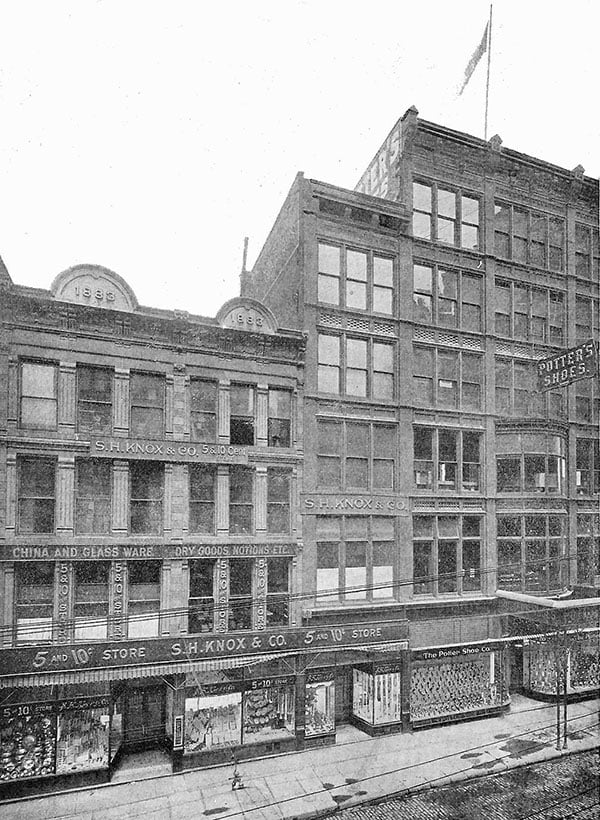
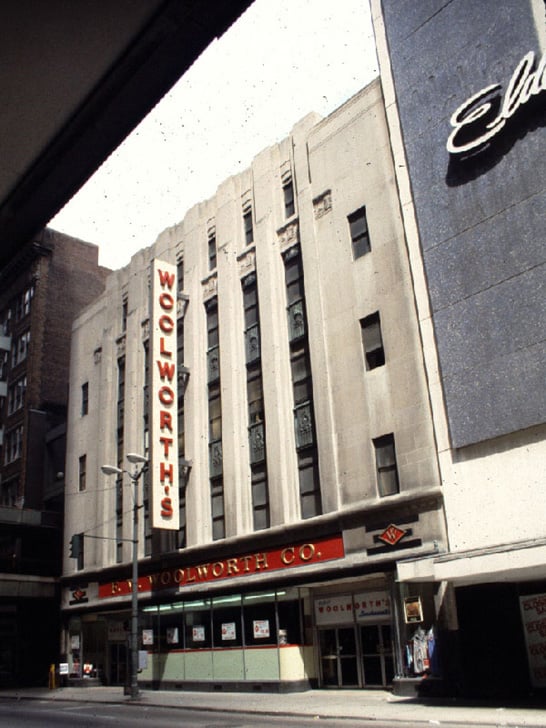
We would visit several department stores, eat at the lunch counter at Hathaway’s in the Carew Tower Arcade, and sometimes shop at Woolworth’s on West Fifth Street. Woolworth’s was located at 18 West Fifth Street, next door to Potter’s Shoe Store on its west, and Mabley and Carew Department Store to its east (on the northwest corner of Fifth and Vine Streets).
The new Woolworth store building on West Fifth was opened on November 22, 1935, during the midst of the Great Depression. It replaced an earlier building, where S. H. Knox and Company had opened a five-and-ten-cent store in 1895. Seymour Knox was Frank Woolworth’s cousin. In 1912, Woolworth acquired the S. H. Knox stores, and the location became a Woolworth’s.
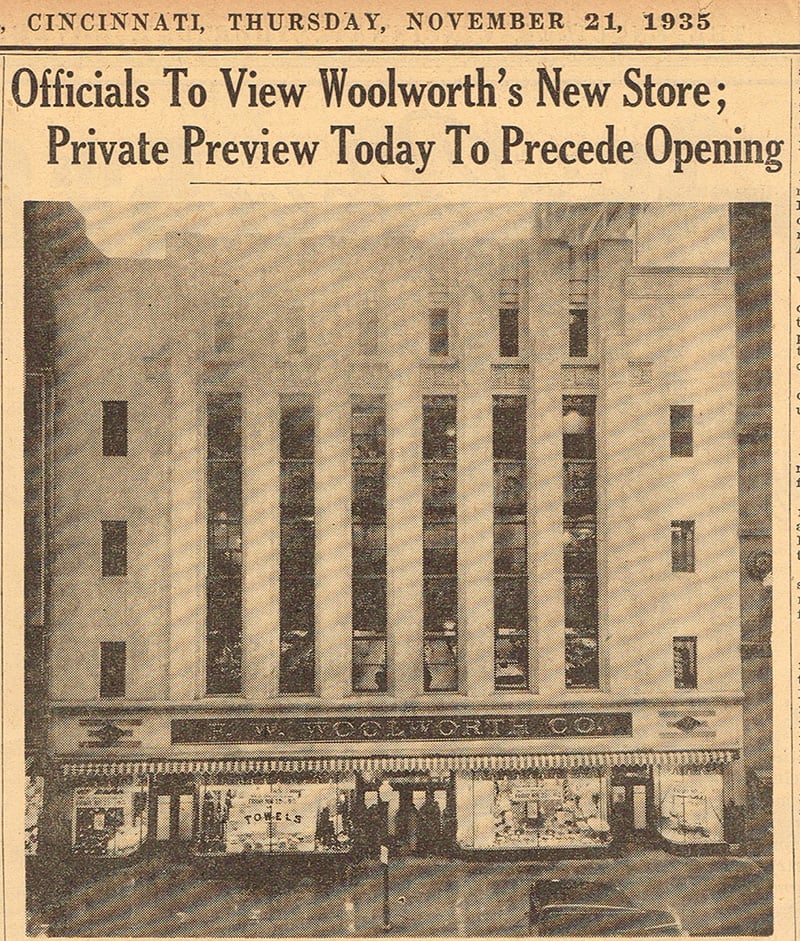
When the old Woolworth store on West Fifth Street was demolished to make room for a new one, the company opened a temporary store on Fourth Street, in order to retain its employees and its customers. An ad in the “Cincinnati Enquirer” of November 21, 1935, proudly proclaimed that the new building was a “magnificent modern super-store.” With three sales floors and another three floors devoted to offices, storage, and a kitchen, the location was a wonderful example of Art Deco architecture. The building’s lines were fresh and clean, its piers expressing verticality, as did its recessed spandrels and windows.
The new store featured air conditioning, promising “a constant flow of fresh, pure, correctly temperature and humidified air,” offering “the last word in safe, healthful and modern comfort” (ad, “Cincinnati Enquirer,” November 21, 1935). In addition, both the basement and first floor had “large, convenient and attractive luncheonettes and fountains, serving breakfast, lunches, afternoon refreshments, and delicious fountain goodies.” Further, the food was freshly made in “model kitchens,” including “pastries and baked goods.”
The basement sales floor included hardware, kitchenware, groceries, and pets. The first floor featured candy, stationery, jewelry, purses, belts, sewing supplies, and hair care/personal products. An Otis escalator carried shoppers to the second floor, with its clothing (men’s, women’s and children’s), toy, and gift departments.
I recall that we sometimes had a fountain drink, such as a cola, and perhaps a piece of pie as an afternoon snack at the luncheonette. The restaurant area featured a lunch counter, as well as tables and chairs.
In my memory, Woolworth stores were well-maintained, clean, and very inviting. Their sales staff, generally women, was friendly and helpful.
Woolworth sales counters seemed rather old-fashioned by 1960s standards, but were well-constructed of wood, with glass dividers to separate merchandise, and drawers below for storing items. Merchandise was lined up very neatly, and little signs attached to the glass dividers advertised prices and sales.
In 1988, Woolworth’s closed its Downtown Cincinnati store. It was demolished for the construction of Fountain Square West, later anchored by Tiffany’s and Macy’s, both of which have since closed.
Paul A. Tenkotte, PhD is editor of the “Our Rich History” weekly series and Professor of History at Northern Kentucky University (NKU). To browse more than ten years of past columns, click here. Tenkotte also serves as Director of the ORVILLE Project (Ohio River Valley Innovation Library and Learning Engagement). For more information see orvillelearning.org. He can be contacted at tenkottep@nku.edu.