













By Howard Whiteman
Murray State University
I don’t feel like I am an overly emotional person, but when I walked into one particular forest for the first time I could feel the tears welling up in my eyes. It happened a few years back when I was visiting a friend in the Pacific Northwest. As part of the trip, he gave me a tour of the ancient, giant trees that still live in northern California.
Walking along a trail, the giant sequoias were suddenly right in front of us. It wasn’t just that they are the most massive trees on Earth, reaching 300 feet high (30 stories!) and almost 30 feet in diameter. No, it is their age—over 3,000 years old—that was so mind numbingly difficult to comprehend. So difficult, in fact, that I could not think of anything besides how grateful I was to be in their presence, and how humbled I was that these creatures had survived the entire modern age of humans, thus far unscathed.
Walking among these ancient giants, gazing at the mossy life that clung to them like beards, and yes, even hugging a few of them left me with the feeling that I was not just in a forest; I was in a cathedral.
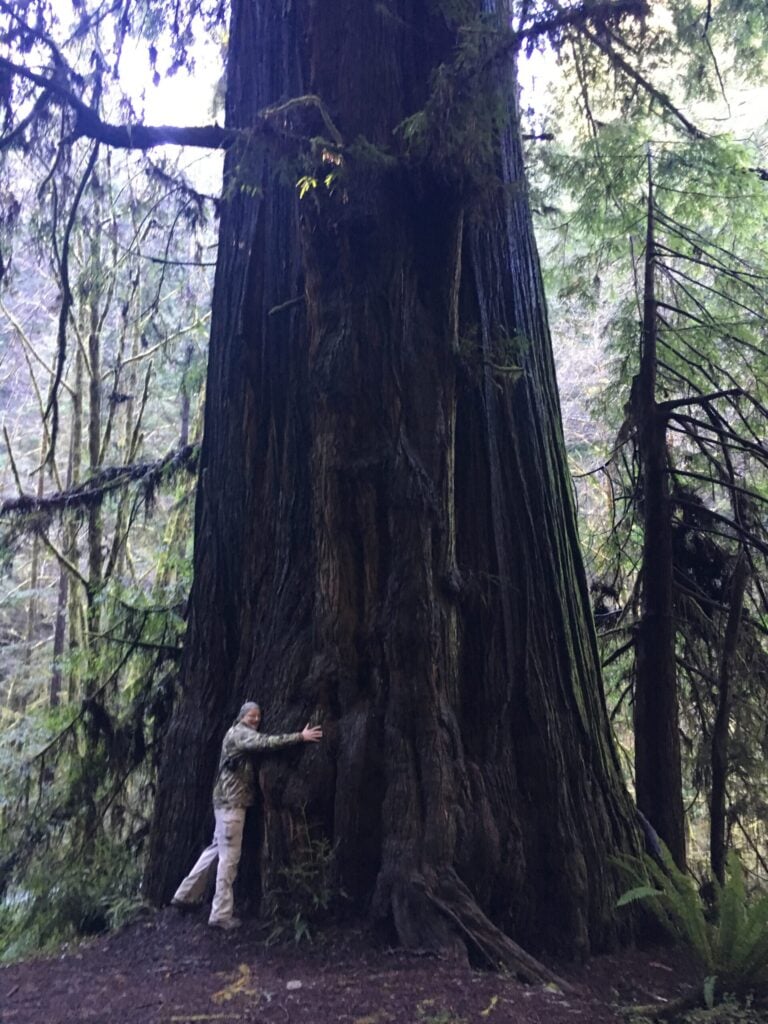
This wasn’t a typical eastern woodlot that had been cut many times since European settlement: this was a grove of trees that began growing long before the first boat arrived on our shores. These were trees that had lived through the entire expanse of our country’s history in less than 10% of their life. I whispered in their presence, just as I would when entering a church.
They weren’t fossils; they were living, breathing, organisms. Their cells had been dividing for three millennia, and continue to do so. Just think about that and let it sink in for a second. Think about the history that has happened to our planet, our species, and our culture over the past 3,000 years while these trees were growing peacefully in their forest.
I did that same thinking, and I can honestly say that the person that walked into that grove is not the same person that walked out.I was forever changed by that experience, and the memory of those ancient giants is with me every day. Those and other memories, like snorkeling over coral reefs in the Caribbean, trekking through the Brazilian rainforest, taking in the scenic vistas of mountain ranges in the Appalachians and Rockies, and watching a cougar lick it’s back like a housecat in the Snake River country of Idaho keep me thinking about other cathedrals that are out there and that we take for granted.
Perhaps you have had a similar experience in your journey through nature. Whether it is walking through a grove of ancient trees, sifting through seashells on the beach, or watching birds out the back window, there are lots of reasons why we might value these experiences. None of these values, however, are about making money; they are about how all of these living things make us feel.
Biophilia means the love of life. E. O. Wilson, the famed conservation ecologist, wrote eloquently about how biophilia can aid our appreciation and conservation of nature. In many ways, biophilia provides the same sense of comfort, joy, peace, and other feelings that we many gain from entering a cathedral. The ancient sequoias do that, but so does sitting on a remote ridge listening for turkeys, floating on a still lake while casting for crappie and sunfish, hearing a coyote howl or an elk bugle, or just watching the sunset on the horizon. All of these experiences can be emotional if we learn to appreciate them, and teach others to do so as well.
When we appreciate these experiences, we are less likely to allow anything to happen to them. No one wants to see a cathedral burning, and we all know the feeling of horror when such destruction occurs, not just because a building was lost, but because of what it represents — the memories, the feelings, the comfort and emotional experiences it had provided to us for years.
Unfortunately, we have already burned down a lot of cathedrals. Giant sequoias are an endangered species because our ancestors decided to log their sisters and brothers rather than protect them. They put economic interests over any biophilia they may have felt toward the trees. There is a long list of such travesties, but the good news is that we may have turned a corner.
The environmental movement began in the early 1900s, caught fire in the 1960s, and continues to this day. That movement is focused on conserving the world’s cathedrals, not only because of how they make us feel, but also because we have realized that forests, grasslands, coral reefs, and other cathedrals of life provide us with so many important things, from clean air and water to new medicines and healthy fish populations.
Those things add up, and economists have begun to realize that even if we take a very self-centered look at what these cathedrals do for us, for free, we cannot replace them without an enormous, perhaps even unimaginable, expense. That is, many economists have come to see what ecologists have known for a long time: that we need healthy ecosystems, these cathedrals of life, to maintain our own quality of life, indeed our very existence. In fact, all of those ecosystems, when put together, make up the greatest cathedral of life that we know of: Earth.
Think about what the Earth looks like from space. It is an oasis of life in the void. There is no other evidence of life in our solar system, yet, and certainly nothing as vibrant as Earth. Beyond our solar system is currently too far even for exploration for life. If our planet is not one giant cathedral, I don’t know what is. I know that astronauts often feel that way. They can feel how special the Earth is, how lucky we are to have it, and how much it hurts when we destroy it. Some economists know it too.
Economics, however, is not enough to save our cathedrals. Economics can be twisted more easily than emotions toward a corporate-centered, rather than an ecology-centered, goal. People have to care; their feelings matter. People have to want to protect nature so that they can go back to their own cathedrals someday, relive the experiences they had in the past, and share those experiences with friends and family.
We all need to be better biophiliacs.
The best way to help people learn to care is to get them out in nature, find a cathedral, and have experiences like I had in the sequoia forest. Not everyone will get as emotional as I did that day, but being in nature helps us appreciate it, and when we appreciate nature we are more likely to protect it.
I challenge you to find your own cathedral of life, and take some time to appreciate it the next chance you get. Then tell others about it, and introduce them to the same experiences, as my friend did with me. If more of us each had such a moment of nature appreciation, we would be well along the way toward a more sustainable future, and keeping our cathedrals safe and sound.
Dr. Howard Whiteman is the Commonwealth Endowed Chair of Environmental Studies and professor in the Department of Biological Sciences at Murray State University. He is an occasional columnist for the NKyTribune.