













By Patricia A. Scheyer
NKyTribune reporter
BOONE COUNTY
Boone County Commissioners considered a proposal from Arlinghaus builders for 182 single-family homes to be built on a 45.5 acre site just off Burlington Pike by Shady Hollow Lane and Springfield Boulevard.
The site was going to be a retirement village of sorts which was approved to be built by the Baptist Life Communities as a Convalescent Center in 1999, but it was never built. The convalescent Center was going to be a 58-unit assisted living facility, which would include a 40 bed nursing facility in addition to 24 town home units within six 4-unit buildings. To do their project, Arlinghaus needs to have commissioner approval for a change in a concept development plan.
When Arlinghaus acquired the property, they made a new concept development plan for 182 free standing single family homes, although the density of four units per acre will remain the same as the Baptist plan. These homes, however, will be for regular families, not senior living, and this change will ratchet up the amount of traffic exponentially from the projected traffic amount from a senior living facility.
Nonetheless, the Boone County Planning Commission approved the project 11 to 1, judging the new project to be mostly in line with the 2045 future land use plan.
Several people spoke up about the projected traffic that will be generated by the new concept development plan. There was no traffic study done in 1999, but a traffic study was done for this new development. The planning commission set some conditions in their approval, two of which were specifying a right hand turn deceleration lane on Burlington Pike, and a left hand turn stacking lane on Burlington Pike. The Kentucky Transportation Cabinet usually approves the lanes if the planning commission mandates it, but they haven’t officially done that yet.
Commissioner Chet Hand and Commissioner Cathy Flaig asked about the length of the stacking lane, but that hasn’t been determined yet. Resident Colton Dunhoft asked about the cost of the homes. When the builder said he didn’t think anyone could build a home for less than $325,000, Dunhoft said he was skeptical that people with a regular income could afford it.
Then Commissioner Hand explained that the decision before them was not ‘do we or do we not build’ but ‘do we think that the new concept development plan is reasonably consistent with the comprehensive plan’?
Comments from the residents centered around the increased traffic and the speed limit,
which they are convinced will encourage accidents.
Ethan Walton asked if there were any incentives for constraining builders, so that neighborhoods are not being built everywhere in Boone County, which is happening now.
Commissioner Hand said that they have parameters on what can be developed based on the zoning of any given property, but they also cannot tell property owners that they don’t have the right to develop their property.
Some residents didn’t like the single egress point and wanted to know if the schools would be prepared for an influx of new students, a consideration that was not applicable if the property was going to center around senior citizens. Others thought that there will be a ‘silver wave’ coming and the county could really use a senior community on the site.
In the end, the first reading of the ordinance to change the concept development plan was held, and officials are going to try and use wordsmithing techniques to make the project more palatable.
The issue of putting vehicles up as surplus and listing them on public auction was brought back, and Commissioner Cathy Flaig acknowledged that even though the vehicles have lower mileage, they were really in bad shape and should be auctioned off. She had caused the issue to be tabled in August so she could look at the vehicles to determine if they were as bad as they said they were, and she confirmed that they are that bad.
State Senator Gex Williams and State Representative TJ Roberts attended the meeting to present checks to the county totalling almost $80 million in investments. The checks represent financial support for road, bridge and highway projects through House Bill 502, including over $668,799 for local priority road projects on Cinquapin Hill Road, Hopeful Road and Sebree Drive through House Joint Resolution 76.
Williams recognized the efforts of Sen. Steve Rawlings,who advocated for funding for Boone County funding but could not attend the check presentations.
Commissioner Hand gave a report on the Ethics Code, and said the staff has done a detailed report on comparing their ethics code to other cities and counties. He thanked staff for the 50-page report, and said it showed that their ethics code was consistent with other places the same size. He explained that they could update some language, but overall, he is not interested in making any changes. In response to that update, a resident stood up and told Hand he shouldn’t have been in charge of updating the code, because he was the cause of the need to update it in the first place. She told Hand to watch himself, please.
KENTON COUNTY
Two Kenton County residents spoke up Tuesday night at the regular Kenton County Fiscal Court meeting about the changes that are being made to the County’s Ethics Code. Michael Staverman was incensed and disgusted by the changes that are in the ordinance that was on the agenda for a second reading. Greta Ellenbaas spoke for two other constituents, and she read one statement aloud, calling the changes ‘ethical fading,’ meaning an ethics decision is sanitized with administrative language so that the ethics themselves disappear. The actual text reduces the five member citizen committee to three members and eliminates term limits. Calling the changes clean up or uniformity is ‘rhetorical laundry,’ according to Elise Sebastian who wrote the statement. It states that the new rules discourage whistle blowers and hides procedures from the public, as well consolidates control by the court.
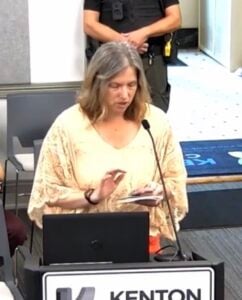
Both of the people that Ellenbaas spoke for wanted the commissioners to vote no, or skip the vote altogether. Staverman was angry that the commission would hold the vote while Commissioner Jon Draud was out recovering from surgery. He accused the court of promoting nepotism. Ellenbaas and Staverman said Kenton County’s ethics code has always been a notch above other counties, and they both asked to have the vote tabled or have commissioners vote no.
When the ordinance came up for the second reading, County Administrator Joe Shriver defended it first, saying he respectfully disagrees with the criticism of the changes and said he sat down with County Attorney Stacy Tapke and levied every claim with her, but found out the tenets are still there and people still have to disclose any conflicts of interest, and if they act badly they still have a price to pay.
Tapke took the floor and said in her 22 years at the county she can count on one hand the ethics violations she has handled, and usually when she gets a violation the people have already left the county. She said the violations are very infrequent, but she has noticed that the violations tend to be filed in election years.
Commissioner Joe Nienaber spoke up, saying he thought three people could adjudicate as well and possibly better than 5 people, and since the violations are so infrequent, people on the board rarely serve, so eliminating term limits is called for in this case.
Judge Executive Kris Knochelmann told the audience that everything is still in place, and if people break the law they will still have consequences. He said the county attorney has dug into it and cleaned it up, and set the county up for the future. But he echoed what Commissioner Beth Sewell said, that if future changes need to be made, they can be made.
The ordinance passed 3 to 0.
Assistant County Administrator Scott Gunning gave a presentation on the new Fox Ridge Park, to be built on the site of the old golf course which closed in 2019, and which will be combined with Lincoln Ridge Park to be an astounding 303 acres of adventure and activity.
When they were trying to figure out initially what they could do with the 225 acres of closed golf
course, they found out that the land had been purchased with land and water conservation funds, which dictated that the land had to be used for recreation purposes. This led to a master plan for a park which will have a groundbreaking next week, and is destined to improve the quality of life for all Kenton County Residents. It will include rock climbing, bike trails, a dog park, natural splash pads, a four season shelter, and an RC course, among other features.
Gary Wolnizek, President of Human Nature, and Mike Prus, President of Prus Construction, also talked extensively about the park, heralding the features that people can look forward to. Commissioner Beth Sewell said she likes the new name but she will always think of it as Northern Kentucky’s Central Park, because it will be so accessible to people. She praised the park for having activities for all ages, especially for the older population who really need places to help them stay active. Commissioner Nienaber said he didn’t think he knows of anything else like this, and it will be a destination feature. Judge Knochelmann said he thinks the people of Kenton County deserve this park, since they are the third largest county in the state.
TAYLOR MILL
Jeff Jackson, a resident and teacher at Scott high school, came to the regular Taylor Mill commission meeting to ask the commission if they could revisit the issue of School Resource Officers for Scott and Woodland schools. He said he was there as a parent of children who attend the two schools, and as a taxpayer of Taylor Mill.
He told the commission that he thought the students in the city’s schools are not being as well protected as they should be and since other schools in other cities have SRO’s he doesn’t see why Scott and Woodland can’t have one.

Mayor Daniel Bell answered the charge, because it has been a sore spot for him for years. He told Jackson that they paid 100 percent for SRO’s for years, but then the state came up with an unfunded mandate that the burden of providing SRO’s for schools is all the responsibility of the school district. He explained how they went to Superintendent Henry Webb and said that in the light of the state’s decision, they were not going to fund the SRO’s entirely anymore, and they needed to come to an understanding where the school district would help pay for it. He highlighted the fact that Taylor Mill’s SRO officers are some of the best in the state and they have received awards for it. But he said that Webb has maintained that they cannot afford it, even though, as Bell brought up, they have built a $30 million dollar office building in Covington and a bus garage in unincorporated Kenton County during the years that they have told Taylor Mill that they can’t afford to pay for SRO’s.
Other commissioners chimed in and agreed that the school district has refused to even meet the city halfway on the issue.
Jackson said he really did not feel comfortable bringing the issue up to the school district because he is a teacher at Scott. He felt that the city should bring up the issue again with the school district and hopefully as a group of adults in the room, should be able to come up with a solution to protect the children who attend school in the city.
He also brought up that Woodland and Scott have teachers who pay an occupational tax of two percent, so he believes they should be entitled to an SRO. He pointed out that Ft Mitchell, Ft Thomas, and Edgewood only charge 1.25 percent occupational tax.
Commissioner Rose Merritt said those cities have more businesses than Taylor Mill, which is a more residential city. She said the rate has remained the same for years.
Commissioner Caroline Braden said that at Scott, not all the students live in Taylor Mill, but when they asked the school board what percentage of students live in each city, they said they didn’t know. Other cities refused to contribute to the cost of providing SRO’s.
Attorney Jack Gatlin said the three-page legislation from the state confirmed that the burden of providing an SRO is totally up to the school district. They can strike a deal with cities or counties, but the burden of making a deal is up to them.
At the time, the school board said they would get the Kenton County Sheriff’s department to provide officers, but the Sheriff’s department said they didn’t have the personnel to provide an SRO at the time. In the meantime, schools don’t have an SRO.
Mayor Bell said they are still open to sharing costs with the school board. He said he thinks the safety issue is monumental. Officers cannot be just dropped into the schools, they have to go through training. Bell said they definitely have to work within the state statute. The cost of a school resource officer is approximately $100,000, and the cost has increased through the years.
New CAO Devon Golden said she would reach out to the school district to see if she can negotiate some kind of conversation with them.
A municipal order passed which amended the employee handbook for the use of credit cards. CAO Golden said the main thing is to make sure the city is not being charged sales tax.
Another municipal order accepted the Holdsbranch Road stabilization project bid from JTM Smith construction for $344,973, which is under the estimated budget price of $414,000. Engineer Shawn Riggs said they have gotten a grant from the state emergency road fund for $50,000 which will be applied to the bid price, and the city will be responsible for $294,973 for
the repair.
Tax rates were discussed but nothing was decided. A special meeting will be held on September 28, at 5:15 p.m. with a public hearing following at 6:15 p.m. for people to comment about the pickle ball courts in Pride Park. Commissioners agreed they should be located between shelter number 3 and the playground, closer to the road. The city has a grant which will be a 50/50 grant, for the pickle ball courts. The city has budgeted $125,000 for the project.
COVINGTON
At a marathon meeting which lasted almost 4 hours, Mayor Ron Washington suspended Roberts Rules so they could listen to the residents speak about the contract with Axon for police technology which was up for renewal.
Commissioners listened to all who wanted to speak, giving them a generous five minutes each and most of the speakers told the commissioners to vote no on the entire contract, which is a 10-year contract that will cost $6 million over the ten years.

City Manager Sharmili Reddy gave a definitive synopsis of the agreement between Covington and Axon, citing how long they have been with the company, what services they have contracted with the company for, and what new services are included in the new agreement. She explained why the city has had services like ALPR mounted on four cruisers, which double as dash cams, body cams, and tasers, and why they want to expand the services to include AI and drone technology.
Several speakers said her report really helped them, but most still spoke against the tech, with statements showing a distinct lack of trust in their government and police. A critical point causing a bit of consternation with the head table was a recent death threat to the commissioners, which did result in more police in attendance, but the crowd overflowed into the lobby, and anyone who wanted to was allowed to speak.
Almost 30 people did want to speak.
Not everyone spoke against it. Detective Adam Uhl spoke about a couple of cases that were solved using the ALPR cameras. His partner, Brian Powers, also talked about how much they help solve cases and get the bad guy or guys off the street. A resident of Latonia, Jessica Turner, thought the city should sign the contract, because she felt it helped the police.The president of the Covington Fraternal Order of Police, Mark Richardson, also spoke positively about the contract.
Some people offered suggestions for commissioners.
After everyone had a chance to speak, Commissioners asked questions. Then Attorney Frank Schultz was asked to modify the contract. Each attorney put their modifications in, and the new contract is to be for one year, and then each year on a year to year basis, but without the ALPR’s on the cruisers, or to be installed on poles. The reports have to be given to the City Manager every 30 days and she will distribute the reports to the commissioners, as to the number of drone flights, and anything else reported by the police for the Axon Company’s services, such as AI services. They do not want automatic software updates, only those approved by the city, and do not want any sharing of data for AI training. They don’t want AI to help in writing police reports. They do want an online transparency portal where any resident can see when and why drones are used.