










By Patricia A. Scheyer
NKyTribune reporter
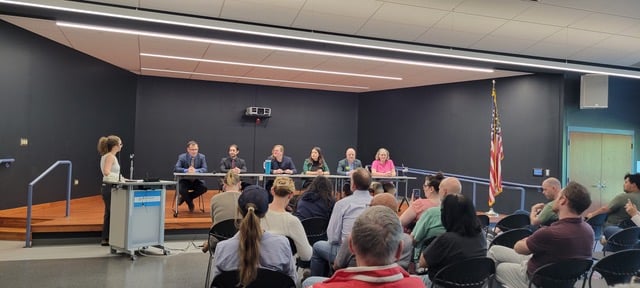
The Kenton County Mayors’ Group met at Taylor Mill, and Mayor Dan Bell introduced his new Chief Administrative Officer, Devon Golden, who has taken over the job now that Brian Haney has retired after eight years at Taylor Mill.
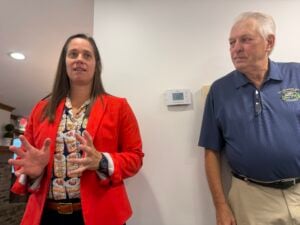
Golden gave an update on what is going on in the city, starting with the properties that the city acquired a while ago, with the help of the county’s partnership program, and had the buildings on the property demolished. So now she said they are looking at what development they would like to attract to the properties.
She acknowledged that they have applied for LART funding for Old Taylor Mill Road which has a section that could use more immediate help. Golden also said they have a Land and Water grant for walking trails and two pickleball courts for Pride Park.
The main topic of conversation was about city tax portals, and Park Hills Mayor Kathy Zembrodt was scheduled to talk about it, but she clarified that she wanted to know what the other cities were doing, since the financial company Quantum is going away in 2028. Zembrodt said her city clerk is investigating other companies, but she hadn’t come up with a replacement yet.
Lakeside Park Mayor Paul Markgraf said his city clerk was also investigating replacement companies.
Villa Hills Mayor Heather Jansen contacted her city clerk, and she said that the Edgewood city clerk is spearheading a search and they are either going to go with Edmunds GovTech or Open Gov.
CAO Golden said she understood that they base their price on property values, which she thought didn’t make a lot of sense.
Crestview Hills Mayor Paul Meier said they are using Edmunds GovTech. Director of PDS Josh Wice said it does seem that once a company is chosen, they tend to merge with another company or have something else happen to make a long term contract unlikely.
Zembrodt said she had reached out to the Kentucky League of Cities about auditors and didn’t hear back, so she didn’t reach out to them on this issue. She said maybe they could bring the issue up again when they have a meeting with more mayors attending, and they all agreed.
State Representative Kim Moser said that the next session in Frankfort is a short session because it is not a budget year, but there are meetings in the interim discussing items that will be on the agenda when they gather in January.
She said there are some significant issues happening in healthcare in Medicaid, changes coming from the federal government. Moser is on the healthcare committee and said cuts are coming, but there is a new Medicaid Oversight and Advisory Board studying everything Medicaid, and they are trying to find a better way of auditing, since Medicaid is the second highest budget item after education.
“Medicaid, when I came in in 2017, was a $10 billion dollar, state and federal funds combined, budget,” she stated. “Now we are up to $24 billion. And we have not doubled our population, we don’t have more people in Medicaid, but we have higher healthcare costs, and the governor has expanded services. So now we are really trying to hone in on what works with the funding.”
Moser explained that currently she is tasked with chairing a subcommittee on digital transportation, putting together a data dashboard for the state.
She is also working on the social media lawsuit settlement against all the social media giants, which showed that the companies are really harming young people. She said Kentucky was the leader on this effort, and the payout is $17 billion to be shared among all 29 states who took part in the lawsuit. Kentucky will receive $358 million over 10 years, with an initial payment of $38.5 million coming in late September or early October, and then in January they will start receiving the installment payments.
“I think it is really important to keep those funds, and invest those in positive youth services,” she said. “Last year I filed a bill to put a framework in place, HB 686, and it creates a trust and commission on the state level, and then allows regional interagency councils to put together stakeholder groups to see what is really needed in the communities. I don’t think it is a good idea for the state to come in and say, ‘you need this program.’ I think the regions really need to decide what their cities and counties need. So that is the infrastructure that I laid out, and it passed the house last year overwhelmingly 87 to 17, and I will be contacting those 17.”
She said there was an injunction relief in the settlement, which means that any social media platform must put in child protections, like age verification, no use at night, and a limit of two hours of use in the day. There will be interrupters set where a child’s use will be disrupted, and kids won’t be able to see how many people like their posts. Moser said she knows some people would like to sweep all that money into the general fund, but she said that was not the point of the lawsuit.
When asked if it could be set up like the opioid settlement, Moser said the opioid abatement was more of a remediation, and this social media case was more of a penalty, so it was different enough so that it couldn’t be set up like the opioid settlement.
The next mayors’ meeting will be on October 17, and will be held at the Villa Hills/Crescent Springs Fire Department.