






By Steve Flairty
NKyTribune columnist
Ken Reis and his wife moved in 1974 to the community of Grant’s Lick, located in the southern part of Campbell County. Though he and his brother, former Kentucky Post reporter Jim Reis, founded the Campbell County Historical Society in 1990, Ken didn’t realize that a love affair with Grant’s Lick would drive him to write a book about the community, particularly one that would take six years to complete.
Included during that process was some drama — Ken’s massive heart attack where he noted he “died twice in the hospital emergency room.”
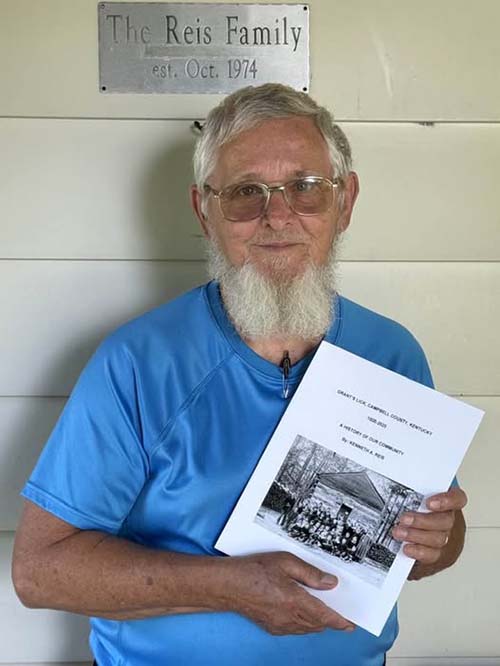
But he persevered, and the proud product is 400 pages of history, geography, culture, and personal reflection — his tribute of passion. It’s called Grant’s Lick, Campbell County, Kentucky 1600-2025: A History of Our Community. Ken has spent uncountable hours perusing old documents, studying newspapers, visiting sites, and relying on the recollective stories of community members who, metaphorically, “know where the bodies are buried (and often literally).”
Having spent my early years growing up and attending school in the Grant’s Lick area, I, like many others, was hungry for such a work to be published. Reading — actually, absorbing — Ken’s authentic work has “quickened my spirit” by retrieving old memories from my youth and helping me gain much new, interesting information since I left the area in the early 1970s.
Normally a prolific, but slow, reader, I’ve devoured this treasure, all 400 pages, including plenty of photos and diagrams, and doing it in just a few days . . . not wanting to put it down.
At the outset, Ken shares an 1883 Grant’s Lick precinct map that he calculates covering some five square miles, calling it “invaluable”. From there, he goes on to look at the period from 1600 to 1800, showing Native Americans living there in three particular sites. He dismisses the myth that they never actually settled in Kentucky. Some of the artifacts, he notes, are today housed in Covington’s Behringer-Crawford Museum. These bits from the long ago past are told in a way that make them seem like neighbors today.
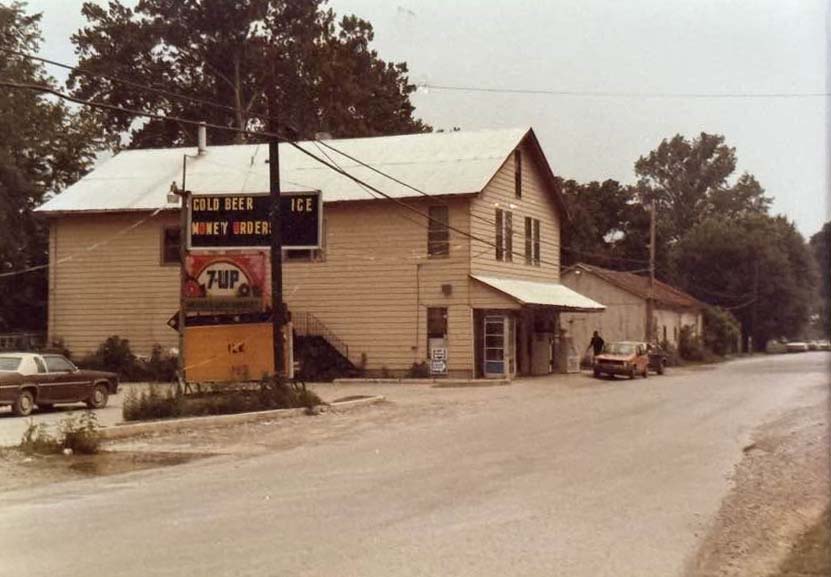
Much time is spent on observing the Grant’s Lick business district from 1850 through modern times, with Ken pointing out the significance of Highway 27 and how it affected the community when the road was redrawn away from the downtown district.
Two of the non-human stars of the book are the well-traveled over infrastructure, “Our Bridge,” along with the locally iconic Phillips Creek, flowing beneath it. The bridge was/is part of the old 27 Highway and near the business district. And oh, did that creek flood. That is, until the efforts of A.J. Jolly to build a dam near Sun Valley and develop a local park and golf course. That pretty much put an end to the worst of the flooding, he notes. The Jolly Park story is fascinating. It certainly has had a big effect on the community and is one of the highlights of the book.
Within the Grant’s Lick community umbrella, Ken notes, are small places such as Brayville, Aspen Grove, and Harrisburg, with Harrisburg being a place that was “ultimately abandoned, but there is a cemetery nearby on the top of the hill.” Along with those mentions, he explores the side roads that reach out like tentacles around the area, with instructive names such as Clay Ridge, Kenton Station (not named after Simon Kenton, however), Siry Road, and many others. He couldn’t get anything definitive on the origin of “Race Track Road,” however, though some have ideas.
The book couldn’t have materialized, Ken emphasized, without a host of many knowledgeable and supportive people in the Grant’s Lick eager to help him. Among them, but here only a very small sampling, are Ken Gosney, J.W. Crail, Aretha Crail, Howard Johnston, Linda Bray, Margaret Strebal Hartman, Russ Stevens, and others through their memoir writings such as Virgil Oetzel and Bobby Sheanshang.
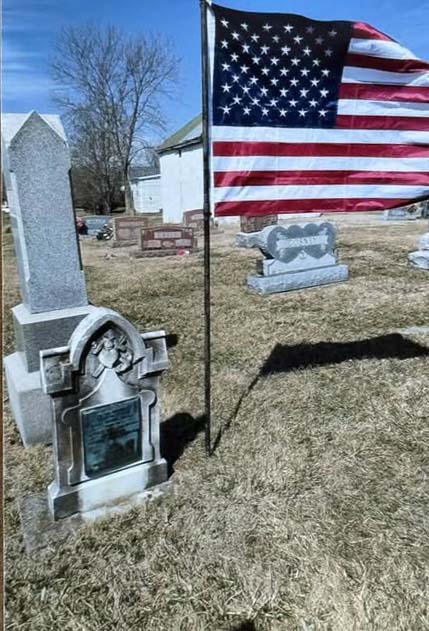
The Oakland Cemetery, where Mary Boone Bryan is buried, is also a big focus of the book. Ken keeps an eye on it since he lives next door…and oh, the stories from there.
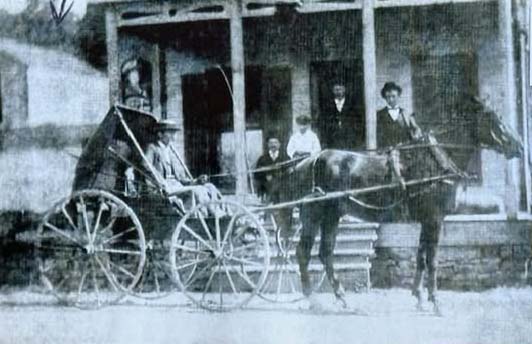
There are interesting chapters on post offices, churches, and schools, and Ken describes carefully how they evolved into what old-timers might hardly recognize today. There was a time when there was no rural mail delivery, when citizens had to travel by horseback to Grant’s Lick or other communities in the area to pick up their mail. Ken relates stories about sales catalogs being the rage before companies like Amazon existed.
He tells of a time in the Grant’s Lick precinct being awash with smaller schools, having a “total of ten one-room schools at one time or the other” until consolidated in the mid-1930s. A great tribute is given to Campbell County superintendent, J.W. Reiley, who often against much pushback, led in the consolidation mandated by the state of Kentucky. One modern school in the system is today named after Reiley. And one can’t properly talk about the history of Grant’s Lick education without mentioning a local icon, “Mrs. Dorothy” Schafer. She taught first grade at the school for 48 years (including one with me in her class). Her touch with kids was magical, and very few bad words have ever been spoken of her.
Another point of interest is Ken’s accounting of the reason for the community’s name, Grant’s Lick. He references Keturah Taylor Jones in her 1876 History of Campbell County that “early in the 1790s salt water was found at Grant’s Lick by Samuel Bryant, who in conjunction with John Grant and Charles Morgan, sank a well and began the manufacture of salt.”
Research by Margaret Strebel Hartman was also crucial. Over the years, the original salt well site has undergone much stress, with it being haphazardly filled and covered, with the rerouting of Highway 27 perhaps the biggest challenge to keeping recognizable as a historical feature of the community. Note that Ken has helped keep the site alive, fighting for and getting a small park to observe the place.
Ken Reis is all about passion for his community, and his book demonstrates the immense work he did in writing it. If you’d like a copy, the price is $25 and Ken can be emailed at kennethareis@yahoo.com or texted at 859-466-0638.
Steve Flairty is a teacher, public speaker and an author of seven books: a biography of Kentucky Afield host Tim Farmer and six in the Kentucky’s Everyday Heroes series, including a kids’ version. Steve’s “Kentucky’s Everyday Heroes #5,” was released in 2019. Steve is a senior correspondent for Kentucky Monthly, a weekly NKyTribune columnist, and a former member of the Kentucky Humanities Council Speakers Bureau. Contact him at sflairty2001@yahoo.com or visit his Facebook page, “Kentucky in Common: Word Sketches in Tribute.”