
















By Jim Dady
Special to NKyTribune
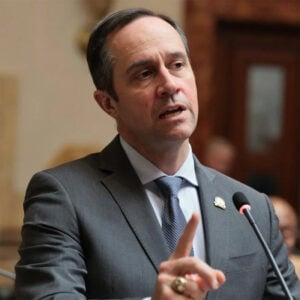
Kentucky voters will be asked in November to limit a governor’s pardoning power by amending Section 77 of the state Constitution. The proposed amendment is the culmination of a seven-year effort by Senator Chris McDaniel to get the amendment through the General Assembly and onto the ballot.
The amendment would stay the governor’s authority to grant pardons after 60 days before the end of the governor’s term and until that governor’s successor is sworn in on the fifth Tuesday after the election.(1)
Senator McDaniel, a Kenton County Republican was offended, as many were, by the granting of more than 600 pardons and sentence reductions in the waning days of the administration of Gov. Matt Bevin.

Governor Bevin pardoned a man convicted of repeatedly sexually assaulting a female child beginning when she was nine years old. Citing a lack of physical evidence and a “sloppy” police investigation, Bevin unconditionally pardoned the man, who had served less than two years of a 23-year sentence.
In another case, Bevin pardoned a friend of the governor’s sister, who was convicted of making a contract with another to kill her ex-husband and his new wife.(2)
Bevin also pardoned a convicted murderer whose brother had raised money for the governor’s unsuccessful re-election campaign. The man pardoned had been convicted in the killing of a pastor and his wife while driving under the influence.
Gov. Bevin pardoned a woman serving a life sentence after giving birth to a child and then throwing the newborn into a trash receptacle.
Governor Bevin’s copious exercise of his pardon authority brought forth bipartisan condemnation across the Commonwealth.
“What Gov. Bevin did was nothing more than a temper tantrum after he lost his reelection,” said Kenton Commonwealth’s Attorney Rob Sanders, who had supported Bevin in his 2015 campaign and had made a financial contribution to the governor’s cause. Jackie Steele, commonwealth’s attorney in the 27th Circuit of Knox and Laurel counties, voiced similar outrage.(3)
Bevin defended his pardon program in an interview with WHAS radio in 2019, saying he had made “the most informed decisions he could after speaking with legal experts and advocates. . .I don’t care what your ideology – whether you’re liberal or conservative, Republican or Democrat – we should want there to be integrity in the system,” he said.(4)
Few constraints
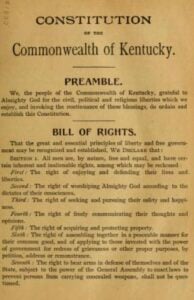
There are few constraints on the sweeping authority of a Kentucky governor as recited in Section 77 of the 1891 Kentucky Constitution.(5)
The limit of the governor’s pardon authority was considered by the former Court of Appeals in 1908.(6)
M.C. Nelson, an attorney, pleaded guilty in Livingston Circuit Court to forgery, for which he was sentenced to two years in state prison, and he was disbarred by the trial court. He won a pardon in the waning days in office of Gov. J.C.W. Beckham. The question squared up on appeal was whether the pardon restored Nelson’s law license. The Court answered the question in the negative in an opinion by Judge William Rogers.
The Kentucky court had operated for just 16 years under the 1891 Constitution when Nelson was decided, and it canvassed the pardon law of other states.
The Kentucky court quoted a New York decision directly: “Pardon removes the legal infamy of the crime … but cannot wash out the moral stain.” (7)
The Court viewed Nelson’s crime and disbarment as separate species.

“In this State … the courts have the power to disbar an attorney who has been guilty of forgery … to disbar an attorney who has been guilty of forgery upon the ground that the commission of the offense shows that he is lacking in those qualities which are necessary for him to possess in order to continue as an attorney at law … While the effect of the pardon was to relieve him of the penal consequences of his act, it could not restore his character. It did not reinvest him with those qualities which are absolutely essential for an attorney at law to possess.”(8)
In a later case, Lattimore Jackson had been convicted and sentenced to 15 years after a trial in Knox Circuit Court in November, 1927. On the day before he left office, Gov. William J. Fields issued a pardon which in one reference referred to the petitioner as “Lattimore Johnson.” The error was fixed in another pardon, and Jackson presented it to the trial court.
The local commonwealth’s attorney argued that the misidentification of Jackson in the first pardon made it a nullity, and that the governor lacked the authority to issue a second one for the same crime. The trial judge accepted the prosecutor’s argument, and said he would not give effect to either pardon, unless forced to by the Court of Appeals.
The former Court of Appeals reversed the trial judge and gave effect to Jackson’s pardon. Citing easily-proved facts the Court ruled that there was no doubt about who had been pardoned. The appellate court dispatched the two-pardons argument, and signaled that a governor’s pardon power is not to be questioned by the judicial branch: “Any attempt of the courts to interfere with the executive exercise of the pardoning power would be a manifest usurpation of authority.”(9)
The pardons issued late in the terms of the respective governors in both the Nelson and Jackson cases would be impermissible under Senator McDaniel’s amendment.

Executive power
The executive power to controvert court decisions traces to the medieval epoch and perhaps classical Rome.
In his eighteenth-century “Commentaries on the Laws of England,” William Blackstone espoused three limitations on the pardon power. First, a pardon should not stop an impeachment. It could excuse a public nuisance that remained uncorrected. It generally could not, Blackstone wrote, be used to obstruct the prosecution of great public offenses before legal proceedings had run their course, and there should exist certain statutory limits on the pardon power for certain crimes.(10)
Blackstone was influential in the debate over the pardon power by the framers of the U.S. Constitution, which centered not so much on whether it should exist, but on what limits should be placed upon it.
“Humanity and good policy conspire to dictate that the benign prerogative of pardoning should be as little as possible fettered or embarrassed,” wrote Alexander Hamilton, as Publius, in Federalist 74. “The criminal code of every country partakes so much of necessary severity that without an easy access to exceptions in favor of unfortunate guilt, justice would wear a countenance too sanguinary and cruel,” Hamilton wrote.”(11)
Another of Hamilton’s justifications for vesting the executive with the pardon power was for its potential to induce combatants against the United States to change sides in times of insurrection or rebellion.
Kentucky vests pardon power with governor
Kentucky is among a plurality of states to vest the pardon power solely with the governor. Seventeen states require consultation with a board or commission.
In Louisiana and Texas, the governor may not grant a pardon without recommendation from the parole board, and the petitioner must have completed his or her sentence.
California vests the authority with the governor, but in cases of repeat offenders, a pardon shall issue only upon the recommendation of a majority of the state Supreme Court, with mandatory input from the parole board.
In Massachusetts and New Hampshire, the governor must consult with that antique New England institution, the Governor’s Council. In Nevada, the power of the pardon is with the governor, together with the Supreme Court and the Attorney General, acting as the pardon authority.
In Oklahoma and Pennsylvania, the governor may not pardon without the affirmative recommendation of parole board. Pardons are available in Utah only by vote of an independent board appointed by the governor. Pardons are rare in Rhode Island, where the governor must have the affirmative recommendation of the state senate.(12)
Fateful decisions
In exercising the pardon power, the Kentucky governor makes a fateful decision in criminal cases without observing the interaction of the jury, the demeanor of the witnesses, the probative impact of exhibits, or the oratorical and persuasive skills of the advocates. The pardon is the societal second thought about the workings of the criminal justice system.
Sen. McDaniel’s amendment would close the window on governor’s pardon authority at 60 days before the governor’s successor is chosen, a small but significant change designed to impose a measure of political accountability upon the governor’s party.
Additionally, the amendment would replace the references in Section 77 referring to the governor as a man and make them gender-neutral.
• • • • • • •
1 Section 7, Kentucky Constitution
2 The New York Times, 12/20/2019, article by Sarah Mervosh, Campbell Robertson and Mike Baker
3 WKU Public Radio website, article by Lisa Autry, 10/26/23
4 ABC News website, article by Enjoli Francis, 12/24/2019, citing WHAS-TV, ABC affiliate.
5 “He shall have the power to remit fines and forfeitures, commute sentences, grant reprieves and pardons, except in case of impeachment, and he shall file with each application therefor a statement of the reasons for his decision thereon, which application and statement shall always be open to public inspection. In cases of treason, he shall have power to grant reprieves until the end of the next session of the General Assembly, in which the power of pardoning shall be vested; but he shall have no power to remit the fees of the Clerk, Sheriff, or Commonwealth’s Attorney in penal or criminal cases.
6 Nelson v. Commonwealth (Ky. 1908) 109 S.W.337.
7 Baum v. Clause 5 Hill (N.Y.) 196.
8 Nelson, 789, 790.
9 Jackson v. Rose (Ky. 1928) 223 Ky. 285, 3 S.W.2d 641
10 Blackstone, Book IV, Chapter 31, Oxford University Press, 2006.
11 The Federalist Papers, American Bar Association Publishing, Chicago, 2009.
12 Canvass of state pardon law supplied by Collateral Consequences Resource Center, Restoration of Rights Project, screen grab 6.16.26.
Jim Dady is an attorney and former journalist. He lives in Bellevue.