













One of the basic responsibilities of county government is taking care of the infrastructure our residents and businesses depend on every day.
Roads. Bridges. Water infrastructure. The basic systems that allow people to get to work, businesses to operate and our community to function.
These aren’t particularly exciting responsibilities of government, but they are among the most important. They are also expensive.

Recently, the Boone County Fiscal Court set our property tax rates for the coming year. We lowered the county’s real property tax rate from 8.5 cents to 8.2 cents per $100 of assessed value. At the same time, continued growth in the county means revenues are expected to be higher than last year.
Several years ago, we made a deliberate decision about how a portion of those additional revenues should be handled.
Beginning in Tax Year 2020 and Fiscal Year 2021, the Fiscal Court began restricting a portion of additional property tax revenue specifically for infrastructure. The idea was simple: rather than allowing every available dollar to become part of the county’s normal operating budget, we would set a portion aside for long-term infrastructure needs.
That matters because recurring government spending has a way of becoming permanent.
Infrastructure investments are different. They build or maintain assets that serve the public for years – and often decades.
Over time, the Fiscal Court has continued adding to that commitment. With our most recent action, the cumulative annual revenue restricted under this policy has reached approximately $2.15 million. The infrastructure fund now has approximately $5.5 million budgeted after accounting for an approved water extension project.
And those dollars are being put to work.
Approximately $3.1 million has been committed to the Rural Water 3.0 expansion. Another $1.47 million has gone toward Porter Road, and $360,000 has been approved for a water extension along Turner Road. Additional projects are now being evaluated.
This approach has become increasingly important because one of the traditional sources counties rely upon for roads is moving in the wrong direction.
Kentucky distributes County Road Aid using what is commonly called the Fifths Formula. The formula includes equal share, rural population, rural road mileage and rural land area – with rural land area accounting for two-fifths of the distribution.
That formula creates a particular challenge for Boone County. We are not one of Kentucky’s geographically largest counties, but we have a significant population, substantial economic activity and an infrastructure network carrying residents, employees, trucks and visitors every day.
Roads don’t wear out based on how many square miles are inside a county boundary. They wear out because people and vehicles use them.
The numbers illustrate the problem.
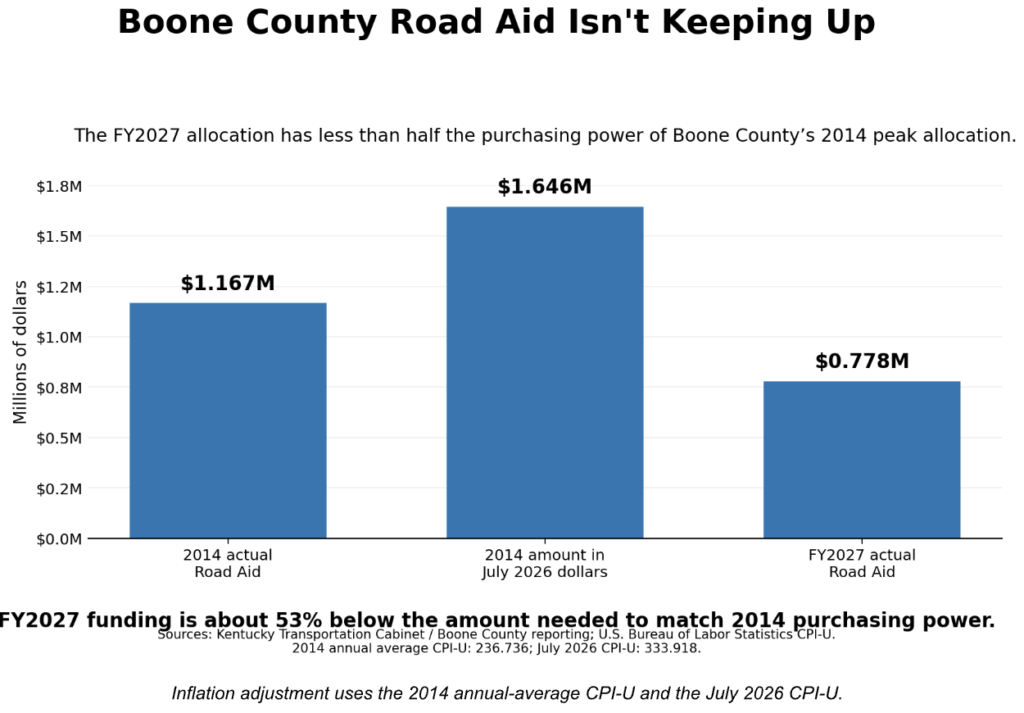
For Fiscal Year 2027, Boone County is scheduled to receive approximately $778,494 in County Road Aid. Last year, the allocation was approximately $949,000. Boone County’s high point was about $1.167 million in 2014.
On its face, that means the FY2027 allocation is about one-third lower than the 2014 peak. But that comparison actually understates the problem because a dollar today does not buy what a dollar bought in 2014.
Using the U.S. Bureau of Labor Statistics Consumer Price Index, Boone County would need roughly $1.65 million in July 2026 dollars to equal the purchasing power of that $1.167 million allocation in 2014. Instead, the FY2027 allocation is about $778,000.
In other words, today’s County Road Aid allocation has less than half the purchasing power of Boone County’s 2014 peak allocation.
And even that is a broad inflation measure. Road construction and maintenance costs have risen faster than general inflation in recent years, making the practical challenge even greater.
That doesn’t mean the Commonwealth isn’t investing other transportation dollars in Boone County. It does, and we continue to work with our legislators and the Kentucky Transportation Cabinet on important projects. But County Road Aid is specifically intended to help counties construct, reconstruct and maintain county roads, and that particular funding source is not keeping pace with Boone County’s needs.
We can point out the shortcomings of an outdated formula, and I believe it deserves another look. But county government still has a responsibility to deal with the situation in front of us.
That’s the thinking behind Boone County’s infrastructure fund.
This isn’t an argument for higher taxes. It is an argument for being disciplined and resourceful with the revenues we already have while continuing to keep our tax rates as low as reasonably possible.
Instead of allowing every additional dollar to feed the normal operating budget, we have deliberately protected a portion for infrastructure. At the same time, these restricted dollars are in addition to the infrastructure investments Boone County continues to make through its regular budget.
I believe that is an important distinction.
Keeping spending under control does not eliminate government’s responsibility to maintain the infrastructure the public already paid to build. Ignoring maintenance isn’t saving money. More often, it is postponing a bill – and sometimes making that bill considerably larger.
The same principle applies to planning for future needs. Boone County will continue to need roads, bridges, water lines and other basic infrastructure regardless of what happens with the state’s funding formula.
Our infrastructure fund isn’t going to solve every one of those challenges. Nor should Boone County simply accept responsibility for replacing every dollar that no longer comes from Frankfort.
But it gives us another tool, and it reflects the way I believe local government should approach these challenges: keep recurring expenses under control, protect important long-term investments, plan ahead rather than waiting for a crisis, and adapt when circumstances change rather than immediately asking taxpayers for more.
That’s what Boone County started doing in 2020. As the purchasing power of state road aid continues to fall behind, that decision looks more important every year.
Fiscal responsibility isn’t simply about what government spends today. It’s also about making sure we don’t create a much more expensive problem tomorrow.
Jesse Brewer is a Boone County commissioner.